
Putty: The Perfect Base for High-Quality POLIFARB Painting
Putty: The Perfect Base for High-Quality POLIFARB Painting
Putty (or spackle) is a paste-like or powder material designed for leveling surfaces, filling cracks, unevenness, and defects before applying final coatings: paint, wallpaper, decorative plaster. Without a properly prepared surface, even the best paint will not deliver a smooth, beautiful, and long-lasting result.
The information in this article is based on material from Wikipedia.
What is putty and why is it needed
Putty fills pores, small cracks, and pits, creating a smooth, even base. It differs from plaster by a thinner layer (usually up to 5–10 mm) and finer filler fraction. Modern putties have almost no shrinkage, are easy to sand, and provide excellent adhesion to acrylic, alkyd, and other POLIFARB paints.
Types of putties
Putties are classified by composition, purpose, and form of release.
Main types by composition:
Gypsum-based — dry quickly, ideal for dry rooms.
Cement-based — moisture-resistant, strong, suitable for facades and wet areas.
Polymer (acrylic, latex) — elastic, no shrinkage, eco-friendly, for interior and exterior work.
Oil and oil-glue — classic for wet rooms and wood.
PVA-based — with antiseptics against mold.
By purpose:
Starting — coarse-grained, for rough leveling (up to 10–20 mm).
Finishing — fine-grained, for perfect smoothness under painting (0.5–2 mm).
Universal — combines starting and finishing properties.
By form:
Dry mixes — diluted with water, economical.
Ready-to-use pastes — ready for immediate application, plastic.
Properties and advantages of different types
Gypsum: fast drying, easy sanding, white color, low price. Disadvantage — not for wet areas.
Cement: high strength, moisture and frost resistance. Disadvantage — harder to sand.
Acrylic (polymer): no cracking, easy application and sanding, odorless, eco-friendly. Perfect match with POLIFARB acrylic paints.
Facade acrylic: weather-resistant, elastic, UV and temperature fluctuation resistant.
Oil-based: high adhesion in wet conditions. Disadvantage — odor and long drying time.
Application of putty
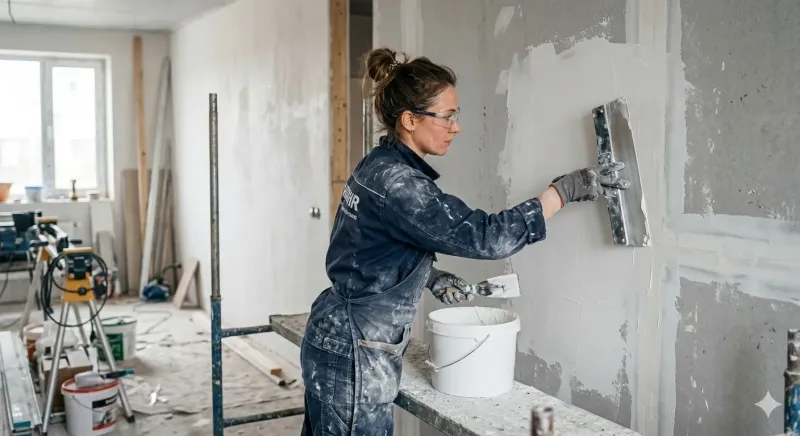
Apply putty after priming (we recommend POLIFARB primers for maximum adhesion). Tools: trowel, rule, sander.
Interior work — walls, ceilings, drywall, concrete in dry and wet rooms.
Exterior — facades, plinths, concrete surfaces.
Filling drywall joints, cracks, holes, leveling wood and floors.
Technology: apply in layers, dry, sand between layers and обязательно before painting.
Comparison of main types of putties
Putty type | Base | Moisture resistance | Drying time | Main application | Best matches with POLIFARB paint |
|---|---|---|---|---|---|
Gypsum | Gypsum | Low | Fast | Dry interior rooms | Interior acrylics |
Cement | Cement | High | Medium | Facades, wet rooms | Facade acrylics, alkyds |
Acrylic universal | Acrylic polymers | Medium–high | Fast | Interior, drywall | All POLIFARB acrylic paints |
Facade acrylic | Acrylic polymers | High | Fast | Exterior, facades | Facade acrylics POLIFARB |
Oil-based | Linseed oil + fillers | High | Slow | Wet areas, wood, floors | POLIFARB alkyd enamels |
How to properly prepare the surface for POLIFARB paints
Clean the surface from dust, old paint, grease.
Prime (POLIFARB primers enhance adhesion).
Level with appropriate putty.
Sand to smoothness (especially important for matte and semi-matte paints).
Remove dust and apply the final POLIFARB paint.
Quality putty + proper priming + POLIFARB paint = perfect result for years.
Why POLIFARB paints adhere perfectly to any putty
POLIFARB offers a wide range of acrylic, alkyd, and other paints that work excellently on gypsum, cement, acrylic, and polymer putties:
high hiding power;
excellent adhesion;
color and coating durability;
economical consumption.
See the full range of POLIFARB paints in the catalog on the official website: polifarb.ua.
Good putty is the foundation of a beautiful renovation. And quality POLIFARB paint is its worthy finish!