
Expert Guide: How to Accelerate Coatings Polymerization and Eliminate Paint Odor within a Few Hours
Expert Guide: How to Accelerate Coatings Polymerization and Eliminate Paint Odor within a Few Hours
A specific indoor odor following paint application is a natural byproduct of the evaporation of volatile organic compounds (VOCs) or the liquid base (water/solvent) that ensures the product's leveling and adhesion.
From a chemical perspective, the objective is not to "mask" the odor, but to maximize the polymerization (curing) rate of the coating and effectively extract residual vapors from the air. Professional painters achieve this by leveraging the laws of physics and controlled microclimate management.
1. Air Exchange Management: The "Forced Injection" Technique
A standard open window creates passive air circulation, which is insufficient to disrupt the boundary air layer adjacent to a freshly painted wall. Solvent vapors "hover" near the surface, thereby decelerating further evaporation.
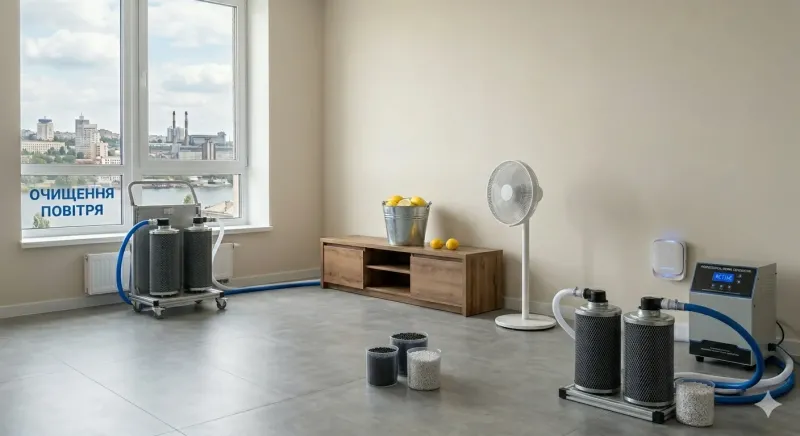
Professional Solution: Creating a directional cross-draft using HVAC or climate control equipment. Position an axial floor fan at maximum power, directing the airflow parallel to the painted walls toward an exhaust vent or an open window.
Result: This breaks the air pocket near the wall, accelerates mass transfer, and evacuates VOC-laden air within 1.5 to 2 hours.
2. Temperature and Humidity Balance (Dew Point Control)
The evaporation rate of solvents depends directly on ambient air temperature and relative humidity. If the room is cold and damp, the coating will retain and emit odors for days.
Professional Solution: The optimal environment for the rapid polymerization of most interior coatings requires a temperature of +20…+24 °C and relative humidity below 55%.
How to Accelerate: Turn on an electric convector heater or a dehumidifier (only after the paint has become tack-free to prevent dust from settling on the wet film). Raising the temperature by just 4–5 °C multiplies the diffusion rate of solvents from the deeper layers of the coating.
3. Professional Chemical Absorption
Standard household aerosols are ineffective at binding the vapors of complex organic solvents (such as xylene, white spirit, or solvent naphtha). Industrial-grade sorbents with a high specific surface area are required.
Professional Solution: Deploying AR-V grade activated carbon (typically utilized in industrial gas filtration plants) or silica gel.
Application Method: Spread the sorbent in a thin layer over wide trays at a ratio of 0.5 kg per 10 sq. m of floor area. Due to its porous structure, the activated carbon traps gas molecules at the molecular level, completely purifying the air within 3 to 4 hours.
4. Ozonation and Photocatalytic Purification
This is the most technologically advanced method, frequently utilized by professional cleaning companies following large-scale renovations.
Professional Solution: Utilizing an industrial ozone generator. Ozone ($O_3$) acts as an exceptionally powerful oxidizing agent. Upon reacting with VOC molecules, it breaks them down into harmless carbon dioxide, water, and oxygen.
Important: No personnel or pets must be present in the room during the ozonator's operation (30–60 minutes is usually sufficient). Following the procedure, the room is ventilated, leaving behind a scent of absolute sterility.
Minimizing the Issue at the Product Selection Stage
The modern paint and coatings industry is committed to reducing environmental impact. The primary way to prevent harsh odors is to specify materials with low volatile organic compound (VOC) content.
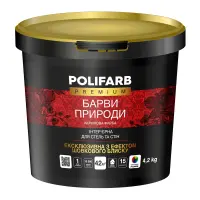
Interior Product Range: For residential properties, schools, and healthcare facilities, Polifarb chemical engineers have developed water-dispersible formulations (such as the STANDARD and «Barvy Pryrody» product lines). Engineered with premium acrylic and latex copolymers, water serves as the carrier. Consequently, these paints carry a neutral odor and cure completely without releasing toxic emissions within just 1 to 2 hours.
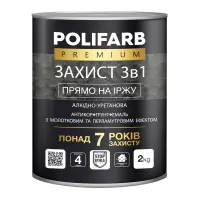
Specialized (Solvent-Borne) Range: When the technical application requires solvent-based systems (e.g., heavy-duty «Zakhyst 3v1» primer-enamel for anti-corrosion metal protection), Polifarb incorporates highly refined volatile components featuring rapid evaporation rates. This enables the coating to cure faster, minimizing odor dissipation times to a technical baseline.
Technical Summary
Post-renovation odor remediation is a controllable physical process. Combining a directional airflow, maintaining temperatures at approximately +22 °C, and employing carbon-based absorbents guarantees comprehensive indoor air purification within 3 to 4 hours without compromising the integrity of the applied coating.