Brush or roller? Expensive paint or affordable? Everyone starting a renovation asks these questions. In practice, a durable paint job rests on several equally important parts: a prepared substrate, the right primer, a paint matched to the conditions of use, a tool suited to each area, and the application conditions set out in the technical data sheet. In this guide POLIFARB walks through each of them and quotes the properties of its paints exactly as the data sheets state them.
What determines how long a coating lasts
Paint holds only as well as the surface underneath it. So the decisions go in this order:
- Substrate: clean, sound, free of dust, cracks and loose layers.
- Primer: strengthens the surface, evens out absorption and improves paint adhesion.
- Paint: chosen by location (exterior or interior), required scrub resistance, vapour permeability and sheen.
- Tool: brush, roller or spray, depending on the area and how intricate it is.
- Application conditions: temperature, humidity, number of coats and drying time between them.
Even the best paint cannot make up for skipping any of these steps.
Brush, roller or spray
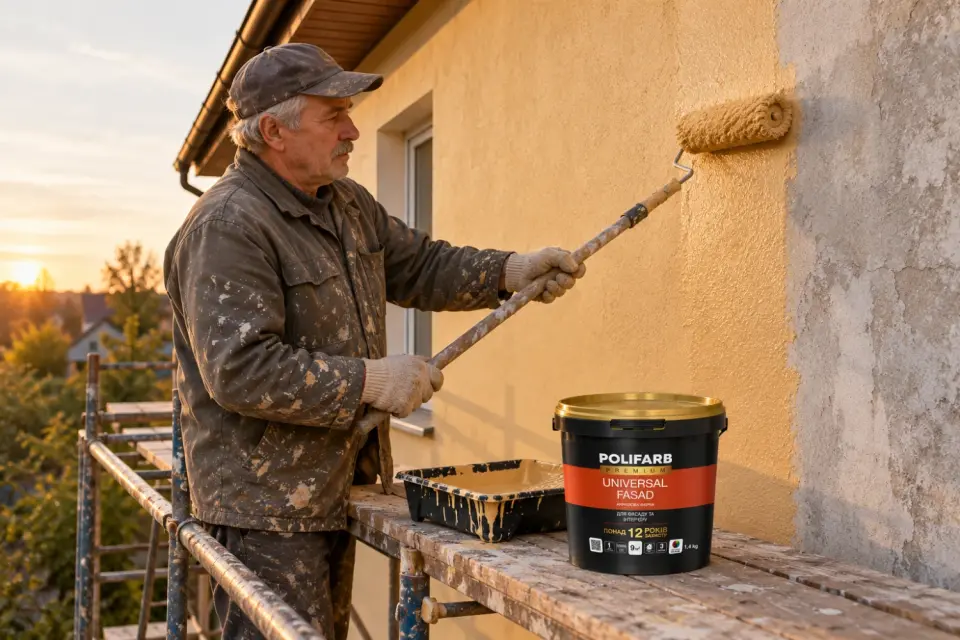
According to their data sheets, the POLIFARB exterior and interior paints covered below can be applied by brush, roller, airless or air spray. The choice of tool depends on the area, not on the paint.
Tool | Best for | What to keep in mind |
|---|---|---|
Brush | Corners, edges along ceilings and skirting boards, around sockets and switches, window reveals, small facade details | Slow on large areas and prone to leaving marks; corners are usually cut in with a brush before rolling |
Roller | Walls and ceilings, flat facade areas | Gives a more even coat than a brush; pick the nap to suit the surface texture; keep a wet edge so the paint does not dry at the joins |
Spray | Large areas, textured surfaces | Mask everything that is not being painted; consumption depends on the application method, so allow extra |
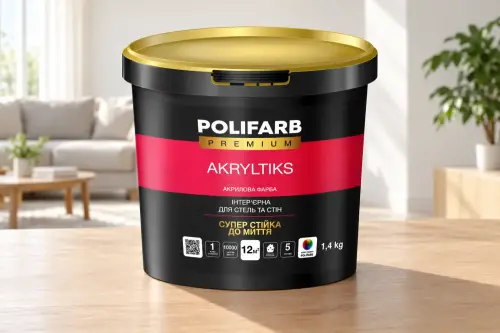
In practice the tools are combined: cut in corners and edges with a brush first, then cover the main area with a roller or spray. If you need paint that does not spatter off the roller, for example in a furnished living room, look at AKRYLTIKS acrylic paint: its data sheet says it spreads easily, does not sag and does not spatter.
How to choose a paint for the job
Compare data-sheet properties rather than country of origin or price per tin: wet scrub resistance under DSTU EN 13300, vapour permeability, sheen, consumption per coat and the stated facade protection period.
Job | Paint | Key data-sheet properties | Consumption per coat |
|---|---|---|---|
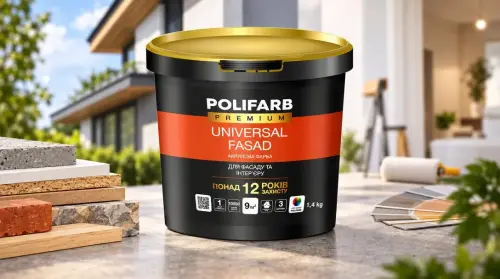
Facade and interior with one product | Acrylic, highly elastic, matt; wet scrub class 2, hiding power class 1; medium vapour permeability (V2); facade protection for over 12 years | 160–190 g/m² on non-absorbent, 180–220 g/m² on absorbent surfaces | |
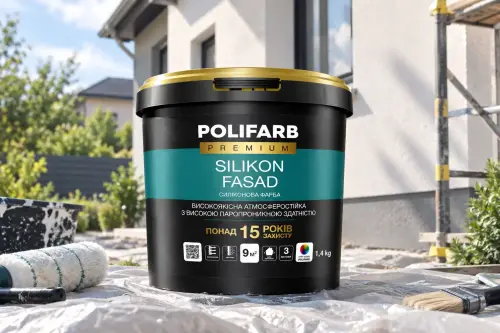
Facades where breathability matters (mineral render, mineral wool insulation, older buildings) | Matt; high vapour permeability (V1), low water permeability (W3); facade protection for over 15 years; can be washed with detergents | 150–200 g/m² on non-absorbent, 180–220 g/m² on absorbent surfaces | |
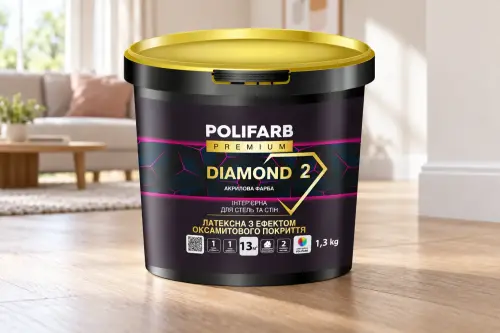
Walls that get washed often: hallway, kitchen, children's room | Acrylic latex, deep matt; wet scrub class 1 (up to 5 µm after 200 cycles), hiding power class 1 | 100–150 g/m² on non-absorbent, 150–190 g/m² on absorbent surfaces | |
Walls and ceilings in homes and public buildings | Matt; wet scrub class 2, hiding power class 1; vapour permeable, hides hairline cracks, does not spatter | 110–150 g/m² on non-absorbent, 170–210 g/m² on absorbent surfaces |
Consumption depends on the substrate, application method and colour, so budget with the upper figure for absorbent walls. Work out the quantity for your project in the paint consumption calculator. How to tell good paint from dubious paint while still in the shop is covered in how to tell quality paint from cheap paint.
Surface preparation and priming
The data sheets set the same substrate requirements for all of these paints:
- remove loose layers and dust, and fill cracks and unevenness with finishing filler;
- remove old distemper and chalk-based coatings and wash the surface with water;
- sound old paint only needs washing with water and detergent;
- new cement and cement-lime renders can be primed after 3–4 weeks, concrete after a month.
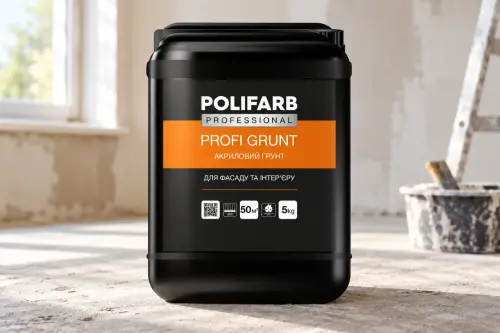
Prime the prepared surface, for example with PROFI GRUNT deep-penetrating primer: one coat, wetting the surface evenly, at 0.1–0.2 kg/m². The primer is not diluted. You can paint after 2 hours. The whole process is described step by step in how to prepare walls for painting.
Facades have one more restriction: UNIVERSAL FASAD and SILIKON FASAD are not compatible with sand-cement renders whose alkalinity at the time of application is above pH 10. Fresh render needs time to cure first.
Application conditions
- Stir the paint thoroughly in the container before use. The data sheet specifies water as the thinner.
- Paint at +5 °C to +30 °C; the optimum is +18 °C to +25 °C at no more than 60 % humidity.
- UNIVERSAL FASAD and SILIKON FASAD exterior paints go on in 2 coats, DIAMOND 2 and AKRYLTIKS interior paints in one or two coats. Allow 2 hours between coats.
- Painted surfaces can be washed no earlier than 7 days after application.
- Clean tools with water after work.
Safety and ventilation
All the paints listed are water-based, non-flammable and non-explosive, and according to their data sheets contain no toxic organic solvents. Even so, the data sheets require painting in well-ventilated rooms and airing them after the work is finished until the material's characteristic odour has gone. Only then can the room be used. Do not plan to sleep in a freshly painted room until the smell has cleared.
DIAMOND 2 carries the H317 label: may cause an allergic skin reaction. Wear protective gloves, and if paint gets on your skin, wash it off with plenty of water. Keep paints out of the reach of children.
Mistakes that shorten a coating's life
- Painting over dust, chalking or crumbling render without cleaning and priming.
- Priming fresh render before 3–4 weeks have passed, or concrete before a month.
- Working below +5 °C or above +30 °C, or painting a facade in the rain.
- Applying the second coat over a first coat that is still wet, without the 2 hours between coats.
- One thick coat on a facade instead of two even ones.
- Washing the wall for the first time less than 7 days after painting.
- Choosing paint by the price of the tin rather than by the scrub resistance class and vapour permeability the room or facade actually needs.
Test patch before the main job
Before painting a whole wall, try two coats on a small area with the same tool you will use for the rest. Once dry, check hiding power, colour in daylight and artificial light, and how even the texture is. A test patch takes a few hours and saves redoing work.
Frequently asked questions
Which is better for walls: brush or roller?
A roller for the main area, because it gives a more even coat. A brush is needed for corners, edges and small details. Most jobs use both.
How do I choose a facade paint?
By its data-sheet properties: vapour permeability, water permeability, scrub resistance and stated facade protection period. Mineral substrates and mineral wool insulation need high vapour permeability, such as SILIKON FASAD (class V1).
When can I use a freshly painted room?
The data sheets require airing the room after painting until the material's odour has gone. After that the room can be used.
Why does preparation matter more than the paint?
Any paint will peel from a dusty or crumbling wall. That is why the wall is cleaned, filled and primed before it is painted.