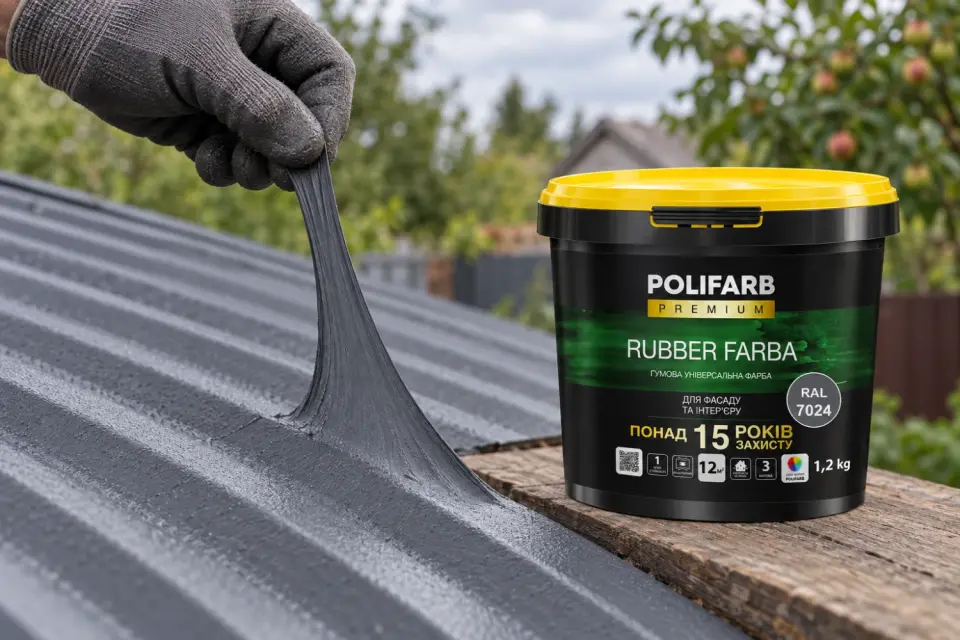
Rubber paint is a water-based acrylic paint whose film stays elastic after drying, like a thin layer of rubber. It contains no liquid rubber: the name comes from the coating's ability to stretch with the substrate, which is why it is used on roofs, plinths, metal and slate, where ordinary paint cracks.
What is inside rubber paint
The base is acrylic latex (a polymer), water, coalescents (additives that help the film form) and pigments. In standard water-based paint the polymer dries into a relatively rigid film. Rubber paint has a higher share of flexible latex resins, so the coating bends and stretches instead of breaking.
How it works
It moves with the substrate
Roofs and metal profiles expand in summer and contract in winter; buildings settle and plinths develop micro-cracks. A rigid coating cracks along with the substrate, water gets into the crack, freezes, and the paint starts to peel. An elastic film stretches over the micro-crack and stays intact.
It keeps water out
As the water evaporates, the polymer particles merge into a continuous, seamless film. Rain, melting snow and splashes cannot pass through it, which is why rubber paint is used on slate, tiles, galvanized roofs (over GF-021 primer) and plinths that are constantly exposed to moisture.
It lets vapour through
The coating is vapour-permeable: liquid water cannot pass through the film, while water vapour from inside the wall escapes outwards. Moisture does not build up under the paint and does not tear it apart in frost.
It bonds to many substrates
According to the manufacturer, RUBBER FARBA acrylic rubber paint can be applied to slate, roof tiles, ondulin, galvanized steel (over GF-021 primer), aluminium, profiled sheeting, ferrous metal (primed or unprimed), asphalt, asbestos cement, concrete, foam and aerated concrete, brick, plaster, plywood, chipboard, cement-bonded particle board, fibreboard, wood, drywall and even wallpaper. It can also go over surfaces previously painted with alkyd and oil paints.
Rubber paint vs. standard acrylic paint
Parameter | Standard acrylic facade paint | Acrylic rubber paint |
|---|---|---|
Dry film | Relatively rigid | Elastic |
Moving substrates (metal, slate, roofs) | Cracks at edges over time | Stretches with the substrate |
Metal and galvanized steel | Usually not intended | Yes, over GF-021 primer after degreasing |
Over old alkyd or oil paint | Generally does not hold | Permitted |
Vapour permeability | Yes | Yes |
Where rubber paint works best
- Roofs. Protects old slate from deterioration and moss and renews galvanized roofs (primed with GF-021 first). Which paint suits your roof type is covered in what to paint a roof with; slate has its own guide, what to paint slate with.
- Plinths and facades. The plinth zone suffers most from driving rain and splashes. See rubber paint for facades.
- Gutters, posts, fences, masonry. One material covers the house and yard in a single shade.
- Indoors. Bathroom, hallway and kitchen walls, and window reveals: see rubber paint for window reveals.
The coating resists detergents and disinfectants, water, salts and lubricants, hence Class 1 wet scrub resistance. The finish is matte (gloss level 3), with colours from the RAL palette.
How to apply it so the technology works
- Clean off dust, dirt, grease stains and any peeling old paint.
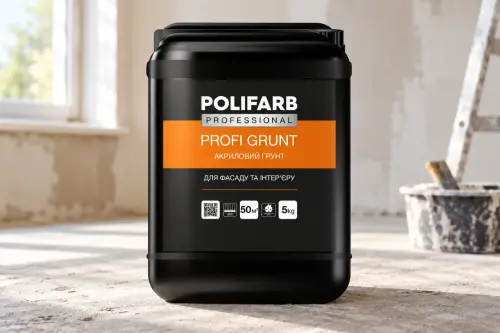
- Bind porous surfaces with PROFI GRUNT deep-penetrating acrylic primer: it evens out absorption and improves adhesion.
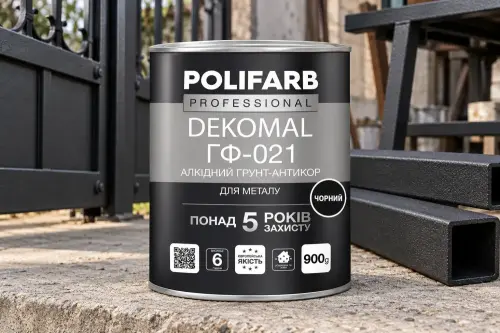
- Treat rusty ferrous metal with Zahyst 3in1 anti-corrosion primer-enamel or remove the rust and prime it straight away with DEKOMAL GF-021 alkyd anti-corrosion primer; degrease galvanized steel and give it 1 coat of GF-021 (rubber paint does not go directly onto zinc).
- Apply three thin coats at 150 g/m² per coat. One thick coat "to save time" is the main mistake: the film forms poorly and cracks.
- Apply each coat only after the previous one has fully dried.
Work out how much paint your area needs with the paint consumption calculator. Typical roof mistakes are listed in mistakes when painting a roof with rubber paint.
What to buy
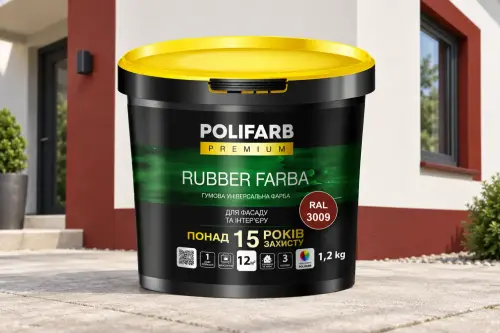
For roofs, plinths and metal: RUBBER FARBA in three coats. Underneath, PROFI GRUNT on mineral substrates and Zahyst 3in1 on rusty metal, or GF-021 once the rust is removed. Pick the colour in the colour visualizer.
FAQ
Does rubber paint contain rubber?
No. It is a latex-based acrylic paint; it is called "rubber" because of its elastic film.
What surfaces can rubber paint be used on?
Slate, tile, metal and galvanized roofs (over GF-021 primer), plinths, facades, concrete, brick, wood and drywall, and indoors on bathroom, kitchen and hallway walls.
How many coats of rubber paint do I need?
For RUBBER FARBA, 2–3 coats at 100–200 g/m² each are recommended.
Can rubber paint go over old paint?
Yes, over sound alkyd and oil coatings. Anything that is peeling has to be removed first.