Selected package
Leftover:
We use necessary cookies for the cart, session, and security. Analytics and marketing cookies are enabled only after your choice. Learn more
Polifarb App
Add the store to your home screen for faster access and an app-like full-screen experience.
It installs in a couple of taps — here is how.
Tap in the Safari toolbar
Choose “Add to Home Screen”
To install the app, open this site in the Safari browser.
Search
Start typing to see suggestions.
Save to favorites
Add to compare
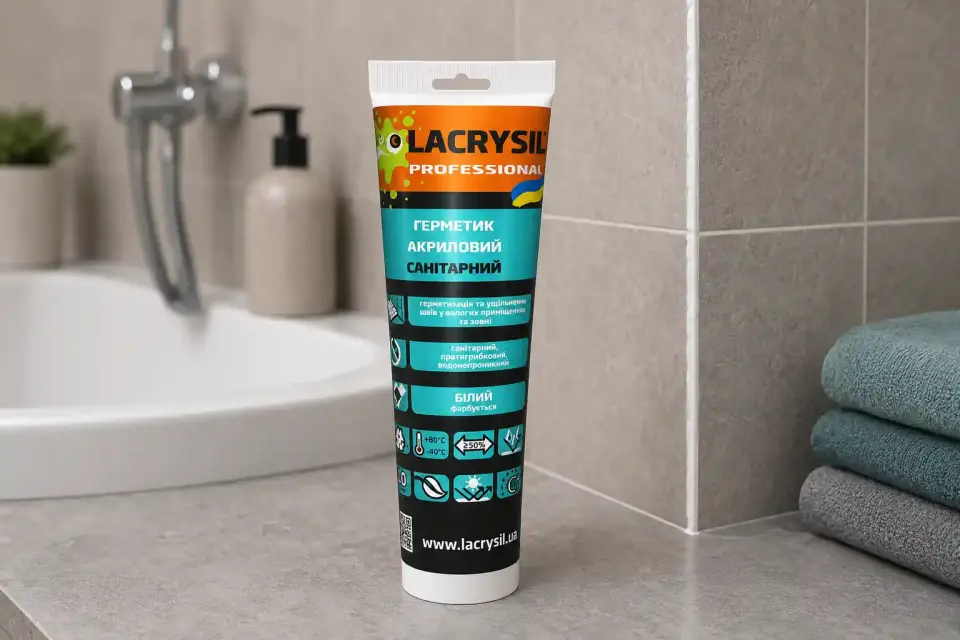
The one bathroom sealant you can paint. Antiseptics against mould Up to 500 % elongation 35 % movement Vapour-permeable
2 available
Maximum joint depth: 5 mm
Selected package
Leftover:
Cheaper package combination
pcs
Leftover:
Sanitary acrylic sealant is a high-strength, water-resistant, flexible sealant for humid rooms.
The default choice for a bathroom is silicone, and silicone can never be painted. This one carries antiseptics like the silicone grade but still takes paint, so it suits joints that must vanish under a painted finish.
More than the 20 % of the silicones here, with up to 500 % elongation. For a joint that shifts daily under the weight of water, elasticity beats ultimate strength.
A silicone bead is sealed both ways. This one lets trapped moisture out of the wall instead of storing it: a real difference in a poorly ventilated bathroom.
They protect against the black line of mould for as long as the bead is intact.
Sealing joints, cracks and abutments in bathrooms, showers, kitchens, laundries and WCs, between glass, timber, ceramics, metal and PVC, indoors and out.
Acrylic, applied at +5 to +35 °C, service -40 to +80 °C, white, 0.15 and 0.28 kg, 18-month shelf life, water clean-up, maximum depth 5 mm. For a joint under standing water, choose the sanitary silicone instead.

Compatibility table
| Material / Base | Concrete, brick, gypsum, plasterboard | Stone, granite, marble | Mirror, glass | Wood, chipboard, fiberboard, MDF, plywood | Tile, ceramic, porcelain | Primed metal | Plastic, PVC | Polystyrene |
|---|---|---|---|---|---|---|---|---|
| Concrete, brick, gypsum, plasterboard | ||||||||
| Stone, granite, marble | ||||||||
| Mirror, glass | - | |||||||
| Wood, chipboard, MDF, fiberboard, plywood | ||||||||
| Tile, ceramic, porcelain | - | |||||||
| Primed metal | ||||||||
| Plastic, PVC | - | - | - | |||||
| Polystyrene |
A 0.28 kg cartridge gives about 15 m of 4×4 mm bead. Maximum depth 5 mm.
The working section here is 4×4 mm against silicone 6×6 mm, so the same weight yields more metres. Pack gaps deeper than 5 mm with backer rod.
Preparation
Application
Baths
Painting and care
Better than the sanitary silicone?
It paints, it breathes, and it takes 35 % movement against 20 % for silicone. Silicone resists chemicals and standing water better.
Which for a bath joint?
Silicone if the joint is open and wetted; this one if it is painted with the wall.
Mould protection?
Antiseptics in the formulation, but no joint survives permanent damp without ventilation.
When can I paint?
Once fully dry; keep it dry until then.
How much for a bathroom?
8–12 m: one 0.28 kg cartridge.
2 similar products