Selected package
Leftover:
We use necessary cookies for the cart, session, and security. Analytics and marketing cookies are enabled only after your choice. Learn more
Polifarb App
Add the store to your home screen for faster access and an app-like full-screen experience.
It installs in a couple of taps — here is how.
Tap in the Safari toolbar
Choose “Add to Home Screen”
To install the app, open this site in the Safari browser.
Search
Start typing to see suggestions.
Save to favorites
Add to compare
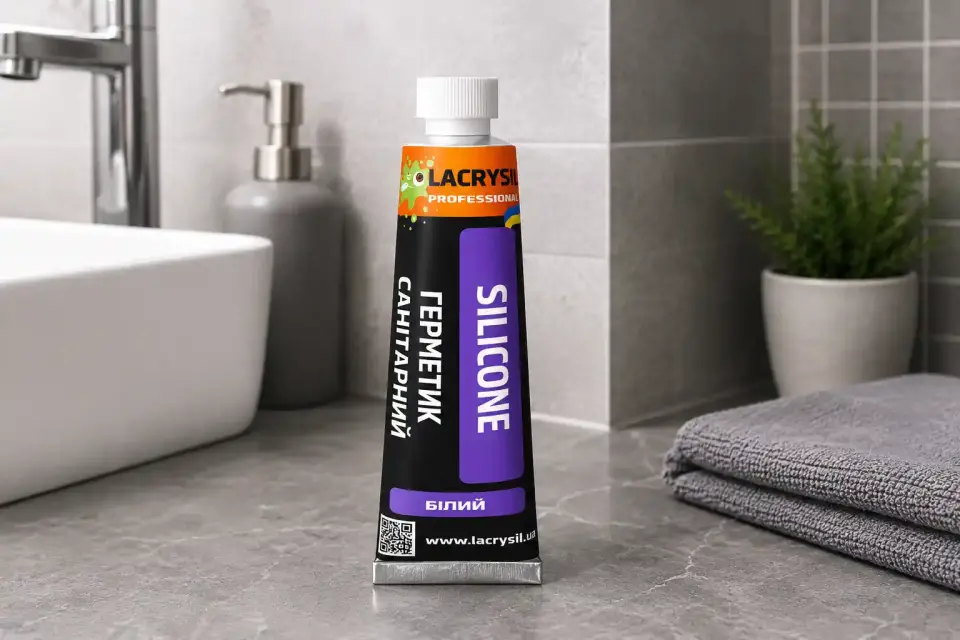
A fungicidal silicone sealant for bathrooms and showers. Near-zero shrinkage 20 % movement capability Service to +130 °C
4 available
Maximum joint depth: 10 mm
Selected package
Leftover:
Cheaper package combination
pcs
Leftover:
Sanitary silicone sealant for plumbing work indoors and out, and for sealing in high-humidity rooms.
The dark streak along a bath joint appears because water sits in the joint, not because the sealant is poor. Fungicides in the formulation prevent mould taking hold for as long as the joint is intact.
The property you notice six months on. A shrinking sealant pulls away from the bath rim and water runs straight into the gap.
A full bath weighs 100–150 kg more than an empty one and settles slightly every time. A rigid joint tears; 20 % elasticity survives the cycle for years.
The widest service range among the ordinary sealants here: usable at boilers, hot-water fittings, heating and air-conditioning runs.
Ceramic tile, glass, primed metal, aluminium, porcelain, timber and plastic. For bathrooms, showers, pools, WCs and kitchens, plus water, drainage and ventilation systems.
Silicone cannot be painted. If the joint must be painted, use the acrylic Sanitary instead. Clean with ethanol or acetone, not water. Applied at +5 to +35 °C, 0.2 and 0.28 kg, white and clear, 18-month shelf life.

Compatibility table
| Material / Base | Concrete, brick, gypsum, plasterboard | Glass | Wood, chipboard, fiberboard, MDF, plywood | Tile, ceramic, porcelain | Primed metal | Plastic, PVC | Polystyrene |
|---|---|---|---|---|---|---|---|
| Concrete, brick, gypsum, plasterboard | |||||||
| Glass | |||||||
| Wood, chipboard, MDF, fiberboard, plywood | |||||||
| Tile, ceramic, porcelain | |||||||
| Primed metal | |||||||
| Plastic, PVC | |||||||
| Polystyrene |
A 0.28 kg cartridge gives about 12 running metres of 6×6 mm bead. Maximum joint depth 10 mm.
A 10×10 mm bead uses material quadratically: the same cartridge then yields only about 4 m.
Preparation
Application
Bath tip
Afterwards
Can the bead be painted?
No. Use the acrylic Sanitary where paint is needed.
Why do bathroom joints go black?
Standing water. Fungicides slow mould, but no joint survives a permanently wet, unventilated room.
Silicone or acrylic?
Silicone for the bath, shower and sink joints themselves; acrylic where the joint is painted or must breathe.
Over old silicone?
No. Cut it all out and degrease first.
How much for a bath?
About 3 m of perimeter; a 0.2 kg tube is enough.
2 similar products