Save to favorites

Add to compare

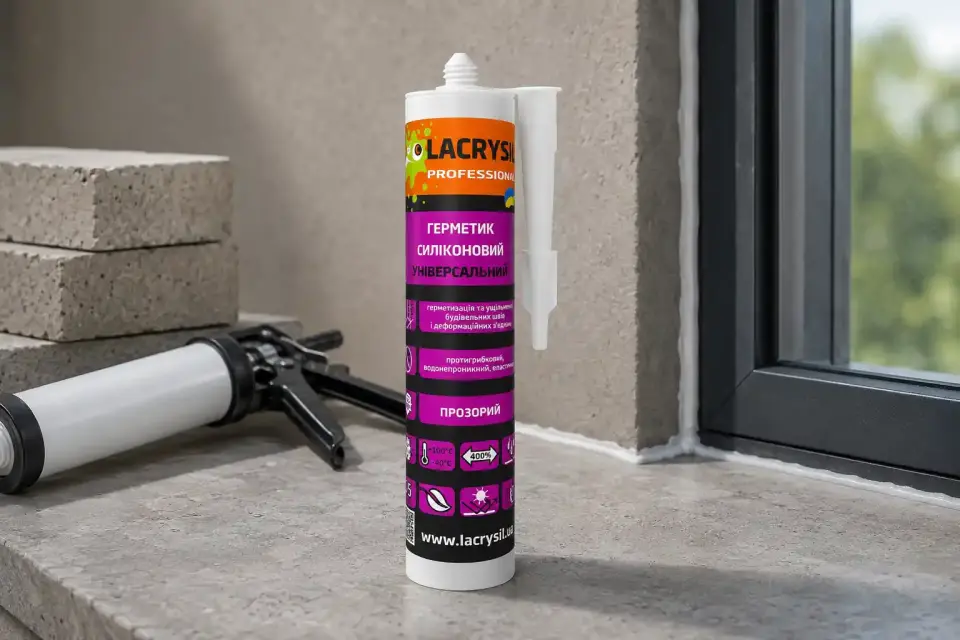
Silicone sealant “Universal”, Transparent, 0.28 kg

4.0 (1)

A weather-resistant silicone for windows, glazing units and gutters. Shields installation foam from UV Takes 20 % movement

Specifications

Color:
Transparent
Maximum joint depth:
10 mm
Consumption:
7.8 linear m (6x6 mm seam, 0.28 kg cartridge)
Storage term:
18 months
Drying time:
24 - 48 hours
Operating temperature:
-40°C ... +130°C
Packaging:
0.28 kg
Base:
Silicone
Application temperature:
+5°C ... +35°C

Choose a variant

4 available

Consumption calculator

Maximum joint depth: 10 mm

Selected variant Transparent · 0.28 kg

142.02 ₴

Description

Universal silicone sealant is a modern multi-purpose silicone for exterior and interior joints.

UV protection for foam

One of its stated uses is sealing around door and window frames to shield polyurethane foam from UV. Bare foam crumbles within a season of sunlight.

Glass and glazing units

Its home ground: structural glass, window frames, casings and sealed units. Silicone grips the non-porous materials acrylics handle poorly: glass, metal, smooth plastic.

Weatherproof and non-shrinking

The bead does not shrink or dull, and with 20 % movement capability it lasts on facades: gutters, small roofing jobs, expansion joints and external insulation systems.

Water under pressure

High water resistance allows use in pools and tanks, where the joint faces a standing head of water rather than splashes.

Versus the sanitary grade

Same chemistry, different purpose: the sanitary version carries fungicides for wet rooms, this one is built for weather, glass and structural joints.

Specs and limits

Silicone, applied at +5 to +35 °C, service -40 to +130 °C, white and clear, 0.2 and 0.28 kg, 18-month shelf life. It cannot be painted. Clean with ethanol or acetone.


How much you need

A 0.28 kg cartridge gives about 12 m of 6×6 mm bead. Maximum depth 10 mm.

  • a 1.4×1.4 m window perimeter, 5.6 m: half a cartridge;
  • six windows, about 35 m: three cartridges;
  • a downpipe with fittings: 2–4 m;
  • 0.2 kg covers about 8 m.

Shielding foam uses less material, but the bead must be unbroken: one exposed centimetre fails as surely as a metre.

Application

Preparation

  • clean the joint of dust, old sealant and moisture;
  • degrease glass, metal and plastic with ethanol or acetone;
  • trim foam flush and dust it off;
  • pack deep cavities with backer rod to 10 mm;
  • mask the edges.

Application

  • cut the nozzle to the joint width;
  • gun an even, unbroken bead;
  • tool with soapy water;
  • pull the masking before it skins.

Outdoors

  • never on a wet surface or before rain;
  • cover foam completely, running onto frame and wall;
  • in external insulation systems, seal before the final finish.

Afterwards

  • do not paint: silicone will not hold it;
  • clean tools with ethanol or acetone;
  • cap the cartridge; 18 months.

Compatibility table

Material / Base Concrete, brick, gypsum, plasterboard Glass Wood, chipboard, fiberboard, MDF, plywood Tile, ceramic, porcelain Primed metal Plastic, PVC Polystyrene
Concrete, brick, gypsum, plasterboard
Stone, granite, marble
Mirror, glass
Wood, chipboard, MDF, fiberboard, plywood
Tile, ceramic, porcelain
Primed metal
Plastic, PVC
Polystyrene

FAQ: UV protection, glass and painting

  • Versus the sanitary silicone?
    Purpose. The sanitary grade has fungicides for wet rooms; this is for outdoors, glass and structural joints.

  • Why cover foam?
    UV destroys exposed foam in a season: it darkens, crumbles and stops insulating.

  • Paintable?
    No. Use an acrylic sealant where paint is required.

  • Pools?
    Yes, its water resistance covers pools and tanks.

  • On glass?
    Yes. That is its home ground.

Video
Reviews (1)

Similar products

2 similar products