











Save to favorites
Add to compare
COLOR-MIX Universal tinting pigment for paint
A universal tinting paste. Twenty base colours make over a hundred shades Works in both water-based and solvent systems
Specifications
- Storage term:
- 36 місяців
- Application area:
- Indoor and outdoor use
Choose a variant
20 available
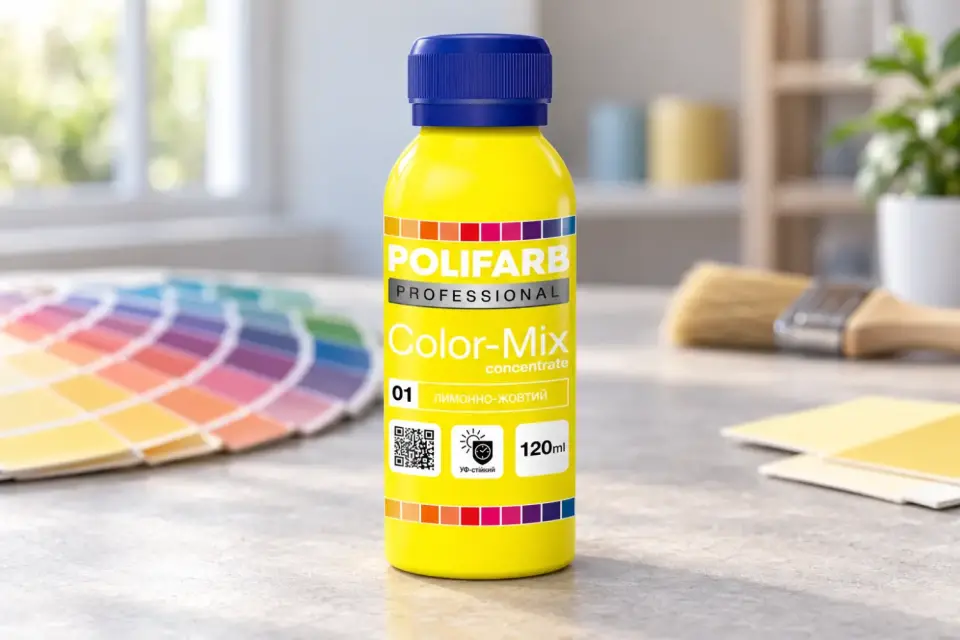
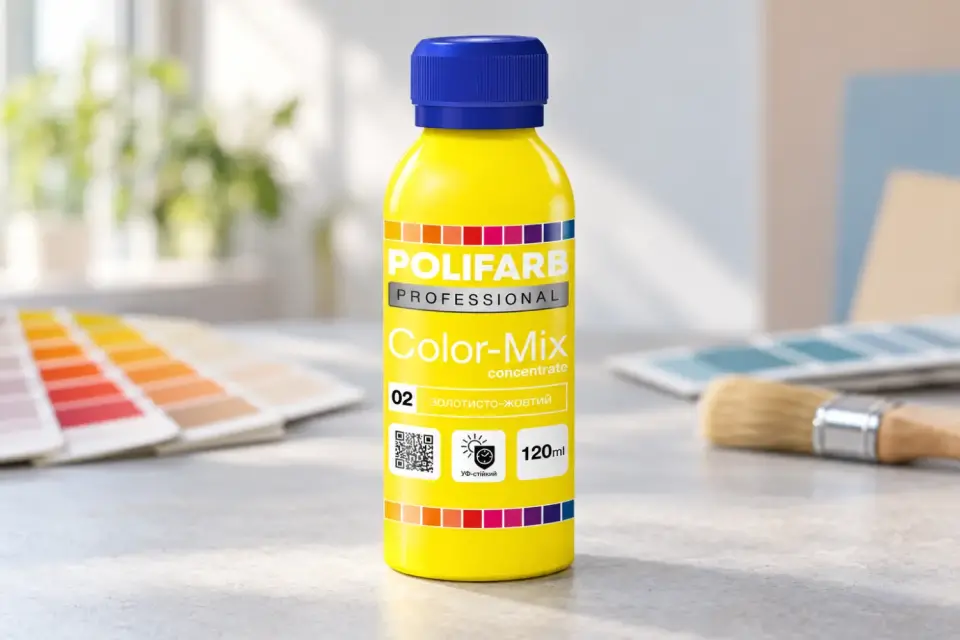
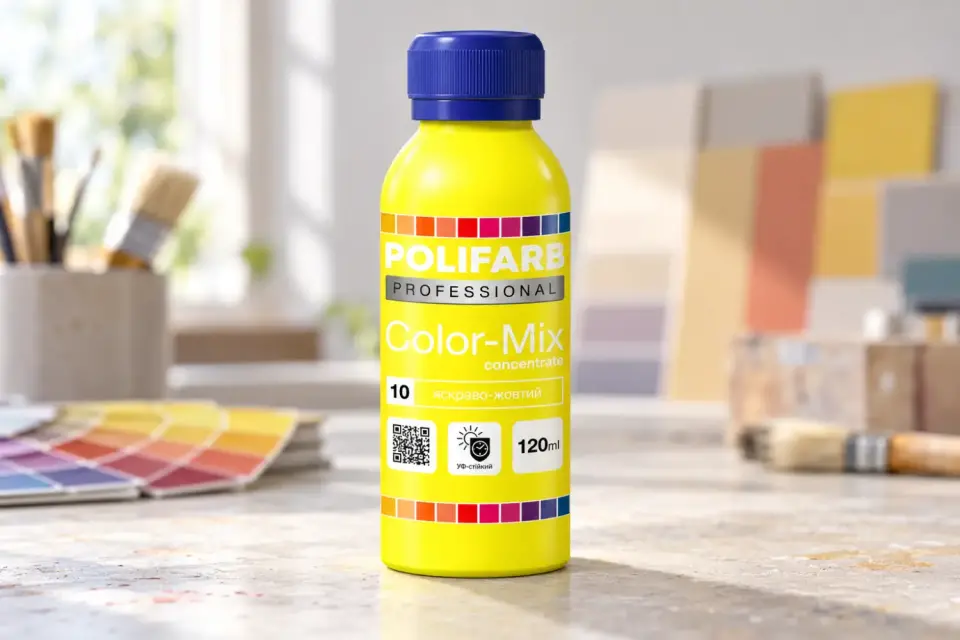
COLOR MIX concentrate by POLIFARB is a universal tinting paste: a suspension of inorganic and organic pigments and fillers with special additives.
One paste for both systems
Most tinting pastes work either in water-based or in solvent-based materials, and mixing them up curdles the pigment. The additives here let the pigment disperse properly in both, so one set covers interior paint, alkyd enamel and wood lazure alike.
Twenty colours, a hundred shades
A balanced range of twenty, from lemon and beige to lilac, emerald and purple, which in a POLIFARB system becomes more than a hundred shades: by mixing, and by varying how much paste goes into the same volume of paint.
What can be tinted
Water-dispersion interior and facade paints, alkyd enamels, varnishes, wood treatments and lazures, lime finishes, grouts, renders and primers.
UV-stable pigments
Decisive on a facade, where a tinted wall must not bleach unevenly in its first season. Frost resistance to -20 °C means it survives unheated storage and winter transport.
120 ml bottles
Larger than the usual 100 ml: enough to finish tinting the last pail from a batch without opening a bottle from another one, which is the commonest reason the last wall comes out a different shade.
Conditions
Shake the bottle hard before use. Find the ratio on a small amount of material in a separate container first, then tint the whole quantity needed for the surface in one go. Use no more than 10% paste by volume of the material being tinted. Store closed at -20…+50 °C. Shelf life 36 months, the longest in the catalogue, so leftovers keep until the next repair.
How much you need
The amount of paste sets saturation, not hue: the same paste gives anything from a hint of colour to a deep tone.
pastels: about 1–2 % of the paint volume;
mid tones: 3–5 %;
deep tones: up to 10 %.
Beyond 10 % the excess pigment reduces opacity and wash resistance.
Example: a 14 kg pail at 3 % needs about 420 ml, three or four 120 ml bottles.
The rule that matters: tint all the paint for a room in one go. Matching a second batch by eye is effectively impossible, and the join shows in raking light.
Application
Before tinting
work out all the paint for the room and tint it together;
check the material accepts tinting;
material and room at +5 to +30 °C.
Tinting
add in small portions, stirring thoroughly after each;
use a slow-speed mixer, not a hand stir, which leaves streaks;
write down the dose per volume: the only way to repeat the shade.
Always make a test panel
apply to the same substrate and let it dry fully;
wet paint is always darker than dry;
judge it under the light the room actually has.
Storage
seal the bottle; 36-month shelf life;
frost-resistant to -20 °C;
keep the remainder for touching up.
FAQ: compatibility, dosage and matching shades
Alkyd enamel?
Yes. Working in both water- and solvent-based systems is its defining feature.How much to add?
1–2 % for pastels, 3–5 % for mid tones, up to 10 % for deep ones. Beyond that opacity suffers.Why is the colour different from the bottle?
It depends on the base paint, the dose and the substrate: always test, and judge the dried film.How do I repeat a shade?
Record the dose per volume; better still, tint all the paint at once.Render and grout?
Yes, along with lime finishes and primers.