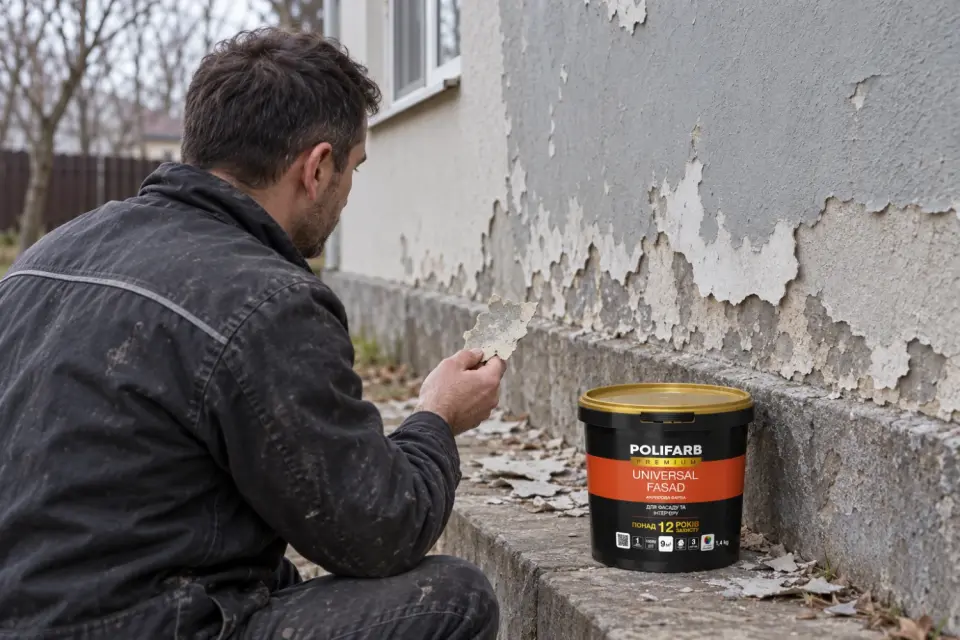
Cheap facade paint ends up costing more than a decent one if the facade has to be repainted after a year or two. The typical scenario: a 14 kg bucket costs noticeably less than paint from known manufacturers, the wall looks neat during the first season, and after winter the paint fades, chalks, develops a network of cracks and peels in places. Let's look at why this happens, how buyers are most often misled, and what to check in the technical data sheet before buying.
Why cheap facade paint does not survive winter
From the price per kilogram you have to subtract packaging, delivery, taxes and the retailer's and manufacturer's margins. If the price looks suspiciously low, the savings are usually built into the formula:
- Too little binder. The binder (acrylic or silicone dispersion) is what holds pigments and fillers on the wall. With too little of it, the film copes worse with moisture, frost and UV and chalks faster.
- Little titanium dioxide and a lot of chalk. The paint hides the substrate poorly, so more coats are needed and the apparent saving disappears.
- No test data. Wet scrub resistance, hiding power, water vapour permeability and water permeability are classified under standards. If these classes are not stated, there is nothing to compare the paint against.
The other half of the problems has nothing to do with the paint itself: skipped priming, painting over fresh render or a damp wall, applying in cold weather. Even good paint lasts less under these conditions.
How buyers are most often misled
- Price per bucket instead of price per square metre. Two paints in the same container can have different consumption, and the one that is cheaper per kilogram is often more expensive per square metre.
- A single "best case" consumption figure. An honest data sheet gives consumption as a range, separately for absorbent and non-absorbent substrates. Facade render is usually absorbent, so calculate with the upper value.
- Vague words instead of classes. "Weatherproof", "durable" or "premium" mean nothing without a wet scrub resistance class under EN 13300 and vapour and water permeability classes under EN 1062-1.
- Hidden application conditions. Temperature, humidity, drying time between coats and substrate requirements affect the result as much as the paint does.
What to check in the data sheet
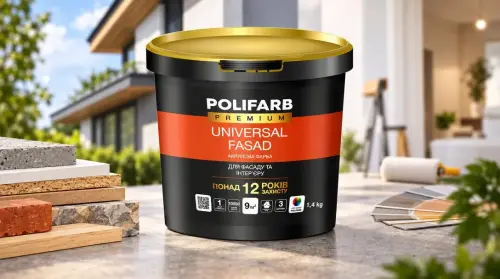
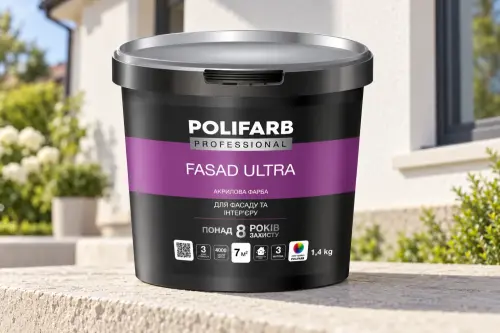
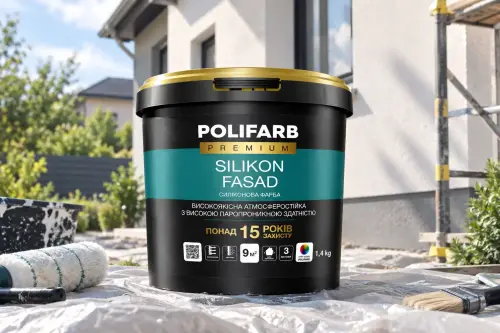
As an example, here are the key figures for three POLIFARB facade paints taken from their data sheets:
Parameter | UNIVERSAL FASAD | FASAD ULTRA | SILIKON FASAD |
|---|---|---|---|
Binder | acrylic dispersion | acrylic dispersion | silicone dispersion |
Wet scrub resistance | class 2 | class 3 | not stated |
Hiding power | class 1 | class 2 | not stated |
Water vapour permeability | medium, V2 | medium, V2 | high, V1 |
Water permeability | low, W3 | medium, W2 | low, W3 |
Consumption per coat, non-absorbent substrate | 160–190 g/m² | 180–220 g/m² | 150–200 g/m² |
Consumption per coat, absorbent substrate | 180–220 g/m² | 220–260 g/m² | 180–220 g/m² |
Declared facade protection | over 12 years | over 8 years | over 15 years |
What this tells you. The wet scrub class shows how much film is worn away in 200 scrub cycles: 5–20 microns for class 2 and 20–70 microns for class 3. Hiding power class 1 means the paint covers the substrate better. Class W3 (low water permeability) means the coating lets less water into the wall, and class V1 (high vapour permeability) lets the wall release moisture outwards more easily.
Price per year, not per bucket
Labour on a facade costs the same whether the paint is cheap or good, and repainting often also means scraping off the peeling layer. That is why the difference in material price usually affects the total budget less than it seems. Calculate it like this:
- Take the consumption per coat for your substrate and the number of coats from the data sheet.
- Multiply by the area to get the kilograms needed and the cost of material.
- Add the cost of primer and labour.
- Divide the total by the declared facade protection period. That is the approximate cost of your facade per year.
Example for 100 m² of absorbent render in 2 coats: UNIVERSAL FASAD needs 36–44 kg, FASAD ULTRA 44–52 kg. Actual consumption depends on the substrate, application method and colour, so keep a small reserve. You can work out the amount for your area in the paint consumption calculator. Why paint prices differ so much is explained in detail in the article why paints have different prices.
How to apply facade paint correctly
- Prepare the substrate. Remove dust and anything loose, strip old glue-bound and chalk-based coatings, fill cracks. A sound old paint coat only needs washing with water and detergent.
- Respect curing times. Fresh render can be painted after 3–4 weeks, concrete after a month. POLIFARB facade paints are not compatible with sand-cement render whose pH is above 10 at the time of application.
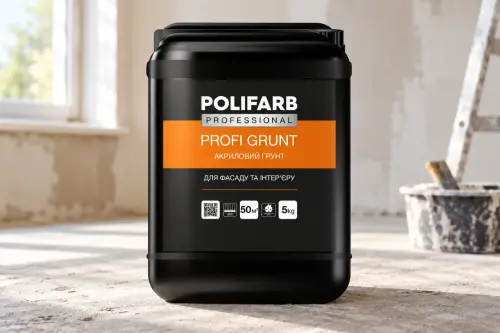
- Prime. PROFI GRUNT deep-penetrating primer is applied in one coat, strengthens the substrate and reduces paint consumption. You can paint after 2 hours.
- Apply 2 coats with a roller, brush or sprayer, allowing 2 hours of drying between coats.
- Watch the weather. The substrate temperature must be between +5 and +30 °C, ideally +18 to +25 °C with humidity no higher than 60%. The painted surface can be washed no sooner than 7 days later.
- Tint a single batch. If the paint is tinted, buy the whole amount for the facade from one batch.
What to choose
For a rendered, concrete or brick facade: PROFI GRUNT in one coat and UNIVERSAL FASAD acrylic facade paint in 2 coats. If the area is large and the budget is tight, there is FASAD ULTRA facade paint with declared protection of over 8 years: it has wet scrub class 3 and higher consumption, but all its characteristics are openly stated in the data sheet. For aerated concrete, insulation systems with mineral wool and historic buildings, the manufacturer recommends SILIKON FASAD silicone facade paint with class V1 vapour permeability. How to choose between the types is covered in the article acrylic or silicone facade paint, and the step-by-step process in the facade painting guide.
Frequently asked questions
Why does facade paint peel after a year?
Most often because of a weak binder in cheap paint, skipped priming, painting over a fresh or damp substrate, or applying below +5 °C.
How can you tell cheap facade paint from a decent one?
By the data sheet: wet scrub resistance class, hiding power class, vapour and water permeability classes, consumption range for absorbent and non-absorbent substrates, and the declared facade protection period. If this data is missing, that is a warning sign in itself.
How long does facade paint last?
It depends on the composition and on how it was applied. The manufacturer declares facade protection of over 8 years for FASAD ULTRA, over 12 years for UNIVERSAL FASAD and over 15 years for SILIKON FASAD, provided the substrate is prepared correctly.