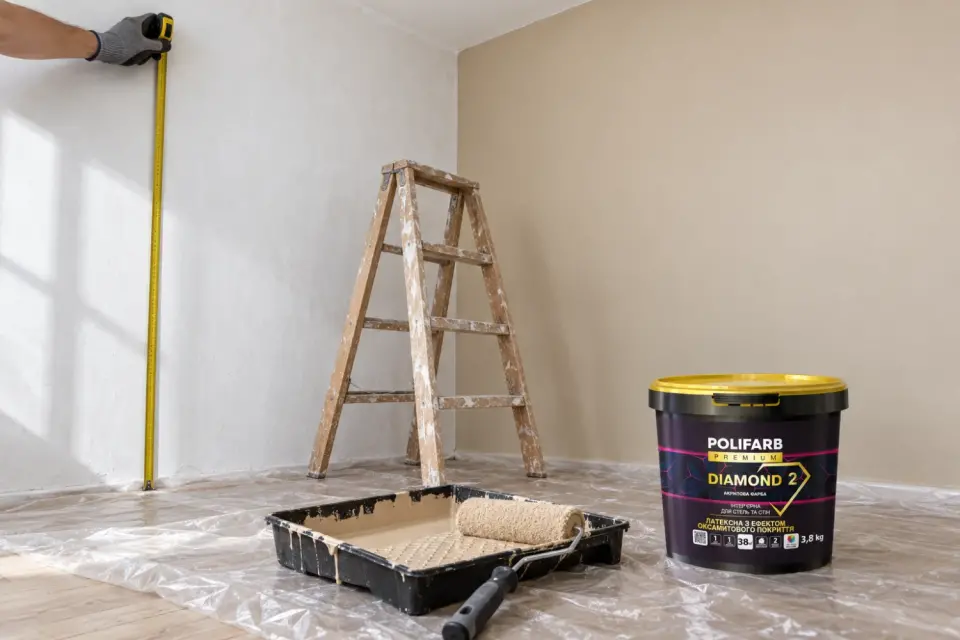
To work out how much paint you need, you need four numbers: the area, the consumption rate per m² per coat, the number of coats and a margin. Multiply the area by the rate and the number of coats, add the margin and divide by the can size. The paint consumption calculator does this automatically; below we show where the numbers come from and how to check the result by hand.
The formula in plain words
- Area. Walls: room perimeter × height minus windows and doors. Ceiling: length × width. Facade: wall width × height minus openings.
- Consumption rate. Take it from the product page or the label. POLIFARB paints list it in g/m² per coat.
- Coats. Most interior and facade paints go on in two coats, RUBBER FARBA rubber paint in three.
- Margin. The calculator page defaults to 10 %, the product-page calculator to 0 %, so there you enter it yourself.
- Packages. Divide the amount by the package size and round up.
In one line: paint, kg = area, m² × rate, kg/m² × coats × (1 + margin / 100). Convert grams to kilograms by dividing by 1000: 125 g/m² = 0.125 kg/m².
Where to calculate: calculator page or product page
The paint consumption page
Works for any paint, even one outside our catalogue. Enter the area (or width, height and the number of identical surfaces), the consumption per m² in litres or kilograms, the coats, the margin and the can size. You get the amount of material and the number of cans, rounded up. If the rate is in kg/m², enter the can size in kilograms too.
The calculator on a paint's product page
Here the rate and the number of coats come from the manufacturer's data, so you only enter the area and the margin. It works in kilograms, picks the best-value combination of package sizes in stock, shows the leftover and tells you how many square metres one package covers.
Example 1: one wall, 3 × 2.7 m
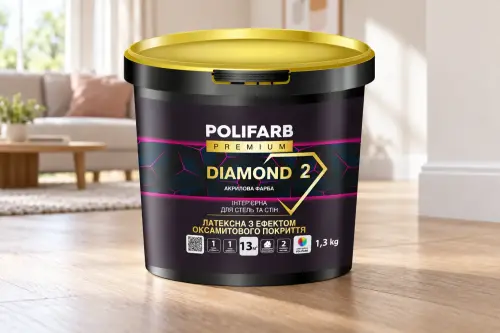
A living-room wall is painted with DIAMOND 2 acrylic latex paint. The rate is 125 g/m² per coat, two coats.
- Area: 3 × 2.7 = 8.1 m².
- Paint for two coats: 8.1 × 0.125 × 2 = 2.03 kg.
- With a 10 % margin: 2.23 kg.
One 3.8 kg bucket covers it with room to spare; two 1.3 kg buckets (2.6 kg) are almost exactly enough. On the calculator page enter area 8.1, rate 0.125, coats 2, margin 10 and package 3.8: you get the same 2.23 kg and one can.
Example 2: a 4 × 3 m room, walls and ceiling
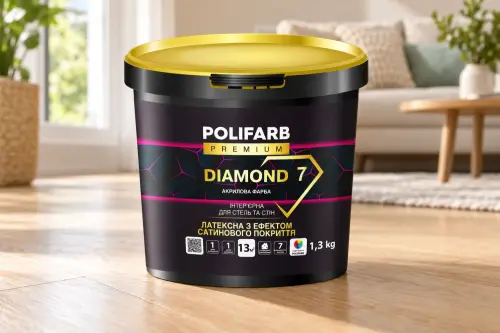
Wall height 2.7 m, a 0.9 × 2 m door and a 1.3 × 1.4 m window. The walls get satin DIAMOND 7 acrylic latex paint, the ceiling gets SNEJINKA ceiling paint.
Surface | Area | Rate per coat | Two coats | With 10 % margin | What to buy |
|---|---|---|---|---|---|
Walls | 14 × 2.7 − 1.8 − 1.82 = 34.2 m² | 125 g/m² | 8.55 kg | 9.4 kg | one 12.5 kg bucket or three 3.8 kg |
Ceiling | 4 × 3 = 12 m² | 245 g/m² | 5.88 kg | 6.47 kg | one 6.5 kg bucket |
The ceiling gets its own line. SNEJINKA's rate is almost twice that of DIAMOND 7, so if you apply the wall figure to the ceiling, you will run short.
Example 3: a 10 × 6 m facade
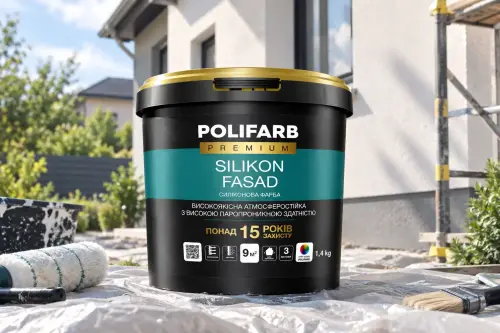
A house wall with four 1.3 × 1.4 m windows, painted with SILIKON FASAD silicone paint at 175 g/m² per coat.
- Area: 60 − 4 × 1.82 = 52.7 m².
- Two coats: 52.7 × 0.175 × 2 = 18.45 kg.
- With a 10 % margin: 20.3 kg, so one 14 kg and one 7 kg bucket.
If the window reveals are painted with the same paint, add their area to the wall.
POLIFARB paint consumption rates
Paint | Use | Rate per coat | Coats | Largest bucket covers |
|---|---|---|---|---|
DIAMOND 2 | walls and ceilings that get washed often | 125 g/m² | 2 | 12.5 kg ≈ 50 m² |
DIAMOND 7 | walls and ceilings, satin | 125 g/m² | 2 | 12.5 kg ≈ 50 m² |
walls and ceilings, matt | 130 g/m² | 2 | 14 kg ≈ 54 m² | |
low-traffic rooms | 195 g/m² | 2 | 14 kg ≈ 36 m² | |
SNEJINKA | ceilings | 245 g/m² | 2 | 12.5 kg ≈ 25 m² |
SILIKON FASAD | facade | 175 g/m² | 2 | 14 kg ≈ 40 m² |
facade and interior | 175 g/m² | 2 | 14 kg ≈ 40 m² | |
roof, plinth, metal, slate | 150 g/m² | 3 | 12 kg ≈ 27 m² |
The area in the last column assumes the recommended number of coats and no margin.
What increases consumption
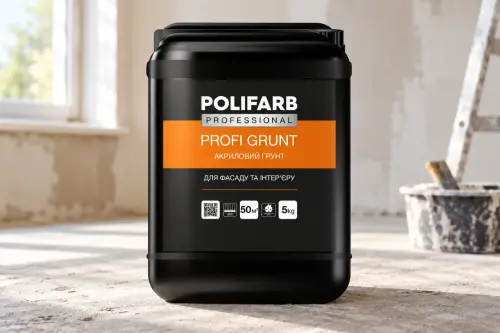
- Porous or unprimed substrate. Fresh plaster soaks up the first coat unevenly. PROFI GRUNT deep-penetrating primer evens out absorption, so the paint covers in two coats instead of three.
- Contrasting colour. Going from dark to light may need one more coat: enter it in the "Number of coats" field.
- Tool. A long-pile roller loads more paint than a smooth wall needs.
Common mistakes
- Counting one coat when the rate on the product page is per coat.
- Mixing up g/m² and kg/m²: entering 125 g/m² as 125 gives a result a thousand times too large.
- Using one rate for walls and ceiling when the paints differ.
- Buying exactly the calculated amount. Top-ups come from a different batch, and with tinted paint that risks a shade difference.
What else affects coverage per square metre is covered in our article on paint consumption per m². Before painting, read how to prime walls properly.
What to buy
For walls that get washed, DIAMOND 2 or DIAMOND 7; for the ceiling, SNEJINKA; for the facade, SILIKON FASAD or UNIVERSAL FASAD; underneath, PROFI GRUNT. Check the area and the number of buckets in the paint calculator or directly on the product page of the paint you choose.
FAQ
How much paint do I need for 10 m² of wall?
At 125 g/m² and two coats, 2.5 kg, or 2.75 kg with a 10 % margin. For a paint rated at 195 g/m², 3.9 kg and 4.29 kg.
Does the calculator account for the number of coats?
Yes. On the calculator page coats are a separate field; on the product page they are built in: two for most paints, three for RUBBER FARBA.
How do I calculate if coverage is given in m²/l?
Divide 1 by that number: 10 m²/l is 0.1 l/m². Then enter the can size in litres.
How much margin should I add?
The calculator suggests 10 %. For porous substrates, contrasting colours or long-pile rollers, add more.