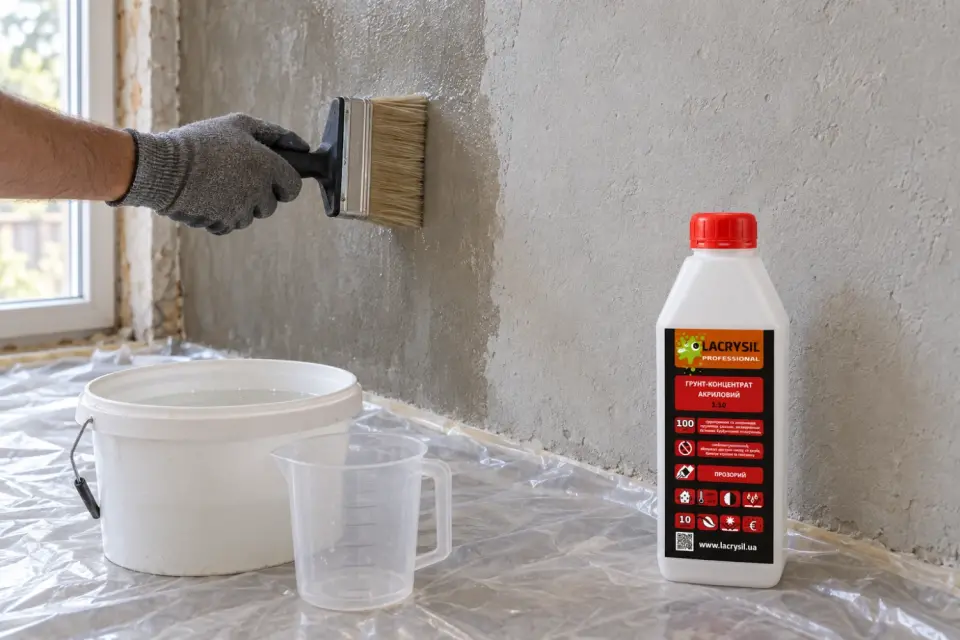
Primer consumption per m² for POLIFARB ready-to-use acrylic primers is 100–200 g per coat, and one coat is enough for a normal substrate. Concentrates work differently: you calculate the working solution but buy the concentrate, which is 5 times (for 1:4) or 11 times (for 1:10) smaller. You can check both in the primer consumption calculator.
Ready-to-use primer or concentrate: what are we calculating?
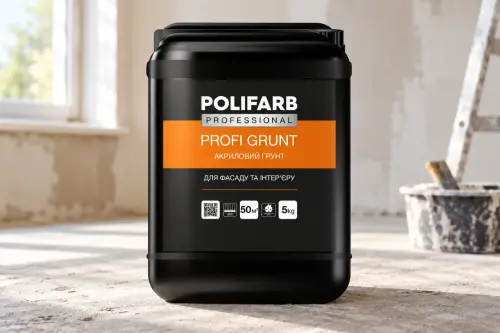
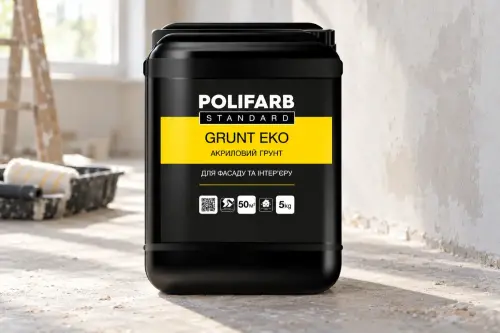
- Ready-to-use primer (PROFI GRUNT deep-penetrating primer, GRUNT EKO basic primer). Open the can and start. The rate is 100–200 g/m² per coat; the product-page calculator uses 150 g/m².
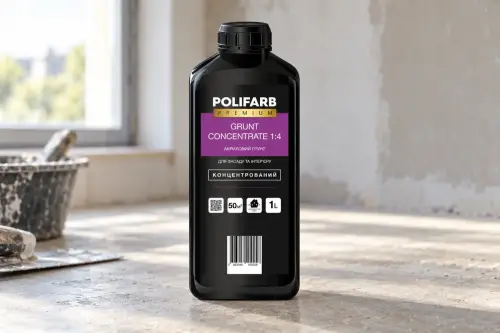
- 1:4 concentrate (GRUNT CONCENTRATE 1:4). One litre is mixed with four litres of water, so a 2 l bottle makes 10 l of working solution. The 100–200 g/m² rate refers to the solution.
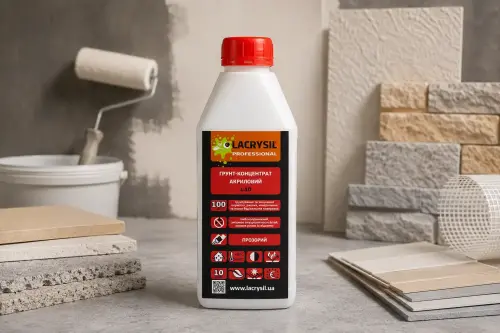
- 1:10 concentrate (primer concentrate 1:10). One litre makes 11 l of solution, a 5 l can makes up to 55 l.
The formula
- Working solution = area, m² × consumption per m².
- Concentrate = solution / (1 + water ratio). For 1:4 divide by 5, for 1:10 by 11.
- With margin: × (1 + margin / 100). The calculator page defaults to 10 %.
- Number of cans = result / can volume, rounded up.
In the calculator's manual mode the fields are "Solution consumption per m², l" and "Canister volume, l", and the result is the working solution. For a concentrate, divide it by 5 or 11. In the "Pick a product" tab the calculator works out the 1:10 concentrate directly: according to the manufacturer's data, 1 l covers about 70 m².
Example 1: a room before painting, ready-to-use primer
A 4 × 3 m room: 34.2 m² of walls (minus a window and a door) plus a 12 m² ceiling, 46.2 m² in total. We prime with PROFI GRUNT at 150 g/m².
- 46.2 × 0.15 = 6.93 kg.
- With a 10 % margin: 7.6 kg.
- Buy: one 10 kg can or two 5 kg cans.
Example 2: the same room with 1:4 concentrate
We take 0.15 l/m² of working solution: the solution is water-based, so 150 g/m² is roughly 0.15 l/m².
- Solution: 46.2 × 0.15 = 6.93 l.
- Concentrate: 6.93 / 5 = 1.39 l, or 1.52 l with a 10 % margin.
- Buy: one 2 l bottle. It makes 10 l of solution; the rest will do the window reveals or the next room.
Example 3: a 52.7 m² facade with 1:10 concentrate
A rendered 10 × 6 m wall with four windows. In the "Pick a product" tab the calculator works out the concentrate directly: 52.7 / 70 ≈ 0.75 l, or 0.83 l with a 10 % margin. One 1 l can is enough.
If the render is crumbling, the manufacturer recommends a different dilution: 1:6 in two coats. Then you need twice as much solution (2 × 52.7 × 0.15 = 15.8 l) and 15.8 / 7 = 2.26 l of concentrate, about 2.5 l with a margin: a 2 l and a 1 l can.
POLIFARB primer rates
Primer | Type | Rate | Dilution | Coverage per package |
|---|---|---|---|---|
PROFI GRUNT | ready-to-use, deep-penetrating | 100–200 g/m², 1 coat | not diluted | 10 kg ≈ 66 m², 5 kg ≈ 33 m² (at 150 g/m²) |
GRUNT EKO | ready-to-use, basic | 100–200 g/m², 1 coat | not diluted | 10 kg ≈ 66 m², 5 kg ≈ 33 m² (at 150 g/m²) |
GRUNT CONCENTRATE 1:4 | deep-penetrating concentrate | 100–200 g/m² of solution, 1 coat | 1:4, 2 l makes 10 l | 2 l ≈ 50–100 m² |
Primer concentrate 1:10 | penetrating, consolidating concentrate | 1 l of concentrate ≈ 70 m² (calculator data) | 1:6, 1:10 or 1:15 depending on the job | 5 l ≈ 350 m² at 1:10 |
For the 1:10 concentrate the manufacturer gives four modes: undiluted for impregnating wood, 1:6 for loose and highly absorbent substrates in two coats, 1:10 before adhesives, fillers and water-based paints, and 1:15 for cement mortar or dry mixes.
What affects consumption
- Porosity. A dry, porous substrate can absorb up to twice as much. Under acrylic paints, aerated concrete and old plaster are primed in two passes.
- Coat order. Apply the second coat only after the first has fully soaked in, otherwise the solution runs off and is wasted.
- Substrate type. Under silicone facade paint, PROFI GRUNT goes on as one thin coat: the primer should soak into the substrate and not form a film that seals the pores.
Common mistakes
- Treating a concentrate as ready-to-use primer and buying 5–11 times more than needed.
- Diluting 1:10 for a crumbling wall. Such a substrate needs 1:6 and two coats.
- Forgetting the second pass on aerated concrete and old plaster.
- Skipping primer to save on paint. It works the other way round: an unprimed wall soaks up the first coat, and you end up applying three coats instead of two.
For the process itself, step by step, see how to prime walls before painting and how to prepare walls for painting.
What to buy
For ordinary plaster and plasterboard, GRUNT EKO is enough; for loose substrates, PROFI GRUNT. On a large job a concentrate pays off: GRUNT CONCENTRATE 1:4 or primer concentrate 1:10, where one 5 l can makes up to 55 l of solution. Check the area and the number of cans in the primer calculator.
FAQ
How much primer do I need for 100 m²?
Ready-to-use primer at 150 g/m²: 15 kg. A 1:10 concentrate at 0.1 l/m² of solution: 10 l of solution, i.e. less than 1 l of concentrate.
What is the difference between 1:4 and 1:10 concentrates?
The dilution: 1 l of 1:4 concentrate makes 5 l of solution, 1 l of 1:10 makes 11 l. On large areas 1:10 is more economical.
Do I need two coats of primer?
One coat is enough for a normal substrate. Aerated concrete, old plaster and crumbling surfaces are primed twice, and that has to go into the calculation.
Can I dilute the concentrate more to cover a larger area?
No. Use the ratio the manufacturer gives for your job. A weaker solution consolidates the substrate less, and the paint again soaks in unevenly.