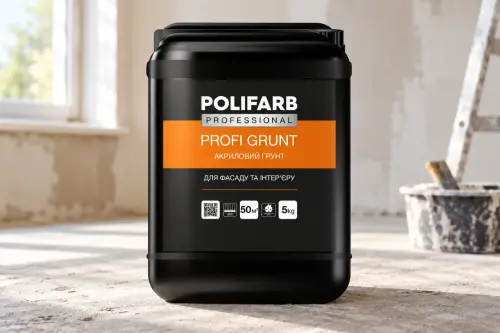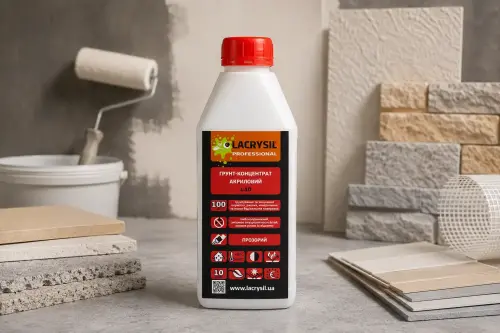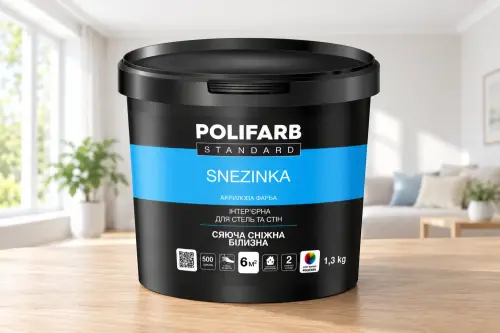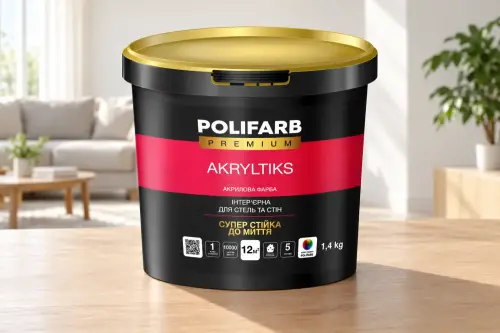
No, you should not paint over whitewash with water-based (acrylic or latex) paint. Chalk, lime and glue-bound whitewash has to be removed completely and the surface washed with water before painting. The technical data sheets for SNEJINKA, AKRYLTIKS and DIAMOND 2 paints and for PROFI GRUNT and GRUNT EKO primers say exactly that. Below we explain why, how to check that the coating really is whitewash, and how to prepare the surface for paint.
Why paint does not hold on whitewash
- Whitewash is chalk or lime with a little glue. The layer is loose and chalky, and its particles are only weakly bound to each other and to the substrate.
- As paint dries it forms a film that pulls on the surface slightly. The film grips the top layer of whitewash firmly, but the whitewash itself holds on to the ceiling poorly. The result is paint peeling off together with the whitewash, in blisters or sheets.
- Primer does not solve this. PROFI GRUNT and GRUNT EKO strengthen a mineral substrate and improve adhesion, but their data sheets require any remaining glue and lime paints to be removed first.
- Glue-bound whitewash also softens from the water in the paint: the layer swells and the paint cracks or blisters.
How to check for whitewash
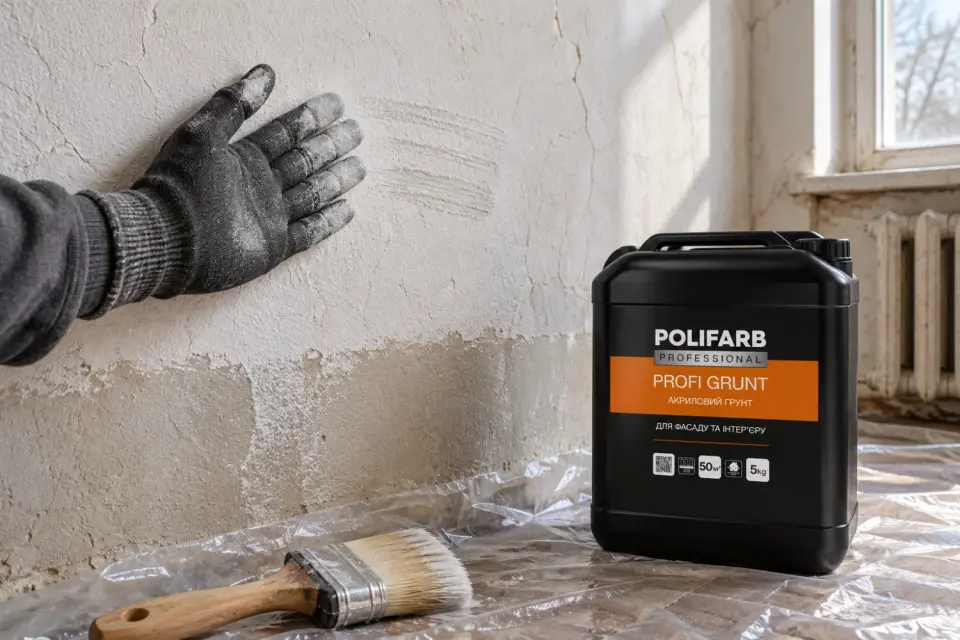
- Palm test. Run a dry palm over the wall or ceiling. A white mark on your hand means a chalky layer. Even if the mark is faint, the whitewash still has to come off.
- Water test. Wet a small area with a sponge. Whitewash darkens, softens and comes away easily with a scraper; glue-bound whitewash turns slippery. Old water-based paint only darkens slightly and does not scrape off.
- Tape test. Press a strip of masking tape down firmly and pull it off sharply. White dust or flakes on the sticky side mean whitewash or another weak coating that has to be removed.
If you find old, sound water-based paint under the whitewash, leave it: according to the data sheets, such coatings only need washing with water and detergent.
How to remove whitewash
- Cover the floor and furniture with plastic sheeting and tape over sockets and switches. This is wet, messy work.
- Soak a small section with water using a roller, sponge or sprayer and let the layer soften. Lime whitewash softens more slowly than chalk, so wet it several times.
- Scrape off the softened layer with a wide scraper. Hold a tray or dustpan under it so the wet chalk does not drop on the floor.
- Wash the surface with a sponge, changing the water often. Keep washing until the water stays clear and a dry palm comes away clean once the surface has dried.
- Let the substrate dry completely.
Useful tips
- Start with the ceiling: dirt from the ceiling will end up on the walls anyway.
- If the whitewash was applied in several layers over the years, wash down to the plaster or concrete. A lower layer left behind chalks just the same.
- Mould, soot and grease stains need separate cleaning after the whitewash is off, or they will show through the paint.
Preparing and painting after removal
- Repair. Removing whitewash exposes cracks and holes. The paint data sheets say to fill them with finishing putty following the instructions on its pack, then sand and dust off.
- Priming. Apply PROFI GRUNT deep-penetrating primer or GRUNT EKO acrylic primer by brush, roller or spray in one coat, wetting the surface evenly. Do not dilute the primers. Consumption is 0.1–0.2 kg/m², drying takes 1–2 hours depending on temperature, and you can paint after 2 hours.
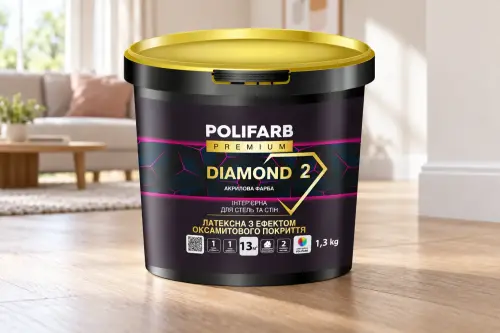
- Painting. SNEJINKA goes on in 2 coats, AKRYLTIKS and DIAMOND 2 in one or two coats, with 2 hours of drying between coats. Stir the paint thoroughly before use.
- Conditions. Substrate and air temperature from +5 to +30 °C, ideally +18 to +25 °C at humidity no higher than 60 %.
Which paint to use
Where | Paint | Consumption per coat | Why |
|---|---|---|---|
Ceiling in a living room or bedroom | 260–300 g/m² on absorbent surfaces, 220–270 g/m² on non-absorbent | deep matt, does not yellow, vapour-permeable | |
Ceiling or walls, if this is your first time | 170–210 g/m² on absorbent surfaces, 110–150 g/m² on non-absorbent | does not drip from the roller or spatter, wet scrub resistance class 2 | |
Kitchen, hallway, children’s room | 150–190 g/m² on absorbent surfaces, 100–150 g/m² on non-absorbent | deep matt, wet scrub resistance class 1 |
SNEJINKA is resistant to dry rubbing, so it suits ceilings that are not washed. Walls painted with AKRYLTIKS or DIAMOND 2 can be washed after 7 days at the earliest. The full ceiling painting method, from tools to patch touch-ups, is in the guide on how to paint a ceiling yourself, and choosing a primer for different substrates is covered in how to prime walls before painting.
What to use
A scraper, sponge and bucket to remove the whitewash, finishing putty for repairs, PROFI GRUNT or GRUNT EKO in one coat, then SNEJINKA on the ceiling or DIAMOND 2 on walls that get washed. Removing whitewash takes time, but skip it and the paint will come off with the whitewash and the job will have to be redone.
FAQ
What if the whitewash is firm and does not chalk?
It still has to come off. The data sheets for SNEJINKA, AKRYLTIKS, DIAMOND 2, PROFI GRUNT and GRUNT EKO require old chalk, lime and glue coatings to be removed and the surface washed with water, with no exception for “firm” whitewash.
Can I bind the whitewash with deep-penetrating primer and paint over it?
No. Primer is meant for a clean mineral substrate. The PROFI GRUNT and GRUNT EKO data sheets say any remaining glue and lime paints must be thoroughly removed before priming.
How do I tell whitewash from old emulsion paint?
Wet a spot with a sponge. Whitewash softens and scrapes off, paint only darkens. Sound old water-based paint is not removed, just washed with water and detergent.
How many coats of primer after removing whitewash?
One. PROFI GRUNT and GRUNT EKO are applied in a single undiluted coat, and you can paint after 2 hours.
Can I use alkyd or oil paint over whitewash?
No. Whitewash is removed before any painting, and for ceilings and walls at home use water-based acrylic or latex paint.