Save to favorites

Add to compare

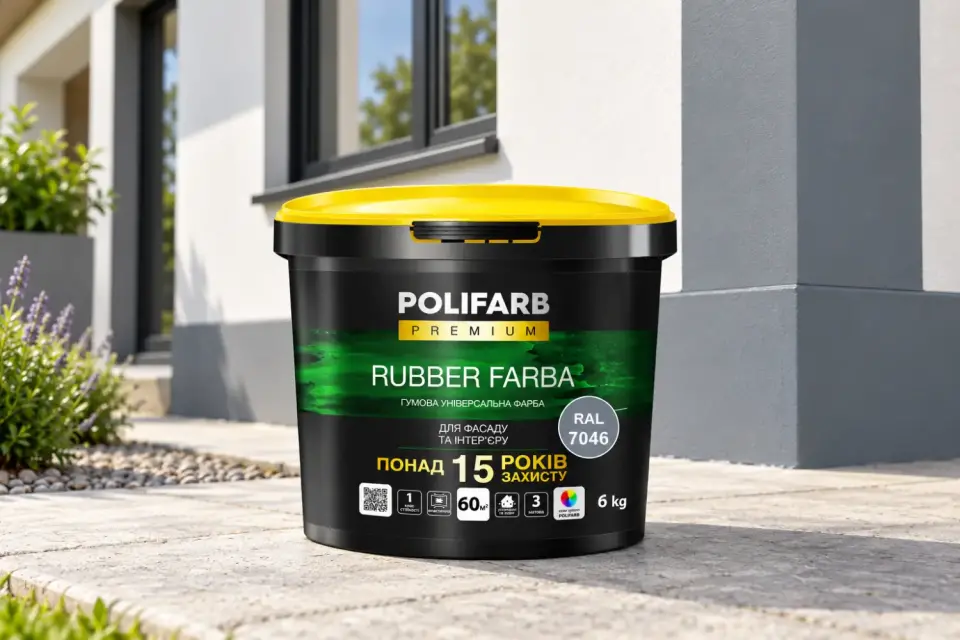
RUBBER FARBA Rubber paint for roofs, slate and plinths, Gray RAL 7046, 6 kg

5.0 (2)

Rubber acrylic paint for roofs, plinths, metal and slate. An elastic film that does not crack A RAL palette and class 1 wash resistance

Specifications

Color:
Gray RAL 7046
Consumption:
100–200 g/m² per coat
Storage term:
18 months
Washability class:
Class 1
Weather resistant:
Понад 15 років
Gloss level:
Matt (3)
Drying time:
up to 2 hours
Tools:
Roller, brush, spray gun
Application area:
Indoor and outdoor use
Number of coats:
2–3
Packaging:
6 kg
Thinner:
Water
Hiding power class:
Class 2
Application temperature:
air +10…+30 °C, substrate from +5 °C

Choose a variant

35 available

POLIFARB Color System Pick a colour and price the tinting of this paint

Consumption calculator

Calculated at the average rate of 150 g/m² per coat (data sheet range 100–200 g/m²). Coats: 3.

Frequently bought together

Often added to this product

+2

Description

RUBBER FARBA is an acrylic rubber paint for exterior and interior work. It goes where ordinary facade paint does not: slate, roof tiles, bitumen sheeting, galvanised steel (over GF-021 primer), aluminium, profiled sheet, bare or primed mild steel, asphalt, asbestos cement, concrete, foam and aerated concrete, brick, render, plywood, chipboard, cement-bonded board, fibreboard, wood, plasterboard and even wallpapered surfaces.

Why "rubber"

Once dry the film stays elastic instead of setting hard the way ordinary acrylic does. A roof and a metal profile expand in summer and contract in winter; a rigid coating cracks at the edges and lifts under that movement, while an elastic one stretches with the substrate. That is why it goes on roofs.

Where it belongs

Roofs, plinths, facades, downpipes and gutters, brick and stone walls, posts and fences, and indoors, bathroom, hallway and kitchen walls. One material covers the house and the yard, from the roof to the fence, in a single shade.

Over old paint

It can go over surfaces previously painted with alkyd and oil paints. That is unusual: most water-dispersion paints will not hold on such a base and the old coating has to come off completely.

What the coating resists

Detergents and disinfectants, water, salts and lubricants, hence class 1 wash resistance. The coating is vapour-permeable and matt at sheen level 3. It dries fast: a coat in up to 2 hours.

RAL colours

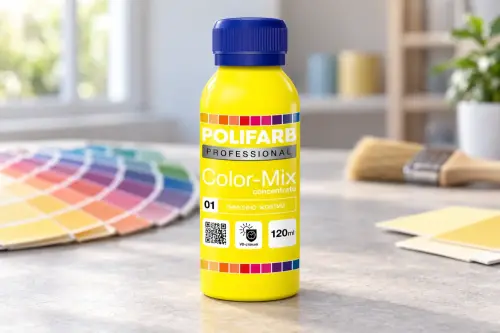
The palette is ready-made, no tinting needed: blue RAL 5005, sea green RAL 6005, red-brown RAL 3009, chocolate brown RAL 8017, grey RAL 7046, graphite RAL 7024, black RAL 9004 and white RAL 9016. A transparent base (TR) is available, tinted with COLOR MIX concentrate pigment pastes. The roof colours are not arbitrary. They are the standard shades of metal tile and profiled sheet, so an existing roof can be touched up without colour matching.

Limitations

Not recommended for floors, thresholds or plastics. Paint at an air temperature of +10 to +30 °C and humidity below 80 %, with the substrate at +5 °C or warmer. Apply 2–3 coats, the second once the first is dry; if needed, thin with clean water by no more than 10 % of the volume. The coating reaches full strength after 28 days. The surface must be clean, dry and degreased, with rust removed from mild steel; gloss and semi-gloss surfaces are sanded matt, and sound old coatings are keyed with fine sandpaper. New mild steel and corrosion-prone areas are primed with DEKOMAL GF-021 or EXTRAMAL GF-021; galvanised steel is degreased and given 1 coat of GF-021 only (ZAHYST 3in1 is not used on zinc, and RUBBER FARBA is not applied directly to zinc either); new wood, very porous substrates and exterior surfaces are first treated with Drevozahyst impregnant. Shelf life is 18 months.


How much you need

The tin states 35 m² for 3.5 kg. That is one coat. The figures below are for three coats at 150 g/m², as used on a roof.

  • 1.2 kg covers about 2.7 m²: a gutter or a post;

  • 3.5 kg covers about 8 m²: a canopy or small shelter;

  • 6 kg covers about 13 m²: an extension roof;

  • 12 kg covers about 27 m²: a roof slope or a plinth around the building.

Application

Preparing the substrate

  • rust is taken back to sound metal;

  • galvanised steel and aluminium are degreased;

  • the substrate is dry, sound and clean: free of dust, efflorescence, grease and flaking coatings;

  • fresh render needs at least 28 days;

  • cracks are opened up and filled with a repair compound;

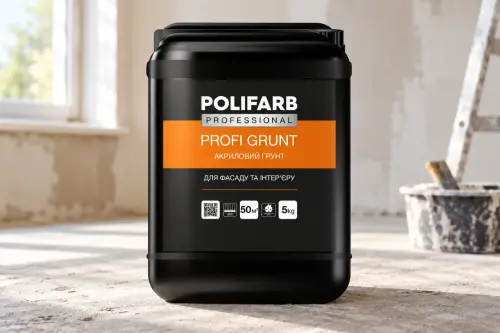
  • absorbent substrates are primed: PROFI GRUNT.

The weather window

  • air, substrate and paint temperature: +5…+30 °C, ideally +10…+25 °C;

  • air humidity 80 % or below;

  • no rain or snow during the work and for 24 hours after;

  • do not paint in direct sun, on a hot wall or in strong wind.

Thinning and tools

  • thinning is usually unnecessary: the paint is ready after stirring;

  • if needed, up to 5–10 % water for the first coat or for spraying;

  • roller, brush for abutments, spray gun for large areas.

Coats and drying

  • 2–3 coats: the third is for roofs and anywhere the coating must be watertight;

  • between coats: 1–2 hours;

  • fully dry: 24 hours;

  • the coating reaches full strength over 7–28 days.

After the job

  • rinse tools with water straight away;

  • store tightly closed at +5…+30 °C, do not freeze.

FAQ: roofs, metal and colour

  • Can it go on slate, bitumen sheeting and metal roof tiles?
    Yes, slate, roof tiles, bitumen corrugated sheeting and profiled sheet are all on the data sheet's substrate list. The surface must be clean, dry and degreased, free of dust, fungus and mould.

  • Can rubber paint go on galvanised steel and aluminium?
    Yes, but galvanised steel only over GF-021 primer. Galvanised steel, aluminium and profiled sheet are on the data sheet's substrate list. Clean, degrease and dry the surface; galvanised steel then gets 1 coat of DEKOMAL GF-021 or EXTRAMAL GF-021 and is painted once the primer is dry. Rubber paint is not applied directly to zinc, and ZAKHYST 3 in 1 is not suitable for galvanised steel.

  • Can it go over enamel or old alkyd paint?
    Yes, it can be applied over surfaces previously painted with alkyd and oil paints. Gloss or semi-gloss enamel is sanded to a matt finish, and a sound old coating is rubbed down with fine sandpaper and degreased.

  • Can rubber paint be used on wood?
    Yes, timber, plywood, chipboard, cement-bonded particle board and hardboard are on the substrate list. New wood and exterior surfaces first get one coat of DREVOZAKHYST impregnant, which protects against beetles, fungus and mould.

  • Can it be used on floors, thresholds or plastic?
    No, the data sheet does not recommend RUBBER FARBA for floors, thresholds or plastics. For a concrete floor there is AKRYLBET, for a wooden one PF-266 enamel.

  • Is it suitable for bathrooms and kitchens?
    Yes, bathroom, kitchen and hallway walls are listed among its uses. The film resists water, detergents and disinfectants, with class 1 wet-scrub resistance.

  • How many coats?
    2–3 coats, the second once the first is dry. A coat dries in up to 2 hours at +23 °C, and the film reaches full strength after 28 days. Paint at air temperatures of +10 to +30 °C and humidity below 80%.

  • Does it need tinting?
    No, eight RAL colours, white included, come ready in the tub. For any other shade there is a transparent base tinted with COLOR MIX concentrate pastes.

  • How much paint for a 60 m² roof?
    Coverage is 100–200 g/m² per coat, so two coats take 12–24 kg and three take 18–36 kg. The exact figure depends on the substrate, application method and colour.

Video
Reviews (2)

Similar products

2 similar products