Selected package
Leftover:
We use necessary cookies for the cart, session, and security. Analytics and marketing cookies are enabled only after your choice. Learn more
Polifarb App
Add the store to your home screen for faster access and an app-like full-screen experience.
It installs in a couple of taps — here is how.
Tap in the Safari toolbar
Choose “Add to Home Screen”
To install the app, open this site in the Safari browser.
Search
Start typing to see suggestions.
Save to favorites
Add to compare
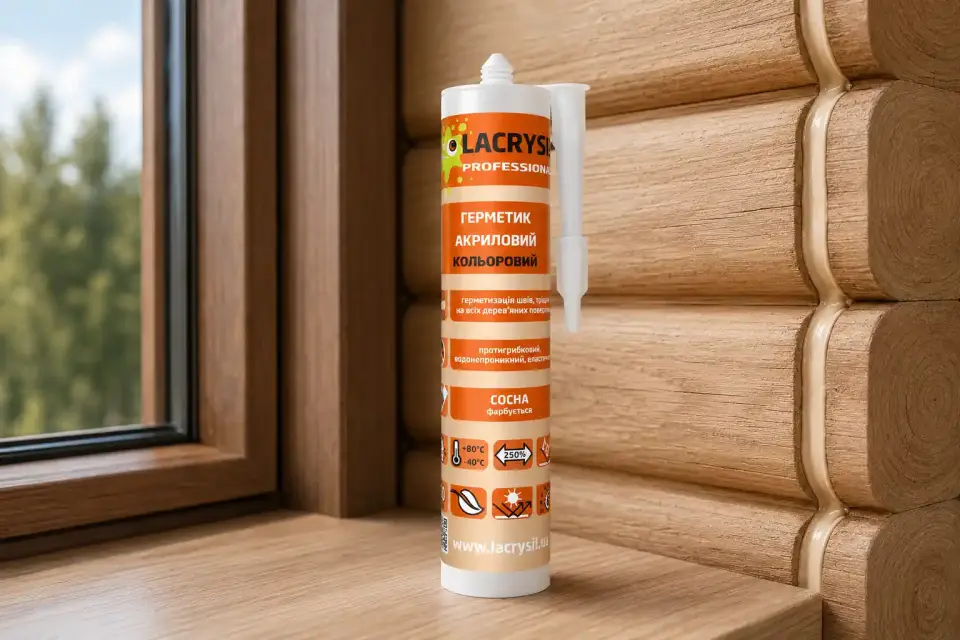
A sealant in wood tones (wenge, walnut, oak and pine) for gaps in parquet, floors and timber joints where a white bead looks like a patch.
4 available
Maximum joint depth: 5 mm
Selected package
Leftover:
Cheaper package combination
pcs
Leftover:
Coloured acrylic sealant is a professional tinted sealant for timber surfaces.
Wenge, walnut, oak and pine. That is the whole point: a white bead in a parquet gap is visible from the doorway, a matched one disappears into the grain.
Filling joints, cracks and gaps in timber and parquet, and joints between timber and rendered, concrete or stone surfaces: shrunken parquet, the gap at the skirting, cracks in wooden stairs, a timber sill against the wall.
Timber breathes: it shrinks in a heated winter and swells in a humid summer. Rigid filler lets go within one cycle; a flexible bead moves with the board.
The bead resists water and UV, so the colour does not bleach in a sunlit patch or darken under wet cleaning. Service to +100 °C covers heated floors.
Match against dry, clean board in daylight, judging by the finished surface rather than the bare cut, since lacquer and oil change the tone. If nothing matches exactly, go slightly darker: a dark line reads as shadow, a pale one as a defect.
Acrylic, applied at +10 to +35 °C, service -40 to +100 °C, 0.4 kg, 18-month shelf life, water clean-up. Strong adhesion to timber, brick, stone, metal, concrete and PVC. Maximum joint depth 5 mm.

A 0.4 kg cartridge gives about 12 m of 4×4 mm bead; parquet gaps are usually narrower, so the run goes further.
Walk the room first and total the gaps that actually need filling: many are under 1 mm and need nothing.
Preparation
Application
After drying
Storage
| Material / Base | Concrete, brick, gypsum, plasterboard | Stone, granite, marble | Mirror, glass | Wood, chipboard, fiberboard, MDF, plywood | Tile, ceramic, porcelain | Primed metal | Plastic, PVC | Polystyrene |
|---|---|---|---|---|---|---|---|---|
| Concrete, brick, gypsum, plasterboard | ||||||||
| Stone, granite, marble | ||||||||
| Mirror, glass | - | |||||||
| Wood, chipboard, MDF, fiberboard, plywood | ||||||||
| Tile, ceramic, porcelain | - | |||||||
| Primed metal | ||||||||
| Plastic, PVC | - | - | - | |||||
| Polystyrene |
Parquet gaps?
Yes. Do it during the heating season, when the timber is at its most shrunk, or summer swelling will push the bead out.
Which shade?
Compare against the finished surface in daylight, not bare wood. When in doubt go darker.
Can it be lacquered?
Test compatibility on a sample first.
Versus wood filler?
Flexibility. Filler sets hard and cracks as the board moves; a sealant moves with it.
Heated floors?
Yes, +100 °C covers it.
4 similar products