Selected package
Leftover:
We use necessary cookies for the cart, session, and security. Analytics and marketing cookies are enabled only after your choice. Learn more
Polifarb App
Add the store to your home screen for faster access and an app-like full-screen experience.
It installs in a couple of taps — here is how.
Tap in the Safari toolbar
Choose “Add to Home Screen”
To install the app, open this site in the Safari browser.
Search
Start typing to see suggestions.
Save to favorites
Add to compare
Matt acrylic paint that does not run off the roller or spatter. Class 2 wet-scrub resistance to DSTU EN 13300 Hides small substrate imperfections
7 available
POLIFARB Color System
Pick a colour and price the tinting of this paint
Calculated at the average rate of 130 g/m² per coat (data sheet range 110–150 g/m²). Coats: 2.
Selected package
Leftover:
Cheaper package combination
pcs
Leftover:
Frequently bought together
+3
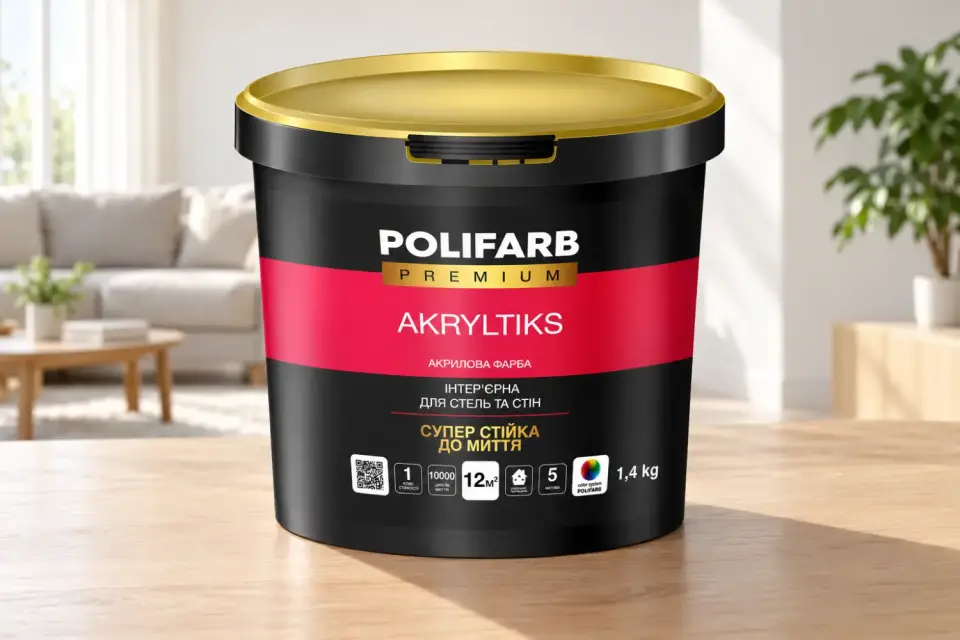
AKRYLTIKS is a water-dispersion acrylic paint for interior walls and ceilings. It goes over any mineral substrate (plaster, filler, brick, concrete) as well as gypsum and wooden surfaces, paper and fibreglass paintable wallpaper, and primed metal.
A thixotropic paint is thick in the tub and thins under the roller, then thickens again the moment the movement stops. So it does not run off the tool, does not spatter and leaves no sags on a vertical surface. This shows most on a ceiling: you work without a puddle on the floor or drips on your face, and the join between passes comes out even for a first-time painter.
Class 2 wet-scrub resistance to DSTU EN 13300: 5–20 µm loss over 200 scrub cycles. The coating withstands repeated washing; wait at least 7 days after application before washing it.
Sheen level 5 gives a matt, glare-free surface. Combined with high filling, that produces the effect this paint is usually bought for: it hides hairline cracks and small plaster defects that a satin or silk coating would show up in raking light.
The coating is vapour-permeable: moisture leaves the substrate instead of building up under the film. That matters on mineral plasters.
Living rooms, offices, medical, pre-school and educational premises, food-industry and industrial buildings: anywhere the surface gets washed and an even matt finish is wanted. Hiding power is class 1 to DSTU EN 13300: one or two coats with 2 hours between them. Consumption per coat is 110–150 g/m² on non-absorbent substrates and 170–210 g/m² on absorbent ones.
Interior use only, not for facades. Do not use in areas of direct water contact: the shower zone and the wall right against the bath. Fresh plaster can be painted after 3–4 weeks, concrete after a month; prime with GRUNT EKO, PROFI GRUNT or GRUNT CONCENTRATE 1:4. Substrate preparation is covered in the Application block below.
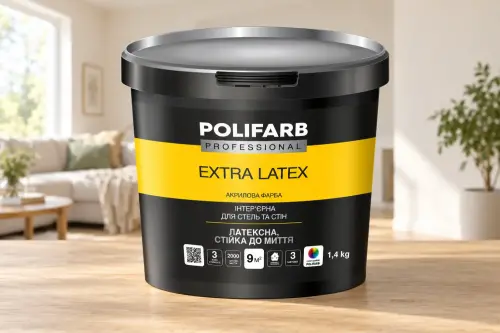
Four tubs: 1.4 / 4.2 / 7 / 14 kg. The smallest suits a colour test or touch-ups, the largest covers a whole flat. The base colour is white, with a transparent base (TR) as well; tinted in POLIFARB Color System and with COLOR MIX pastes.

How much you need
The tin states 12.7 / 38 / 63 / 127 m²: one coat at the minimum 110 g/m². The figures below are for two coats at 130 g/m².
1.4 kg covers about 5.4 m²: a colour test, a niche, touch-ups;
4.2 kg covers about 16 m²: one room ceiling;
7 kg covers about 27 m²: a small room;
14 kg covers about 54 m²: a 16–18 m² room with 2.7 m walls, start to finish.
Application
Preparing the substrate
the substrate is dry, clean and sound: free of dust, grease and flaking coatings;
old chalk, whitewash and glue-bound paints are removed completely;
fresh plaster needs at least 28 days;
plasterboard joints are filled;
absorbent and chalky substrates are primed: PROFI GRUNT.
Thinning
usually unnecessary: the paint is ready after stirring;
if needed, up to 5–10 % water for the first coat or for spraying;
stir with a drill and paddle at low revs.
Application conditions
air, substrate and paint temperature: +5…+30 °C;
humidity 80 % or below;
do not apply in sun, on hot surfaces, in wind or draughts.
Tools
a roller is the main tool: the paint lays down well with one;
a brush for corners and abutments;
a spray gun for large areas.
Coats and drying
1–2 coats; two give an even tone over a coloured or contrasting substrate;
a coat dries in up to 2 hours, with 1–2 hours between coats;
fully dry: 24 hours;
full wash resistance builds over 7–28 days: leave the wall unwashed for the first month.
After the job
rinse tools with water straight away;
store tightly closed at +5…+30 °C, do not freeze.
FAQ: application, cleaning and substrate
Is it good for ceilings?
Yes, it is recommended for walls and ceilings. It is thixotropic, does not sag and does not spatter while you paint.
Will it hide cracks in the wall?
It hides hairline cracks. Cracks and uneven spots are filled with finishing filler before painting.
How much paint for an 18 m² room?
Walls 2.7 m high come to about 48 m². Two coats take 10.6–14.4 kg on a non-absorbent surface and 16.3–20.2 kg on an absorbent one: a 14 kg tub, plus 7 kg for absorbent walls.
Can it be used in a kindergarten or hospital?
Yes, it is intended for medical, pre-school and educational buildings among others.
When can the wall be washed for the first time?
No sooner than 7 days after painting. Wash resistance is class 2.
Can wallpaper be painted?
Yes, if it is paper-backed or glass-fibre wallpaper. The data sheet does not name vinyl or non-woven wallpaper, so paint only those the wallpaper maker marks as paintable. Liquid wallpaper is not on the substrate list.
2 similar products