Save to favorites

Add to compare

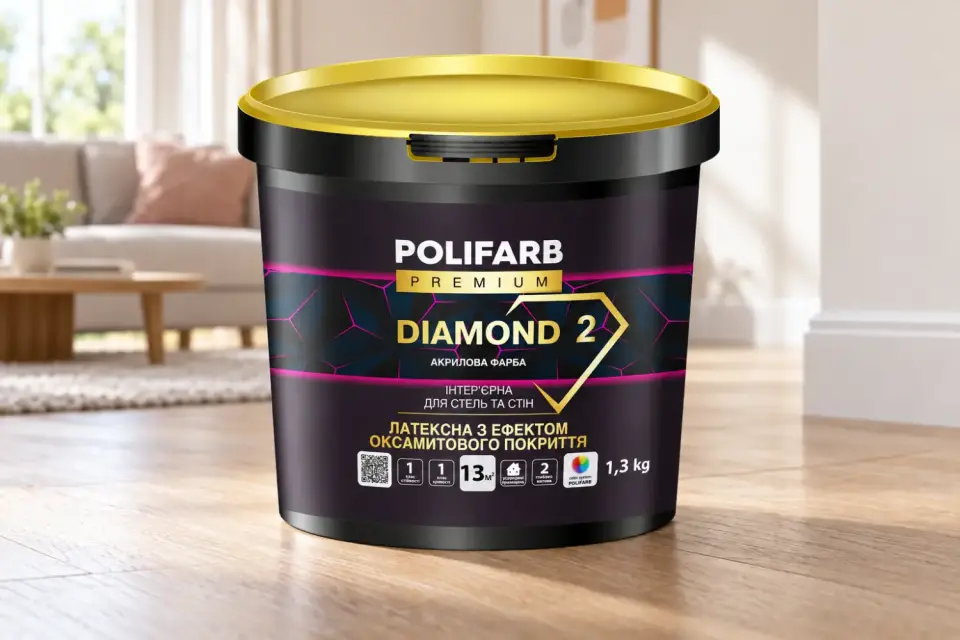
DIAMOND 2 Acrylic latex paint, White, 1.3 kg

5.0 (2)

Acrylic latex paint for interior walls and ceilings. A deep matt finish and the highest resistance to wet cleaning For hallways, kitchens, children’s rooms and offices Wherever a wall gets washed regularly

Specifications

Color:
White
Consumption:
100–150 g/m² per coat (non-absorbent), 150–190 g/m² (absorbent)
Storage term:
24 months
Washability class:
Class 1
Gloss level:
Deep matt (2)
Drying time:
up to 2 hours
Tools:
Roller, brush, spray gun
Application area:
Indoor use
Number of coats:
1–2
Packaging:
1.3 kg
Thinner:
Water
Hiding power class:
Class 1
Application temperature:
+5…+30 °C

Choose a variant

4 available

POLIFARB Color System Pick a colour and price the tinting of this paint

Consumption calculator

Calculated at the average rate of 125 g/m² per coat (data sheet range 100–150 g/m²). Coats: 2.

Frequently bought together

Often added to this product

+3

Selected variant White · 1.3 kg

399.60 ₴

Description

POLIFARB DIAMOND 2 is a water-dispersion acrylic latex paint for finish coating of interior walls and ceilings. It is applied over cement and cement-lime plasters, plasterboard, paper and fibreglass wallpaper, wood, porous materials and pre-primed metal.

Where it fits

This is a paint for surfaces that have to be cleaned: hallways, kitchens, children’s rooms, classrooms, offices, hotel rooms, retail floors. The catalogue also lists bathrooms, apart from places water reaches directly. Class 1 is the highest on the five-point wet-scrub scale: the colour does not rub off where a wall is wiped weekly for years. That margin is why the paint goes into children’s rooms and schools, where walls are cleaned far more often than at home. For a bedroom or a ceiling nobody ever cleans it is wasted: a lower class will do.

How many coats and why

Hiding power class 1 means the substrate is covered with no show-through at the stated consumption. Two coats are still applied: the first evens out the absorbency of the substrate, the second gives a uniform tone. A single coat is only enough when repainting in a close shade. Allow 2 hours between coats. Consumption per coat: 100–150 g/m² on non-absorbent substrates and 150–190 g/m² on absorbent ones.

A deep matt surface does not reflect light and visually hides small plaster imperfections, which is why it is chosen for large uninterrupted walls under raking light, where a satin finish would pick out every ripple. The POLIFARB catalogue calls this a velvet effect: the matt here is deeper than that of an ordinary interior paint. If you do want visible sheen, the range also holds DIAMOND 7 with a satin effect and DIAMOND 15 with a silk one.

Colour and tinting

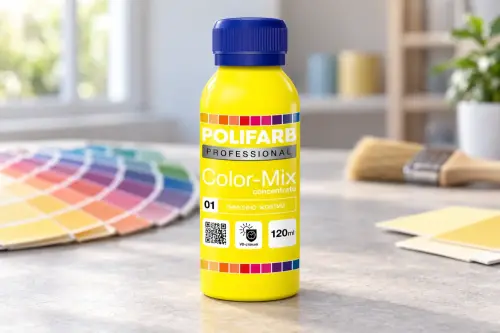
Bases: white and transparent. Shades are mixed in the POLIFARB Color System and COLOR MIX systems, so the choice is not limited to ready-made tins. Tint the whole quantity you need in one go, from one production batch: matching the same shade later without a visible difference is not realistic.

Limitations

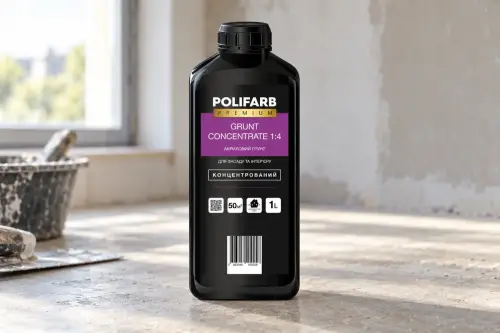
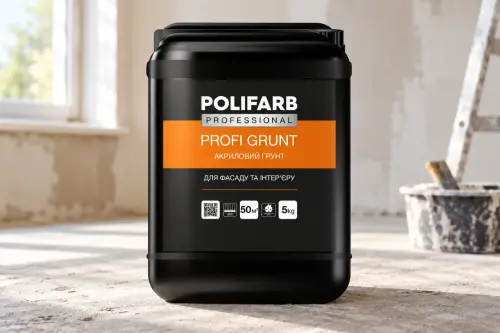
Interior use only, not for facades. Bathrooms are fine, but not the places water reaches directly: the shower tray and the wall right against the bath. Fresh plaster can be painted after 3–4 weeks, concrete after a month; prime the prepared substrate with GRUNT EKO, PROFI GRUNT or GRUNT CONCENTRATE 1:4. Apply at +5 to +30 °C. The coating can be washed no earlier than 7 days after application. Contains CMIT/MIT: may cause an allergic skin reaction (H317). Substrate requirements and preparation are set out below, in the Application block.


How much you need

The tin states 13, 38 and 125 m². That is one coat at the minimum 100 g/m². The figures below are for two coats at 125 g/m².

Area × 125 g/m² × 2 coats = 250 g/m². Add 10–15 % on unprimed porous plaster.

  • 1.3 kg covers about 5.2 m²: touch-ups, a niche, a colour test;

  • 3.8 kg covers about 15 m²: one room ceiling or a single wall;

  • 12.5 kg covers about 50 m²: a 16–18 m² room with 2.7 m walls, start to finish.

Application

Preparing the substrate

  • the substrate is dry, sound and clean: free of dust, grease, chalk and flaking coatings;

  • old chalk whitewash and glue-bound paints are removed completely;

  • fresh plaster or filler needs at least 28 days to dry and carbonate;

  • glossy or soiled surfaces are degreased and lightly sanded to a matt key;

  • porous and highly absorbent substrates are primed: GRUNT KONCENTRATE 1:4, diluted 1:4 with water.

Thinning

  • first coat: thin with clean water by up to 5–10 %;

  • further coats: up to 5 %, or apply unthinned;

  • stir with a drill and paddle at low revs.

Application conditions

  • air, substrate and paint temperature: +10…+30 °C;

  • relative humidity: 80 % or below;

  • do not apply in direct sun, on hot surfaces, in strong wind or draughts.

Tools

  • roller with 8–12 mm nap for smooth substrates, 12–18 mm for textured;

  • brush with synthetic bristles;

  • spray gun: 150–200 bar, nozzle 0.015–0.019".

Coats and drying

  • normally 2 coats; 3 over very porous or high-contrast substrates;

  • tack-free: 1–2 hours;

  • between coats: 2–4 hours;

  • fully dry: 24 hours;

  • full resistance to wet cleaning builds over 7–28 days: leave the wall unwashed for the first month.

After the job

  • rinse tools with water straight away, before the paint dries;

  • store tightly closed at +5…+30 °C, do not freeze.

Drying times are given for +20 °C and 50–65 % humidity.

FAQ: consumption, cleaning and substrates

  • How much paint for an 18 m² room?
    Walls 2.7 m high come to about 48 m². Two coats take 9.6–14.4 kg on a painted, non-absorbent surface and 14.4–18.2 kg on an absorbent one: a 12.5 kg tub, plus a 3.8 kg tin for absorbent walls.

  • Can the painted wall be washed?
    Yes, class 1 is the top wet-scrub rating. Wait at least 7 days after painting before the first wash.

  • Is it suitable for a bathroom?
    Yes, except where water hits directly: the shower tray and the wall right against the bath.

  • Can it go over old paint?
    Yes. A sound old coating only needs washing with water and detergent. Glue-bound and chalk coatings are removed and the surface washed with water.

  • Is a primer needed?
    Yes, the data sheet calls for priming the prepared surface with GRUNT EKO, PROFI GRUNT or GRUNT CONCENTRATE 1:4.

  • Can wallpaper be painted?
    Yes, if it is paper-backed or glass-fibre wallpaper. The data sheet does not name vinyl or non-woven wallpaper, so paint only those the wallpaper maker marks as paintable. Liquid wallpaper is not on the substrate list.

Video
Reviews (2)

Similar products

3 similar products