Selected package
Leftover:
We use necessary cookies for the cart, session, and security. Analytics and marketing cookies are enabled only after your choice. Learn more
Polifarb App
Add the store to your home screen for faster access and an app-like full-screen experience.
It installs in a couple of taps — here is how.
Tap in the Safari toolbar
Choose “Add to Home Screen”
To install the app, open this site in the Safari browser.
Search
Start typing to see suggestions.
Save to favorites
Add to compare
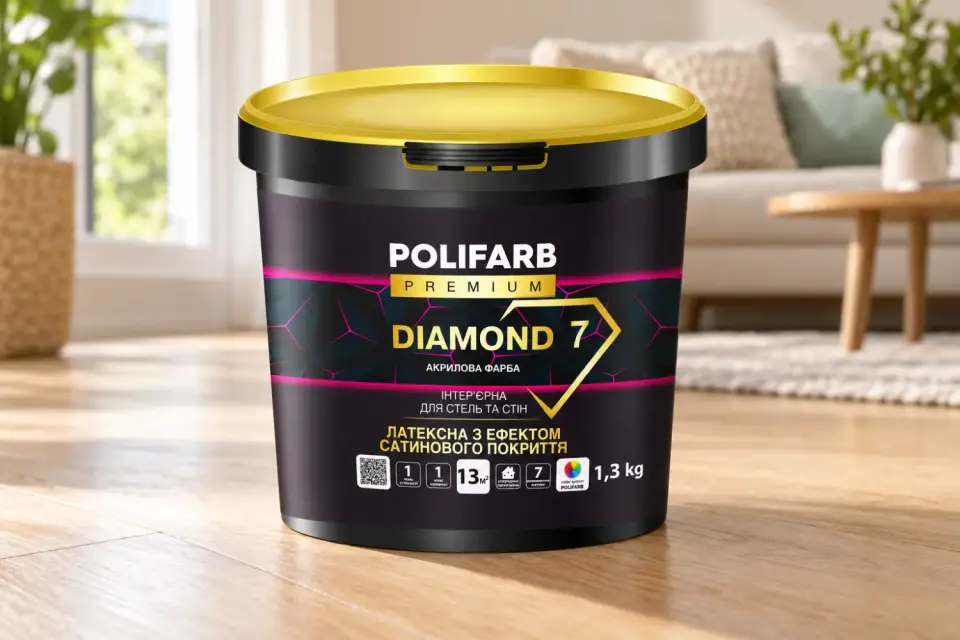
Acrylic latex paint with a satin finish for walls and ceilings. A light sheen that does not pick out imperfections, and a film marks come off faster than on matt.
3 available
POLIFARB Color System
Pick a colour and price the tinting of this paint
Calculated at the average rate of 125 g/m² per coat (data sheet range 100–150 g/m²). Coats: 2.
Selected package
Leftover:
Cheaper package combination
pcs
Leftover:
Frequently bought together
+3
POLIFARB DIAMOND 7 is an acrylic latex paint with a satin finish for interior walls and ceilings. The substrates are the same as for the rest of the range: cement and cement-lime plasters, plasterboard, paper and fibreglass wallpaper, wood, textured and porous surfaces, and metal primed with an anti-corrosion primer.
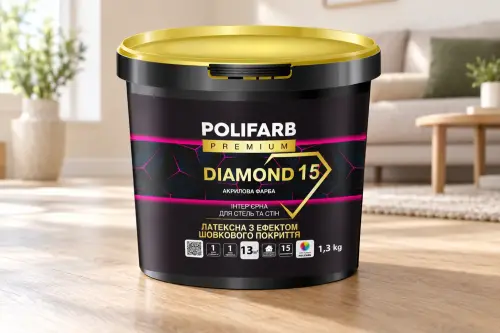
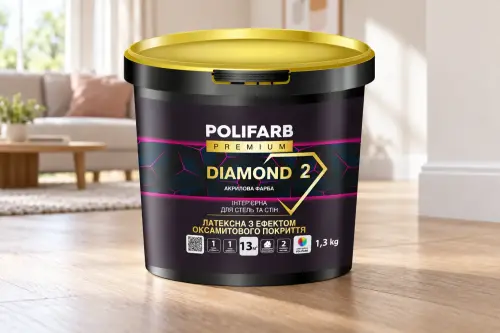
The seven in the name is the sheen level. A satin film is denser than a matt one: dirt grips the surface less, and a fingerprint or marker stain comes off on the first pass rather than the third. The trade-off is a light reflection under direct light. On walls where plaster imperfections show, DIAMOND 2 with its deep matt is the wiser pick; if you want a pronounced sheen and the substrate is flat, take DIAMOND 15.
Satin is the working choice for kitchens, hallways, children’s rooms, bathrooms outside the splash zone, classrooms or hotel rooms: anywhere the wall is wiped regularly. Wet-scrub resistance is class 1, the highest of five: the coating takes repeated washing without losing colour. The manufacturer recommends it for high-traffic rooms, children’s rooms and schools. The painted surface can be washed no earlier than 7 days after application.
The manufacturer allows 1–2 coats with 2 hours’ drying between them; consumption per coat is 100–150 g/m² on non-absorbent substrates and 150–190 g/m² on absorbent ones. A single coat only makes sense when repainting in a close shade over a flat substrate; otherwise apply two: the first evens out the substrate’s absorbency, the second levels the tone and the sheen. A satin surface is less forgiving of technique than matt: blend the joins while the coat is still wet, or the lap mark will show in raking light.
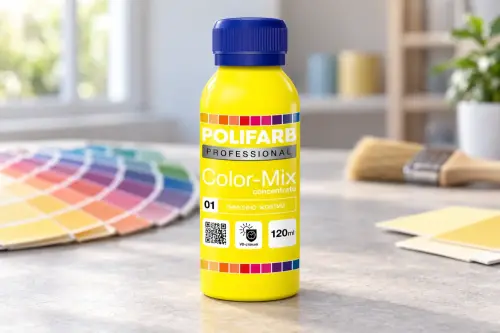
The paint is white, and a transparent base (TR) is also available. Shades are mixed in POLIFARB Color System or with COLOR MIX pigment pastes. Work out the volume you need with a margin and tint it all in one go: hitting the same shade twice is hard, and on satin the difference shows more than on matt.
Interior use only. Bathrooms are fine, but not where water hits the wall directly: the shower zone and the wall right against the bath. Fresh plaster can be painted only after 3–4 weeks, concrete after a month. Apply at +5 to +30 °C, ideally +18…+25 °C with humidity no higher than 60%. The other substrate requirements are in the Application block below.

How much you need
The tin states 13, 38 and 125 m². That is one coat at the minimum 100 g/m². The figures below are for two coats at 125 g/m².
Area × 125 g/m² × 2 coats = 250 g/m². Add 10–15 % over an unprimed porous substrate.
1.3 kg covers about 5.2 m²: a splashback wall, a niche, a colour test;
3.8 kg covers about 15 m²: a hallway or one kitchen wall with a window;
12.5 kg covers about 50 m²: a 16–18 m² kitchen-living room with 2.7 m walls.
Application
Preparing the substrate
the substrate is dry, sound and clean: free of dust, grease, chalk and flaking coatings;
old chalk whitewash and glue-bound paints are removed completely;
fresh plaster or filler needs at least 28 days to dry and carbonate;
glossy or soiled surfaces are degreased and lightly sanded to a matt key;
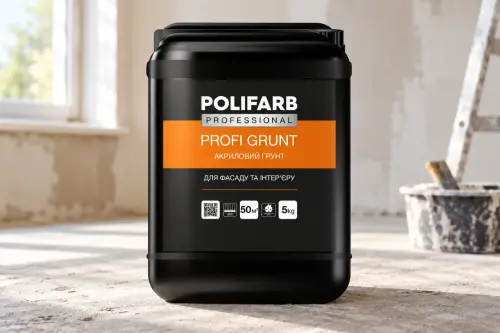
porous and highly absorbent substrates are primed: PROFI GRUNT.
Thinning
first coat: thin with clean water by up to 5–10 %;
further coats: up to 5 %, or apply unthinned;
stir with a drill and paddle at low revs.
Application conditions
air, substrate and paint temperature: +10…+30 °C;
relative humidity: 80 % or below;
do not apply in direct sun, on hot surfaces, in strong wind or draughts.
Tools
roller with 8–12 mm nap for smooth substrates, 12–18 mm for textured;
brush with synthetic bristles;
spray gun: 150–200 bar, nozzle 0.015–0.019".
Coats and drying
2 coats; 3 over strongly contrasting or porous substrates;
tack-free: 1–2 hours;
between coats: 2–4 hours;
fully dry: 24 hours;
full resistance to wet cleaning builds over 7–28 days: leave the wall unwashed for the first month.
After the job
rinse tools with water straight away, before the paint dries;
store tightly closed at +5…+30 °C, do not freeze.
Drying times are given for +20 °C and 50–65 % humidity.
FAQ: satin, cleaning and choosing within the range
How does DIAMOND 7 differ from DIAMOND 2?
Only in sheen: 7 is satin, 2 is deep matt. Consumption, wash class, hiding power and drying time are identical.
Will wall imperfections show?
Less than on DIAMOND 15 and more than on matt. If the plaster is wavy, choose matt.
How much paint for a 10 m² kitchen?
Walls 2.7 m high less the window and door come to about 28 m², two coats need ~7 kg: two 3.8 kg tubs, or one 12.5 kg with a margin.
Can it go on a ceiling?
It can, but on a ceiling the satin sheen picks out trowel ridges. Matt is the usual ceiling choice.
How should the painted surface be cleaned?
A damp cloth with a mild detergent. No abrasive powders or solvents.
4 similar products