Save to favorites

Add to compare

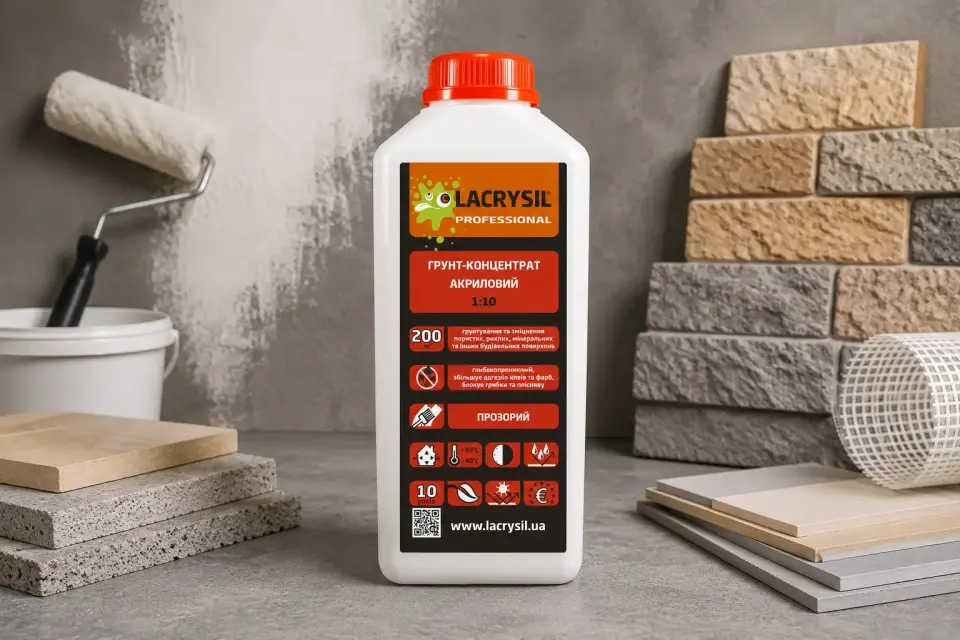
Primer concentrate 1:10, White, 2 l

5.0 (1)

A 1:10 concentrate. A 5 l can makes up to 55 l of primer Four dilutions for different jobs From treating timber to gauging mortar

Specifications

Color:
White
Storage term:
18 months
Water resistance:
Packaging:
2 l
Base:
Acrylic
Application temperature:
+5°C ... +35°C

Choose a variant

3 available

Consumption calculator

Selected variant White · 2 l

491.04 ₴

Description

Acrylic primer concentrate 1:10 is a penetrating, consolidating acrylic primer.

Why a concentrate

A litre diluted 1:10 becomes eleven litres of working primer, so a 5 l can makes up to 55 l, enough for a house, carried and stored as one container instead of ten.

Four dilutions, not one

The maker specifies a different ratio for each job:

  • Neat: treating timber; 1 l per 50 kg of cement when gauging sand-cement mortar to improve its performance.
  • 1:6, friable, loose and highly absorbent mineral surfaces, applied in two coats.
  • 1:10, the standard dilution before adhesives, fillers and water-dispersion paints.
  • 1:15, for gauging cement mortar or a dry building mix.

Blocks efflorescence

A stated property: it blocks the white salt bloom that comes through finishes on brick and concrete, the kind of fault that only appears after painting.

Evens out absorbency

Unprimed render drinks the first coat unevenly and dries patchy. Priming levels the absorbency and noticeably reduces how much of the next material is needed.

Specs

Acrylic, white, applied at +5 to +35 °C, 1, 2 and 5 l, 18-month shelf life. Also used to consolidate decorative stone. Indoors and out.


How much you need

Work out the volume of working primer you need, then divide by the dilution.

  • 1 l of concentrate at 1:10, 11 l of primer;
  • 2 l: 22 l;
  • 5 l: 55 l.

How much primer: about 0.1–0.15 l/m² per coat on ordinary render.

  • a 3×4 m room with a 2.7 m ceiling, about 50 m², 5–7 l: one litre of concentrate;
  • a 60 m² flat, about 200 m², 20–30 l: two litres;
  • a 150 m² facade, 15–22 l: two litres with margin.

Friable substrates take 1:6 in two coats, roughly doubling the concentrate used.

Application

Choosing the dilution

  • sound render under paint or filler, 1:10;
  • loose, friable, very absorbent substrates, 1:6 in two coats;
  • timber: neat;
  • into cement mortar, 1:15, or 1 l per 50 kg of cement.

Preparation

  • remove limewash, loose material, dust and grease;
  • dilute with clean water in a separate container, not in the can;
  • stir and let it stand a few minutes;
  • substrate and air from +5 °C.

Application

  • roll, brush or spray evenly, without pooling;
  • spread out surplus on non-absorbent areas so no glossy film forms;
  • second coat only when the first is dry;
  • friable substrates always need two.

Afterwards

  • paint or fill once the primer is fully dry;
  • wash tools with water;
  • do not freeze; 18 months;
  • diluted primer does not keep: mix only what you will use.

FAQ: dilution, yield and efflorescence

  • How much primer from a 5 l can?
    Up to 55 l at 1:10.

  • Which dilution?
    1:10 on sound render; 1:6 in two coats if your hand comes away chalky.

  • Can it be used neat?
    Yes. On timber, and into mortar at 1 l per 50 kg of cement.

  • Does it really stop efflorescence?
    Blocking efflorescence is a stated property of this primer.

  • Can diluted primer be stored?
    Not for long. Mix what you will use in a shift.

Video
Reviews (1)

Similar products

2 similar products