Save to favorites

Add to compare

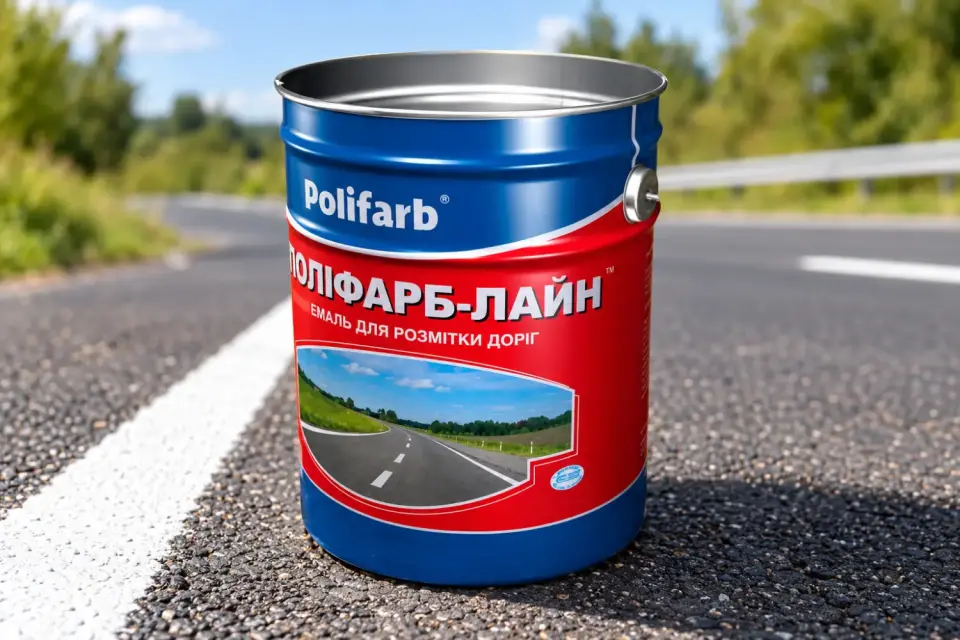
POLIFARB-LINE Acrylic enamel designed for horizontal marking of the roadway, Red, 30 kg

4.5 (4)

Road marking paint that dries in 20–30 minutes, so the lane reopens almost at once. Five colours 30 kg pails

Specifications

Color:
Red
Consumption:
300–500 g/m² per coat
Drying time:
20–30 minutes
Application area:
Outdoor use
Packaging:
30 kg
Thinner:
Органічний
Application temperature:
+15 °C і вище

Choose a variant

5 available

Consumption calculator

Calculated at the average rate of 400 g/m² per coat (data sheet range 300–500 g/m²).

Description

POLIFARB LINE is an acrylic enamel for horizontal road marking on asphalt, concrete and other road surfaces.

20–30 minutes means reopening the lane

The headline figure is measured in downtime, not in film quality. A line that dries in half an hour lets the section reopen in the same shift, and on a highway or a shopping centre every hour of closure costs money.

What it withstands

Heavy traffic, tyre abrasion and chemicals (salts and oils) plus UV, moisture and mechanical load, so it neither bleaches nor wears away in its first season.

Visibility at night

High reflectivity is the core function of marking, not a bonus: the line has to read in headlights through rain and fog, when the surface is wet and mirror-like.

Five colours

White, yellow, red, blue and black. White and yellow are the standard road colours; red and blue mark zones in car parks, warehouses and yards; black is for blanking out old marking rather than adding to it.

Where it is used

Roads and highways (lines, crossings, arrows; car parks) bays and zones; warehouses and industrial areas (walkways and loading zones; sports grounds) courts and pitches.

Conditions

Apply at +15 °C and above: a narrower window than most materials here. 300–500 g/m² per coat, one or two coats, organic thinner. Spray, roller or marking machine. 30 kg pails.


How much you need

300–500 g/m² per coat; budget 400 g/m². Marking is counted in running metres, not area.

  • a 10 cm line: 0.1 m² per metre, about 40 g/m;
  • a 15 cm line: about 60 g/m;
  • a 30 kg pail: about 75 m², or 750 m of 10 cm line.

Examples:

  • a 50-bay car park at 2.5×5 m, about 400 m of line: 16 kg;
  • a 4 m crossing with eight 50 cm bars, about 16 m²: 6.5 kg;
  • a centre line over 1 km: 40 kg.

Rough asphalt takes more. Smooth new surfaces sit near 300 g/m², old porous asphalt at 500 g/m² and above. New asphalt should cure 28 days before marking.

Application

Preparation

  • a dry, clean surface: sweep and blow off dust and grit;
  • degrease oil stains;
  • remove failing old marking by milling or shot blasting;
  • let new asphalt cure 28 days.

Setting out

  • set the axes and strike the lines with string or laser;
  • mask the edges for hand application;
  • stir, and thin for the chosen method if needed.

Application

  • spray, roll or use a marking machine;
  • one or two coats: white on dark asphalt almost always needs two;
  • second coat after 20–30 minutes;
  • pull the masking immediately, not after drying.

Conditions and reopening

  • +15 °C and above, in dry weather;
  • never before rain;
  • reopen once the film is fully dry;
  • clean tools with organic thinner at once.

FAQ: reopening, coverage and new asphalt

  • When can traffic return?
    Once the film is dry: 20–30 minutes.

  • How much for a car park?
    Fifty 2.5×5 m bays is about 400 m of 10 cm line: 16 kg.

  • On new asphalt?
    Not for 28 days: fresh asphalt releases oils and marking will not hold.

  • Why black?
    To blank out obsolete marking, which is cheaper than milling the surface.

  • Why not at +10 °C?
    Its rated minimum is +15 °C; below that the film will not form and the line goes with the first traffic.

Video
Reviews (4)