










Аркадій
Держиться як влитий! Минуло 2 тижні, дощ був, сніг трохи, машини по 20 раз на день — ні лусочки не відлетіло. Білий з шариками — світиться вночі під фарами, як у казці, видно за кілометр.
We use necessary cookies for the cart, session, and security. Analytics cookies help us improve the site and can be turned off. Marketing cookies are enabled only with your consent. Learn more
Polifarb App
Install Polifarb on your device?
Add the store to your home screen for faster access and an app-like full-screen experience.
It installs in a couple of taps — here is how.
Tap in the Safari toolbar
Choose “Add to Home Screen”
To install the app, open this site in the Safari browser.
Catalog
Popular categories
Search
Start typing to see suggestions.
Save to favorites
Compare
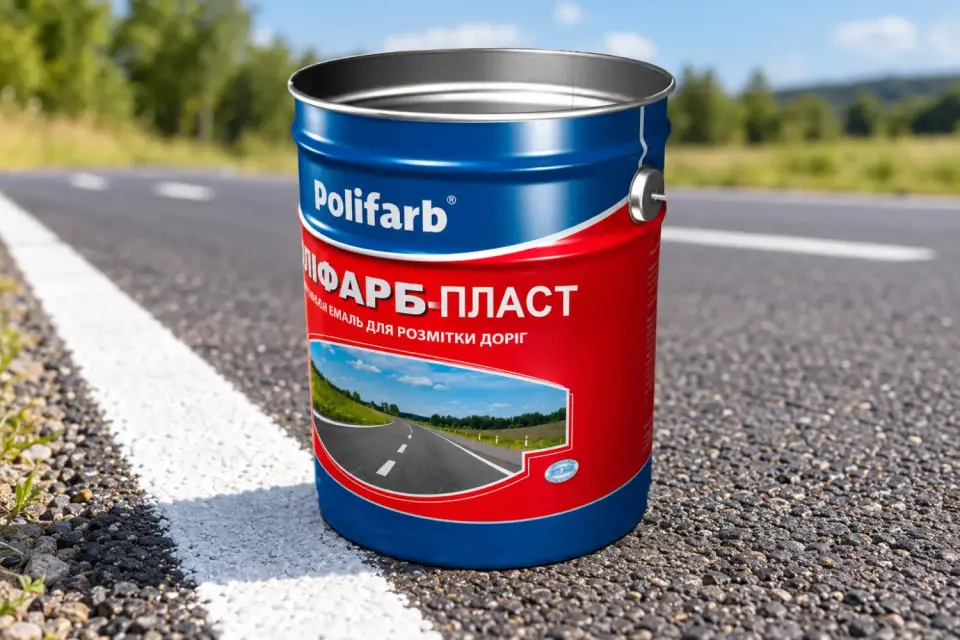
Cold plastic with glass microspheres. A 2–4 kg/m² layer instead of paint, retroreflective and anti-slip Open to traffic in 30–40 minutes
POLIFARB PLAST is a cold plastic for horizontal road marking on asphalt and concrete surfaces.
The difference from marking enamel is thickness. Paint goes on as a film at 300–500 g/m²; cold plastic goes on as a layer at 2–4 kg/m², five to ten times as much. That thickness is what gives it service life: where paint is renewed every season, plastic lasts years.
The retroreflective spheres are through the mass, not sprinkled on top, so fresh ones are exposed as the layer wears: the line keeps reflecting long after the surface has been worn.
Additives keep the surface non-slip. On a thick layer that matters: a smooth 50 cm polymer bar across a wet road is exactly where a motorcycle brakes or a bicycle loses its line.
Despite the thickness, the section reopens 30–40 minutes after application. That combination of durability and short closure is what decides in favour of plastic.
Heavily trafficked roads (centre and edge lines, crossings, arrows; airfields) runway marking; car parks and industrial sites; urban streets: cycle lanes and bus stops. Resistant to abrasion, UV, salts and chemicals.
No thinner: applied as supplied, by hand or with dedicated equipment, at +5 to +35 °C on a dry surface, a wider window than the +15 °C of POLIFARB LINE. A primer may be used for better adhesion. 18 kg, white.
2–4 kg/m² depending on thickness; budget 3 kg/m². An 18 kg pail covers about 6 m².
Examples:
Why it uses eight times more than paint. POLIFARB LINE goes on at 300–500 g/m², this at 2–4 kg/m², but paint is renewed each season and plastic lasts years. Cost per metre over the service life is the figure that matters.
Preparation
Setting out
Application
Reopening
Plastic or POLIFARB LINE paint?
Paint is cheaper and uses eight times less, but needs renewing more often. Plastic goes on at 2–4 kg/m² and lasts years: crossings and highway centre lines take plastic, warehouse marking takes paint.
Does it really reflect at night?
Yes. The microspheres run through the mass, so reflection survives wear.
How much for a crossing?
A 4 m crossing of eight 50 cm bars is 16 m²: about 48 kg.
Is it slippery in rain?
No. Anti-slip additives are built in precisely because the layer is thick.
Is a primer needed?
Not essential, but it improves adhesion on old porous asphalt.
Аркадій
Держиться як влитий! Минуло 2 тижні, дощ був, сніг трохи, машини по 20 раз на день — ні лусочки не відлетіло. Білий з шариками — світиться вночі під фарами, як у казці, видно за кілометр.
Света
Девочки, мальчики, я вчера решилась и сама покрасить разметку на нашей детской площадке во дворе этой LINE белой 😅 Никогда в жизни валик в руках не держала, только видела, как мужики на улице красят. Но дети уже по старым линиям не понимают, где качели, где песочница, а где просто асфальт — сплошной хаос. Купила ведро в Эпицентре (тяжёлое, блин, еле дотащила до машины), взяла ещё валик, кисть, лоток и перчатки. Размешивала эту краску, — она густая такая, как йогурт греческий, не льётся сразу. Сначала думала, что всё размажу криво, но когда начала — ничего страшного, валик сам едет, линии получаются ровненькие, если не торопиться. Делали с подругой в два слоя — первый впитался, второй уже белый-белый стал. Сохнет супер быстро — нанесли после обеда, через час уже не липнет, а к вечеру дети уже бегали и ничего не испачкали. Запах был, конечно, но на улице быстро улетучился, даже не сильно голову кружило. Теперь площадка выглядит как новая! Белые линии чёткие, видно, где что, и даже ночью под фонарём светится. Я прям горжусь собой, что без мужиков справилась 😂 Ведро тяжеленное, одной не поднять нормально. Краска густая, если не размешать хорошо Руки потом оттирала ацетоном полчаса, перчатки порвались быстро.
Ruslan
За свои деньги — нормальная краска, не какая-то китайская дрянь, что через месяц смоется. Лучше, чем ждать, пока кто-то из ЖЭКа соизволит. Я ещё жёлтую возьму, для бордюров, а то совсем серо стало.
Степан
Загалом, якщо робити "на совість" і не на один сезон — беріть сміливо, краще акрилу в рази.