











Save to favorites
Add to compare
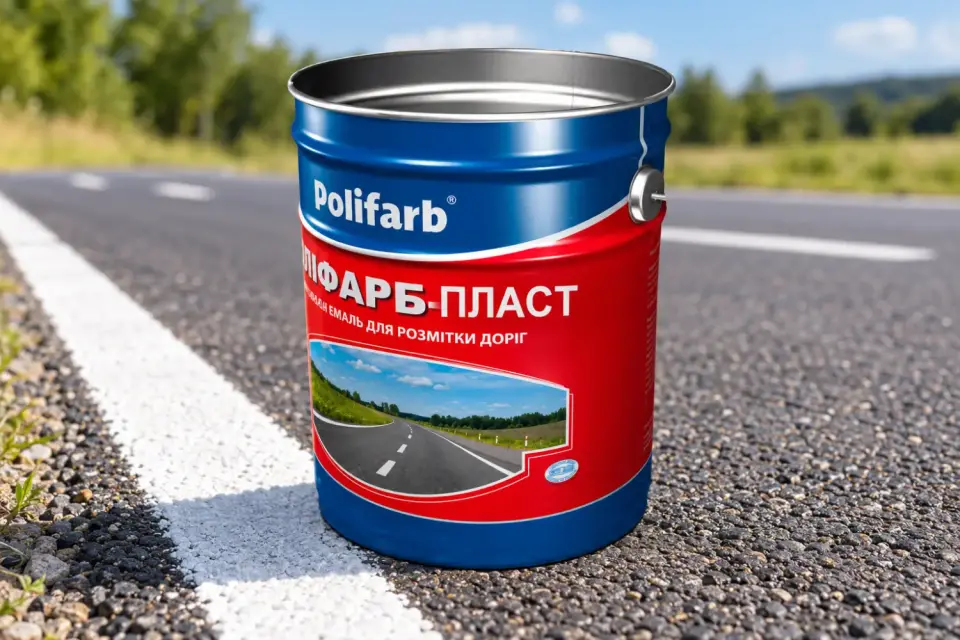
POLIFARB-PLAST Material intended for applying thick-layer horizontal marking in road, White, 18 kg
Cold plastic with glass microspheres. A 2–4 kg/m² layer instead of paint, retroreflective and anti-slip Open to traffic in 30–40 minutes
Specifications
- Color:
- White
- Consumption:
- 2–4 kg/m²
- Packaging:
- 18 kg
- Thinner:
- Не потрібен
- Application temperature:
- From +5 to +35 °C
Choose a variant
1 available
POLIFARB PLAST is a cold plastic for horizontal road marking on asphalt and concrete surfaces.
Not a paint but a layer
The difference from marking enamel is thickness. Paint goes on as a film at 300–500 g/m²; cold plastic goes on as a layer at 2–4 kg/m², five to ten times as much. That thickness is what gives it service life: where paint is renewed every season, plastic lasts years.
Glass microspheres
The retroreflective spheres are through the mass, not sprinkled on top, so fresh ones are exposed as the layer wears: the line keeps reflecting long after the surface has been worn.
Anti-slip
Additives keep the surface non-slip. On a thick layer that matters: a smooth 50 cm polymer bar across a wet road is exactly where a motorcycle brakes or a bicycle loses its line.
30–40 minutes to traffic
Despite the thickness, the section reopens 30–40 minutes after application. That combination of durability and short closure is what decides in favour of plastic.
Where it is used
Heavily trafficked roads (centre and edge lines, crossings, arrows; airfields) runway marking; car parks and industrial sites; urban streets: cycle lanes and bus stops. Resistant to abrasion, UV, salts and chemicals.
Conditions
No thinner: applied as supplied, by hand or with dedicated equipment, at +5 to +35 °C on a dry surface, a wider window than the +15 °C of POLIFARB LINE. A primer may be used for better adhesion. 18 kg, white.
How much you need
2–4 kg/m² depending on thickness; budget 3 kg/m². An 18 kg pail covers about 6 m².
- a 10 cm line: about 300 g per metre;
- a 15 cm line: about 450 g per metre;
- an 18 kg pail: about 60 m of 10 cm line.
Examples:
- a 4 m crossing with eight 50 cm bars, 16 m²: 48 kg;
- a 6 m stop line 40 cm wide, 2.4 m²: 7 kg;
- a directional arrow, 1.5–2 m²: 5–6 kg;
- 200 m of cycle lane with two 10 cm edge lines, 40 m²: 120 kg.
Why it uses eight times more than paint. POLIFARB LINE goes on at 300–500 g/m², this at 2–4 kg/m², but paint is renewed each season and plastic lasts years. Cost per metre over the service life is the figure that matters.
Application
Preparation
- a dry, clean, dust-free surface;
- degrease oil stains;
- remove failing old marking mechanically;
- prime for better adhesion;
- let new asphalt cure first.
Setting out
- strike the lines and mask the edges: a thick layer spreads without a stop;
- use stencils for symbols;
- check the geometry first: cured plastic can only be milled off.
Application
- apply by trowel or with dedicated equipment;
- do not thin;
- keep the thickness even along the whole line;
- pull the masking immediately, before it sets.
Reopening
- work at +5 to +35 °C in dry weather;
- ready for traffic after 30–40 minutes;
- clean tools before the material cures.
FAQ: plastic or paint, reflectivity and coverage
Plastic or POLIFARB LINE paint?
Paint is cheaper and uses eight times less, but needs renewing more often. Plastic goes on at 2–4 kg/m² and lasts years: crossings and highway centre lines take plastic, warehouse marking takes paint.Does it really reflect at night?
Yes. The microspheres run through the mass, so reflection survives wear.How much for a crossing?
A 4 m crossing of eight 50 cm bars is 16 m²: about 48 kg.Is it slippery in rain?
No. Anti-slip additives are built in precisely because the layer is thick.Is a primer needed?
Not essential, but it improves adhesion on old porous asphalt.