Save to favorites

Add to compare

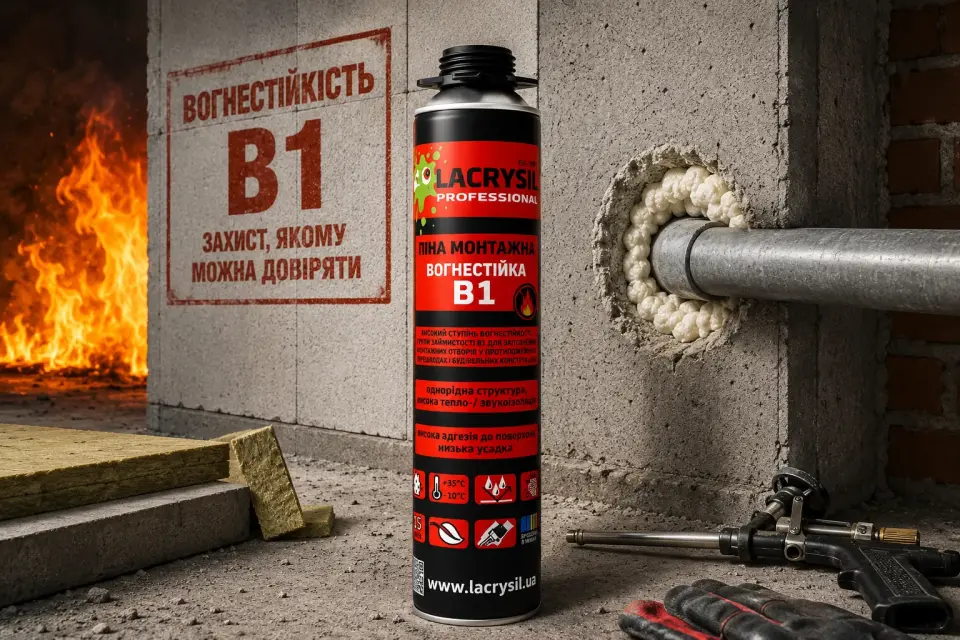
Fire-resistant professional polyurethane mounting foam, Red, 800 ml

Fire-rated B1 gun foam, coloured red so the fire-stopped joint is identifiable. For joints that must hold a fire rating.

Specifications

Color:
Red
Curing time:
3 - 6 hours**
Full polymerization time:
24 hours**
Maximum joint depth:
30 mm
Storage term:
18 months
Tack-free time:
5 - 30 minutes**
Cylinder temperature:
+15°C ... +30°C
Secondary expansion:
150 - 250%*
Packaging:
800 ml
Base:
foamed polyurethane composition
Application temperature:
+10°C ... +35°C

Choose a variant

1 available

Color: Red Red
Packaging: 800 ml

Consumption calculator

Maximum joint depth: 30 mm

Selected variant Red · 800 ml

398.04 ₴

Description

Professional fire-rated gun foam is a one-component polyurethane foam classified B1 for reaction to fire.

What B1 means

Ordinary foam burns and carries flame along the joint. B1 denotes a flame-retardant material: the bead does not sustain combustion on its own and delays fire passing through the opening. For fire doors, escape routes and service penetrations through fire walls this is a design requirement, not an upgrade.

Red is a marking, not a style

On site the colour distinguishes a fire-stopped joint from an ordinary one, so an inspection or a later refit can see at a glance which is which, and not replace one with the other.

Where it is used

Fitting window and door units including fire doors, sealing pipe and cable penetrations through walls and floors, and joints in assemblies with a required fire resistance.

Working figures

150–250 % secondary expansion, so fill joints about half deep. Tack-free in 5–30 minutes, set in 3–6 hours, fully cured in 24: longer than ordinary professional foam.

Conditions

Apply at +10 to +35 °C, narrower than the -10 °C of standard gun foam. Can at +15 to +30 °C. 800 ml, gun only, 18-month shelf life.

An important limit

The B1 class applies to the foam, not to the assembly. A structure's fire resistance is set by its design and by every material in it. And like any polyurethane foam, an exposed bead degrades under UV and must be covered.


How much you need

An 800 ml can gives about 10–12 running metres of 30×30 mm joint.

  • a 0.9×2.1 m fire door: 5.1 m of perimeter, half a can;
  • two door units: one can;
  • a cable tray penetration: 0.3–1 m;
  • a Ø100 mm pipe penetration: about 0.3 m.

Fill about half deep: 150–250 % expansion does the rest. Overfilling a fire-stopped joint is worse than underfilling: the surplus is trimmed away anyway and the pressure can distort the frame.

Application

Preparation

  • check the design requirements: the foam class is not the only condition;
  • clean and mist the joint;
  • bring the can to +15–30 °C and shake;
  • the room must be at +10 °C or above.

Application

  • fit the can to the gun and hold it inverted;
  • fill about half deep;
  • build deep penetrations in layers, misting each;
  • make sure the full section is filled: a void defeats the whole detail.

Curing

  • tack-free in 5–30 minutes;
  • set in 3–6 hours;
  • fully cured in 24 hours;
  • trim once set.

Afterwards

  • always cover the joint per the design;
  • flush the gun at once;
  • store upright; 18 months.

FAQ: B1 class, marking and filling

  • Does B1 make the assembly fire-resistant?
    No. B1 describes the foam. The rating of the structure is set by its design.

  • Why red?
    So a fire-stopped joint is identifiable and is not replaced with ordinary foam later.

  • Versus standard gun foam?
    Fire class, colour and timing: 24 hours to full cure, and application only from +10 °C.

  • How full?
    About half. Expansion is 150–250 %.

  • Can it be used as insulation?
    It insulates, but it is made for rated details. Use adhesive foam for boards and standard gun foam for ordinary joints.

Video
Reviews (0)

Similar products

1 similar products