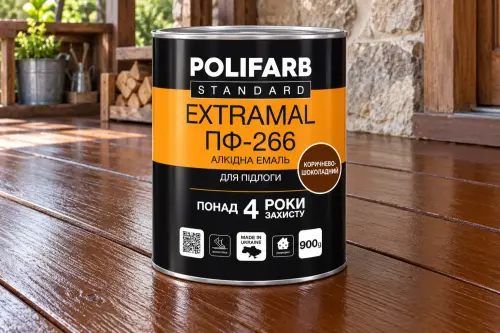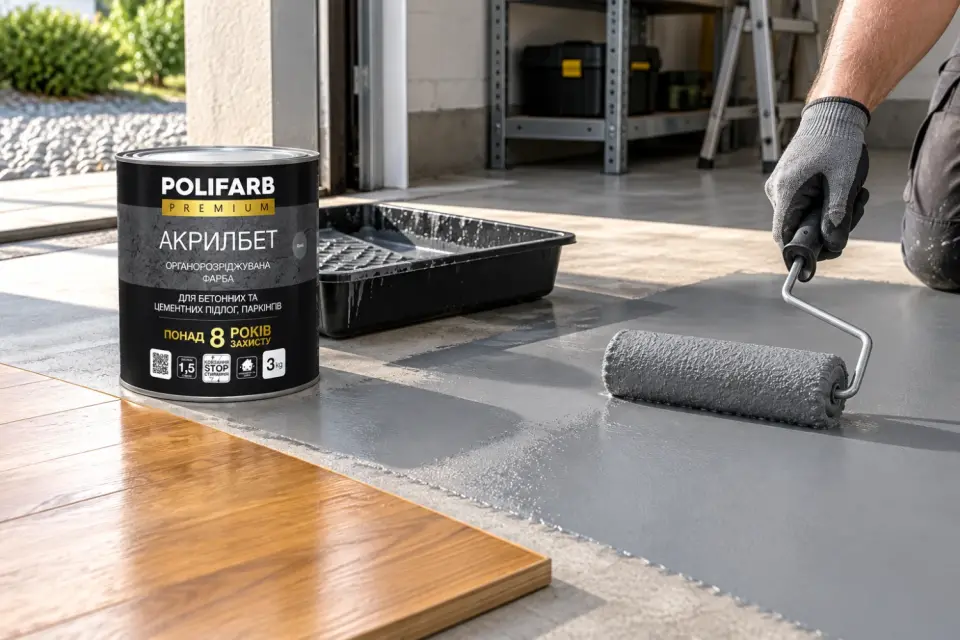
Floor paint is chosen by substrate: concrete and screeds need a hard-wearing concrete floor paint, timber boards need an alkyd floor enamel. In the POLIFARB range that means AKRYLBET concrete floor paint and two PF-266 enamels. Below is how they differ, how the data sheets say to apply them and what not to use on a floor.
Which floor paint to choose: quick table
Substrate | Product | Coats | Consumption per coat | Between coats | Ready for use |
|---|---|---|---|---|---|
Concrete, cement screed, garage, car park | AKRYLBET | 2 | 120–160 g/m² (new), 180–250 g/m² (old) | 1.5 h | after 72 h |
Indoor timber floor | DEKOMAL PF-266 | 2 on bare, 1–2 on painted | 80–130 g/m² | once fully dry, within 24 h | after 7 days |
Indoor timber floor | EXTRAMAL PF-266 | 2 on bare, 1–2 on painted | 160–220 g/m² | once fully dry, within 24 h | after 7 days |
Figures come from the technical data sheets. Real consumption depends on the substrate, colour and tool, so work out the number of tins in the paint consumption calculator.
Paint for concrete floors
AKRYLBET is a solvent-borne acrylic resin paint with quartz sand. The filler reduces wear and makes the surface non-slip. According to the data sheet it is intended for concrete, cement, fibre cement, brick and reinforced concrete under heavy mechanical load: warehouses, shops, garages and car parks. The film resists detergents, disinfectants, water, salts and lubricants. Colours are white and grey, finish semi-matt.
How to paint a concrete floor
- Let a new screed cure for 3–4 weeks. Concrete moisture must not exceed 4%.
- Sand the screed and remove dust with a vacuum or brushes. The substrate must be sound, dry, clean and free of cracks.
- Degrease oil stains with solvent. Deeply soaked areas are removed mechanically and filled with repair mortar.
- For first-time painting, prime with the paint itself thinned 20% with solvent naphtha.
- Apply two undiluted coats of AKRYLBET by roller or brush, 1.5 hours apart.
- Work at air and substrate temperatures of +5 to +30 °C and relative humidity up to 60%. The floor can be used after 72 hours.
The paint is flammable, so ventilate a closed garage or basement and keep open flames away. More on this product in the article on concrete floor paint.
Paint for wooden floors
For indoor boards and plywood there is the gloss alkyd DEKOMAL PF-266 floor enamel and its more economical sister EXTRAMAL PF-266. Both are hard-wearing and withstand detergents, and suit busy rooms such as schools, hospitals and offices. Colours are yellow-brown and red-brown. Both data sheets limit use to interiors, so they are not for open decks or porches.
How to paint a wooden floor
- Sand the boards and fill gaps and dents. The surface must be dry and free of dust, resin, oil and flaking paint.
- A sound old coating only needs washing with detergent.
- Prime bare timber with one coat of a clear alkyd preservative such as DREVOZAHIST IMPREGNAT, or with linseed oil. Allow at least 24 hours before the enamel.
- Apply the enamel by roller, brush or spray: two coats on bare wood, one or two on painted floors. The second coat goes on once the first is fully dry, but within 24 hours.
- If the enamel is too thick, thin it with white spirit, solvent naphtha or a 1:1 mix, no more than 10% by volume. See how to thin alkyd paint.
- Air and substrate temperature +5 to +30 °C, humidity up to 60%. The floor can be walked on after 7 days.
Other products for timber are collected on the wooden floor paint page.
Garage floor paint
Garages are named directly in the AKRYLBET data sheet. Two properties matter there: resistance to the road salt that tyres bring in over winter, and to lubricants. Both are stated for this coating. Degrease oil stains first or the paint will not hold on them. Drive the car in no earlier than 72 hours later.
Can you use epoxy or rubber paint on a floor?
POLIFARB does not make an epoxy floor paint, so we do not compare our products with one. For concrete floors the range offers AKRYLBET only.
RUBBER FARBA rubber paint is not suitable for floors. Its data sheet states plainly that it is not recommended for floors, thresholds or plastics. Stair treads take the same foot traffic, so it does not go there either. Rubber paint is meant for roofs, facades, plinths and walls, covered in a separate article on rubber paint.
Common mistakes
- Painting a fresh screed. Concrete needs 3–4 weeks and moisture below 4%.
- Skipping sanding and dust removal, so the paint bonds to dust instead of concrete.
- Putting PF-266 on bare timber without a primer.
- Thinning the enamel by eye beyond 10%.
- Putting furniture on a wooden floor before 7 days, or a car in the garage before 72 hours.
What to use
For a concrete floor, garage or warehouse use two coats of AKRYLBET. For an indoor timber floor use DEKOMAL PF-266 or EXTRAMAL PF-266 over IMPREGNAT. If the walls come next, start with preparing walls for painting.
FAQ
What is the most hard-wearing concrete floor paint?
In the POLIFARB range, AKRYLBET is the paint for heavily loaded concrete floors: its quartz filler reduces wear and slipping.
How long does floor paint take to dry?
AKRYLBET needs 1.5 hours between coats and 72 hours before use. With PF-266 enamels the second coat goes on once the first is fully dry, and the floor can be walked on after 7 days.
Can I paint a floor with rubber paint?
No. The RUBBER FARBA data sheet does not recommend it for floors or thresholds.
What should I prime a wooden floor with before enamel?
One coat of clear alkyd DREVOZAHIST preservative or linseed oil, left to dry for at least 24 hours.