Dried expanding foam cannot be fully dissolved: once cured, you cut it back first, then soften the residue and remove it with a method the surface can tolerate. Fresh foam is far easier to deal with, so we start with telling one from the other and then go through methods for plastic, glass, wood, fabric and skin.
Fresh or cured: this decides the method
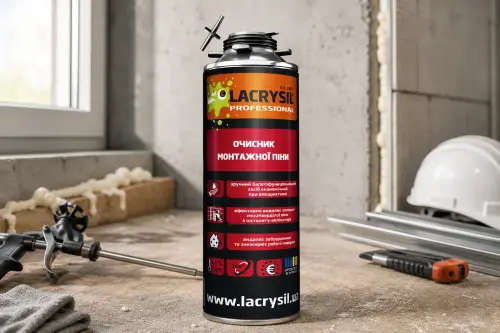
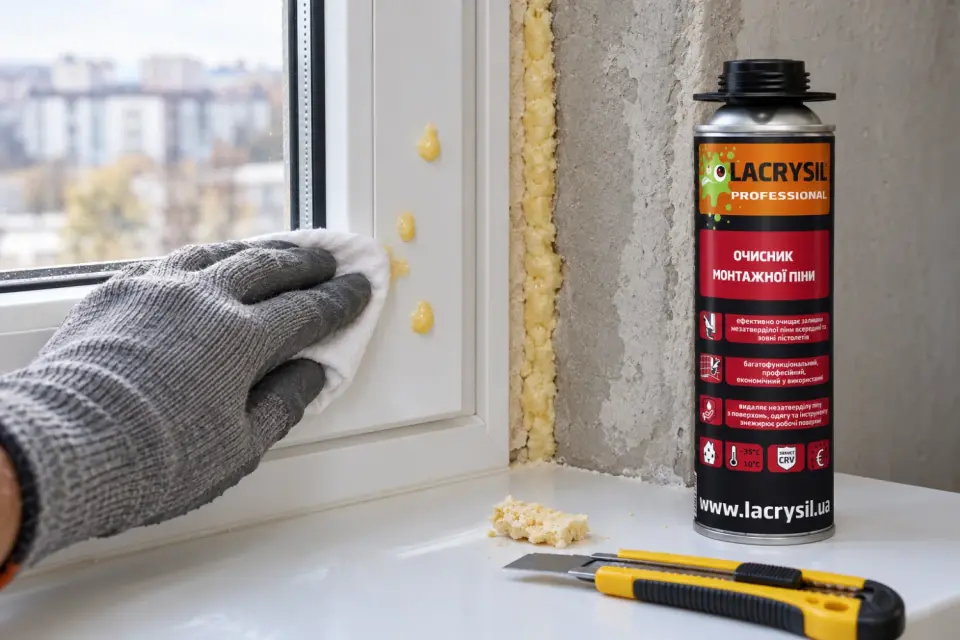
Polyurethane foam cures gradually. POLIFARB household and professional foams form a surface skin in 10 minutes, become tack-free in 15–20 minutes and cure fully in 12–24 hours. While the foam is still fresh, a butyl acetate mounting foam cleaner dissolves it: the nozzle delivers the liquid precisely, so you can wipe drops off a frame, sill or tile before they turn into a crust.
The cleaner does not work on cured foam. Cured foam is removed mechanically, and softeners only make the thin residue easier to handle.
General rules before you start
- Wear gloves and work in a ventilated room.
- Cut the excess off first with a sharp knife, blade or plastic scraper as close to the surface as possible without scratching it.
- Test any product on a hidden spot first.
- Take your time: removing the softened layer in several passes gives a cleaner result than one forceful attempt.
Ways to remove dried foam
1. Mechanical removal
The most universal method. Cut thick layers off with a knife or scraper, then sand the thin residue with 120–220 grit sandpaper or a pumice stone. Suitable for concrete, brick, metal, tile, glass and, with care, wood. The only drawback is that it takes time and patience.
2. Removers for cured foam
There are dedicated products for cured polyurethane foam. Do not confuse them with gun cleaner, which only works on fresh foam. Apply the remover to the residue, wait 5–30 minutes as instructed and wipe it off with a soft cloth or plastic scraper. This is the gentlest option for plastic, PVC, painted surfaces, metal and glass.
3. Acetone, solvent 646, white spirit
Soak a cloth or sponge, hold it on the foam for 5–15 minutes, refreshing the solvent from time to time, and scrape the softened layer off. Use this on metal, glass, tile and concrete. On plastic, lacquered surfaces, linoleum and fabric the solvent may leave a stain or dissolve the finish.
4. Dimexide (DMSO)
Apply pharmacy-grade dimexide to a cotton pad and press it against the residue for 10–30 minutes, then wipe the softened foam away. A gentle option for wood, parquet, laminate and painted walls.
5. Household remedies
- Vegetable oil, petroleum jelly or rich cream: apply, wait 20–60 minutes, rub with a sponge.
- 9% vinegar or citric acid: for plastic and skin.
- Coarse salt with water: as a scrub for hands.
How to remove foam from different surfaces
Surface | What to do | What to avoid |
|---|---|---|
Metal, glass, tile | Cut back, then acetone or remover | Abrasives on coated glass |
Plastic, PVC windows and doors | Cut back, then oil, vinegar or remover | Acetone and solvent 646 |
Wood, parquet, laminate | Cut back, dimexide, light sanding | Wire brushes |
Concrete, brick | Knife and sandpaper | Almost no restrictions |
Fabric, upholstery | Let it dry, cut off, treat with dimexide or remover | Rubbing fresh foam in |
Skin | Remove large pieces, oil, vinegar, pumice or salt | Acetone and solvents |
What not to do
- Rub plastic, PVC, lacquered doors, laminate or fabric with strong solvents.
- Clean soft surfaces with a wire brush.
- Expect a single solvent to fully dissolve cured foam.
- Put off cleaning the gun: foam that cures inside the barrel and valve ruins the tool for good.
How to avoid excess foam
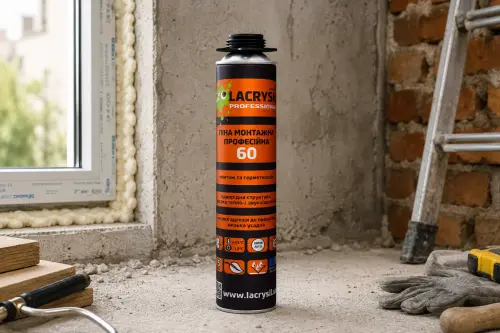
Household foam produces the most excess: its secondary expansion is 200–300%, so the gap is filled to one third of its depth, not to the brim. Professional gun-grade mounting foam expands only 15–30% and is dosed precisely, leaving almost nothing to trim. The mounting foam calculator shows how many cans your joints need. Why foam pushes a frame or crumbles in the joint is covered in why mounting foam crumbles, sags or deforms a window.
Excess foam in an installation joint is trimmed once the foam has fully cured, usually after 12–24 hours. Cutting opens the foam cells, so the cut must be protected from UV and moisture: on the outside, for example, with vapour-permeable installation joint sealant “A”.
What to use
Keep mounting foam cleaner at hand and wipe fresh drops off at once, before they cure. For windows and doors use professional gun foam with low expansion, and seal the exposed cut with sealant “A”. Remove cured residue with a knife and a softener matched to the surface from the table above.
FAQ
What dissolves dried expanding foam?
Nothing dissolves it completely. Cured polyurethane foam is cut off, and the thin residue is softened with a remover, acetone (only on resistant surfaces) or dimexide.
How do I get expanding foam off my hands?
Peel off the large pieces, apply vegetable oil or rich cream for 20–60 minutes, then rub with vinegar and pumice or salt with water. Do not use acetone on skin.
Can I use acetone to clean foam off a PVC window?
No, acetone and solvent 646 can damage PVC. Remove fresh foam with cleaner; cut cured foam off and finish with oil, vinegar or a remover.
How do I clean an expanding foam gun?
With mounting foam cleaner, right after work and before removing the can. Foam that has cured inside the barrel cannot be flushed out.