Expanding foam crumbles because of a cold can, a dry substrate, UV and moisture freezing in the joint; it sags off a dirty or frozen substrate; it deforms a window when the gap is filled to the brim and secondary expansion is ignored. Below we go through each problem with figures for household, professional and fire-rated foam and show how to fill a joint without rework.
Secondary expansion: the key figure on the can
After leaving the can, polyurethane foam keeps growing. How much depends on the foam type, and that decides how deep you fill the joint.
Foam | Secondary expansion | Joint fill | Application |
|---|---|---|---|
200–300% | One third of the depth | From -10 °C | |
15–30% | What you dispense is what you get | From -10 °C | |
150–250% | About half | +10 to +35 °C |
Why foam deforms a window
A frame bends when there is more foam in the gap than it can take. Household foam grows 2–3 times within an hour: a joint that looked neat bends the frame, squeezes out from under the sill and pushes the window. The second cause is a frame that was not wedged, so nothing counters the foam pressure.
- Wedge the frame and check its geometry before dispensing foam.
- Fill the gap partially, allowing for the expansion of the specific foam.
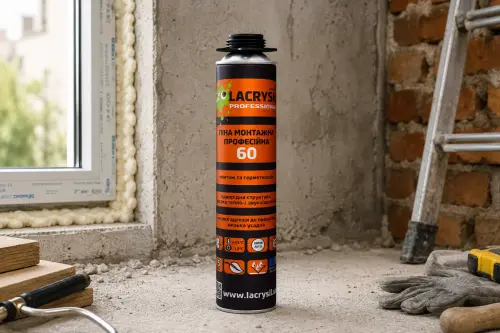
- Use professional foam for windows and doors: 15–30% expansion does not bend frames or lift sills.
- Leave the wedges in until the foam has fully cured.
Why expanding foam crumbles
Cold can and dry substrate
A cold can gives lower yield and a torn structure with large voids. Warm the can to the temperature on the label before work; for fire-rated foam it is +15…+30 °C. Polyurethane cures with moisture, so on a very dry substrate it gains strength poorly: clean the gap and mist it lightly if the instructions call for it.
Trimming and loading too early
Household and professional foam forms a skin in 10 minutes, becomes tack-free in 15–20 minutes, can be trimmed after 25 minutes and cures fully in 12–24 hours. Load the joint only after full cure. Fire-rated foam needs longer: 3–6 hours to set and 24 hours to cure fully.
UV exposure
Exposed foam in the sun crumbles within one season. A trimmed joint is never left bare: it is covered with sealant, plaster or paint.
Moisture freezing in the joint
Foam absorbs moisture. In winter it freezes, expands and breaks the foam from inside, and the joint starts letting in draughts by the second or third season. Protect both sides:
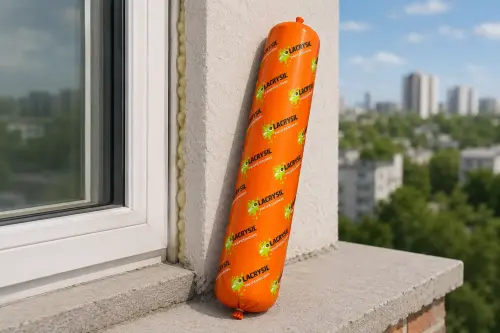
- outside, vapour-permeable installation joint sealant “A”: lets vapour out of the foam, applied from -25 °C, 20-year joint life, paintable with the facade;
- inside, vapour-barrier installation joint sealant “B”: keeps warm room moisture out of the foam and is painted with the reveal.
Never swap them: a vapour barrier on the outside traps moisture in the foam. For glazing units and exterior joints with non-porous materials, silicone sealant “Universal” fits, and protecting foam around frames from UV is one of its stated uses.
Why foam sags or loses volume
- The substrate is dirty, wet or frozen: foam does not grip and slides down.
- The can is held wrong. The working position is upside down; shake the can before work and regularly during application.
- A clogged gun or valve: the flow is uneven and so is the foam.
- Wrong temperature: fire-rated foam only from +10 °C, household and professional foam from -10 °C.
How to fill an installation joint without defects
- Wedge the frame, check level and diagonals.
- Clean dust out of the gap and mist the substrate lightly if needed.
- Warm the can, shake it and work upside down.
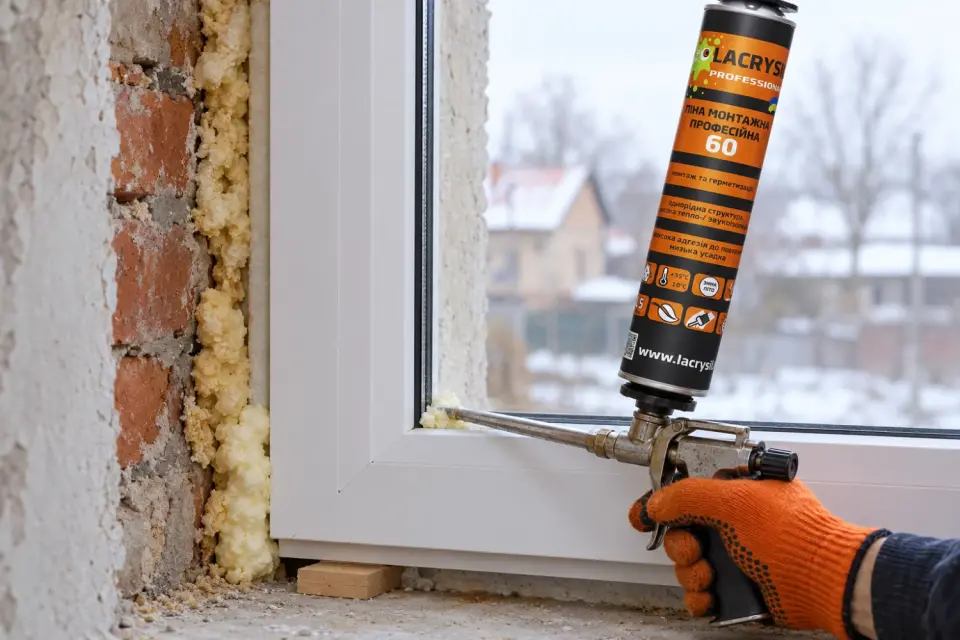
- Fill from the bottom up, allowing for expansion: household foam one third, fire-rated about half, professional almost full depth.
- Trim the excess after 25 minutes; remove wedges after full cure.
- Seal the joint: sealant “A” or silicone outside, sealant “B” inside.
- Flush the gun with cleaner straight away, before foam cures in the barrel.
The mounting foam calculator shows how many cans your windows and doors need. To clean foam that has already cured on a frame or sill, see how to remove dried expanding foam, and for drying times before painting, how long sealant and silicone take to dry.
What to use
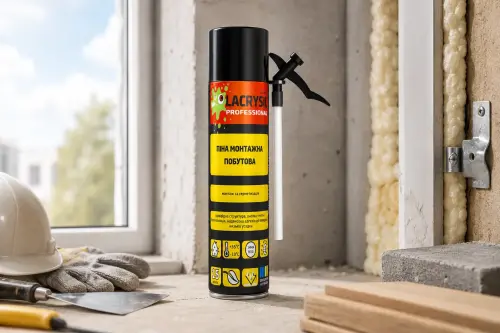
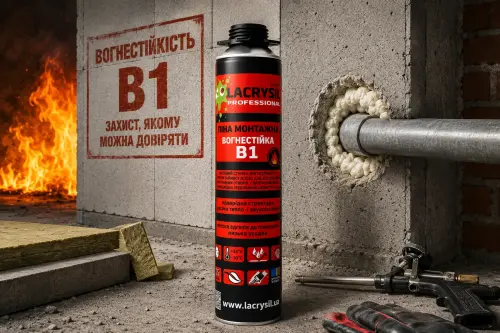
For windows, doors and sills use professional gun foam: with 15–30% expansion it does not push the frame. Household foam with a straw makes sense for a one-off job if you fill the gap to one third. Fire-stop joints need class B1 fire-rated foam. Seal the joint with sealant “A” outside and “B” inside, and flush the gun with mounting foam cleaner right after work. The full range is in mounting foams.
FAQ
What is secondary expansion of expanding foam?
The growth in volume after leaving the can: 200–300% for household foam, 15–30% for professional, 150–250% for fire-rated. It decides how far to fill the joint.
Can expanding foam be left exposed?
No. In sunlight exposed foam crumbles within a season. Cover the joint with sealant, plaster or paint.
When can expanding foam be trimmed?
POLIFARB household and professional foam can be trimmed after 25 minutes; load the joint after full cure in 12–24 hours.
Why did the foam push and bend the frame?
Usually the gap was filled to the brim with household foam or the frame was not wedged. Household foam grows 2–3 times, so it fills only one third of the joint depth.