Putty (filler) before painting levels the wall and fills pores, cracks and dents, and its quality decides whether a painted wall looks flat under side light. The right sequence is primer, putty, sanding, primer again, and only then paint.
Why fill a wall before painting
Paint follows the relief of the substrate. Wallpaper can still hide small defects, but a painted surface, especially one with a sheen, shows every wave in the plaster and every trowel mark. Putty differs from plaster in its thinner layer, usually up to 5–10 mm, and finer filler, so after sanding it gives a smooth surface.
Types of putty
By composition
Type | Moisture resistance | Drying | Where used | Notes |
|---|---|---|---|---|
Gypsum | Low | Fast | Dry rooms | Easy to sand, white |
Cement | High | Medium | Facades, damp rooms | Strong, harder to sand |
Polymer (acrylic, latex) | Medium to high | Fast | Interior and exterior, plasterboard | Flexible, practically no shrinkage |
Oil-glue | Low | Slow | Wood, dry rooms | Odour, slow drying |
By purpose
- Base coat: coarse, for rough levelling in layers up to 10–20 mm.
- Finishing: fine, 0.5–2 mm layers, gives a smooth surface for paint.
- All-purpose: combines base and finishing properties.
By form
Dry mixes are mixed with water and cost less. Ready-mixed pastes are workable straight from the tub and are convenient for finishing coats and small areas.
Step by step: from bare wall to paint
- Clean the wall of dust, flaking paint, grease and whitewash.
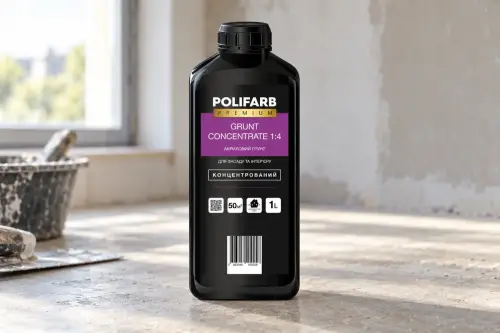
- Prime the substrate. Primer consolidates the surface, improves putty adhesion and evens out absorbency. Before filling, use GRUNT CONCENTRATE 1:4 concentrated primer: 2 l of concentrate makes 10 l of ready solution.
- Apply base putty where larger level differences need correcting. Let it dry.
- Apply finishing putty in thin layers. Dry and sand each layer.
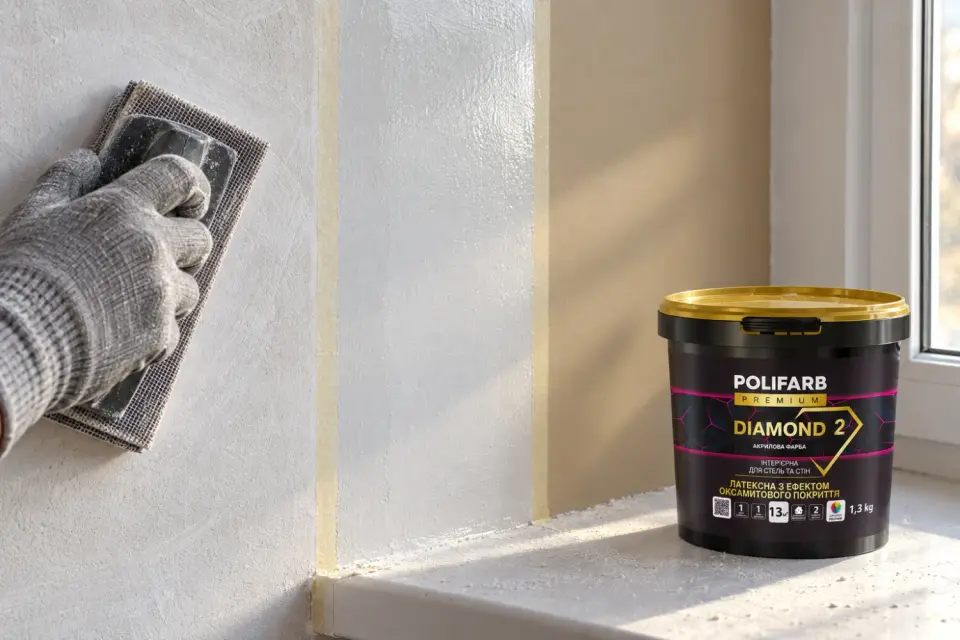
- Sand the whole surface. This matters most under matt and semi-matt paints.
- Remove dust with a brush or vacuum cleaner.
- Prime the putty again and, once dry, apply two coats of paint.
For more on substrate preparation, see how to prepare walls for painting and how to prime walls properly.
Why prime putty before painting
Putty absorbs moisture unevenly: where the layer is thicker or more porous, paint soaks in more. Once dry, this shows as patches and uneven sheen. An unprimed surface drinks the first coat, so you end up needing three coats instead of two.
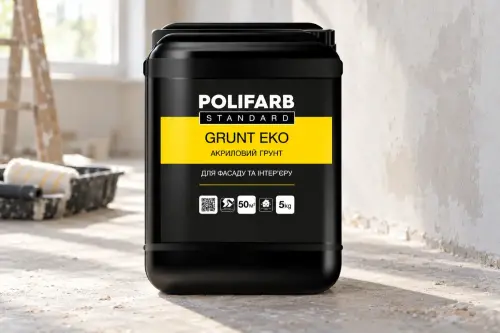
- For sound, firm putty a basic GRUNT EKO acrylic primer is enough, 100–200 g/m² in one coat.
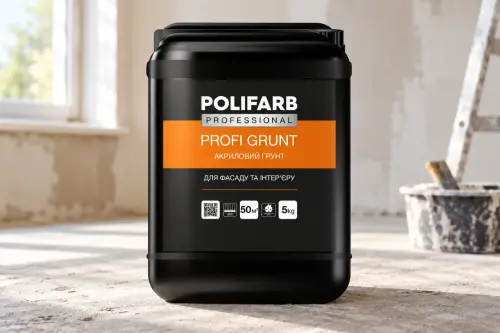
- For old putty that is dusty or crumbling, use PROFI GRUNT deep-penetrating acrylic primer: it binds dust within the layer.
Which paint to use over putty
Filling quality | What to choose |
|---|---|
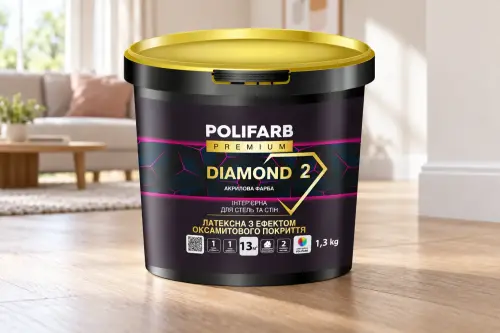
Minor unevenness, side light from a window | Deep matt: DIAMOND 2 acrylic latex paint hides small irregularities, class 1 wet scrub resistance |
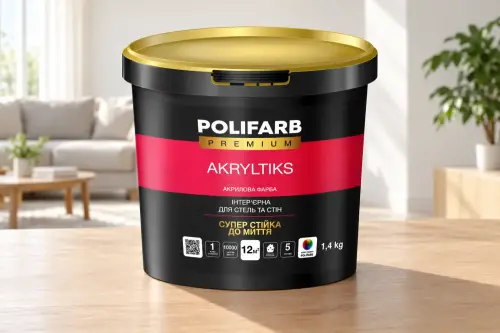
Ceiling or wall with hairline cracks | AKRYLTIKS acrylic paint: matt, does not drip from the roller, hides microcracks |
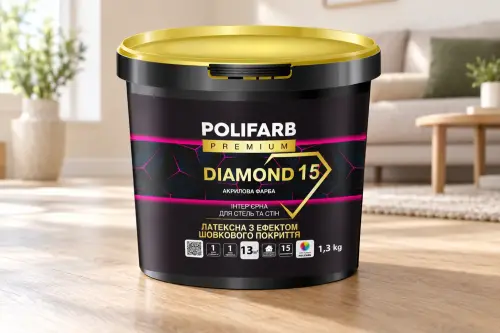
Perfectly levelled surface | DIAMOND 15 acrylic paint with a silky sheen: needs a fully filled surface with no waves |
The higher the sheen, the more careful the filling and sanding need to be. Gloss and silk finishes show trowel marks, deep matt hides them.
Common mistakes
- Filling without primer. The putty holds worse and can come away with the dust.
- Applying finishing putty too thick. It cracks and takes long to dry.
- Painting unprimed putty. The result is patchy with uneven sheen.
- Skipping dust removal after sanding. The paint goes on lumpy.
- Using gypsum putty in a bathroom. Damp areas need cement or polymer putty.
Other mistakes that make paint peel or streak are covered in common wall painting mistakes.
What to buy
For one room: primer before and after filling, the right type of putty and a finish paint that matches how flat your walls are. POLIFARB primers are listed under surface preparation materials, and you can work out the amount of paint with the paint coverage calculator.
FAQ
Do I need to prime putty before painting?
Yes. Primer evens out the absorbency of the putty, so the paint goes on without patches and with lower consumption.
Which putty is best for painting?
For the final layer under paint, use a fine finishing putty: gypsum for dry rooms, polymer or cement for damp areas.
How many coats of putty do I need?
It depends on the wall: base putty corrects large differences, finishing putty goes on in thin 0.5–2 mm layers, each dried and sanded.
Can I paint a wall without putty?
Yes, if the plaster is flat and sound. On an uneven surface choose a deep matt paint that hides small defects.