Save to favorites

Add to compare

Sale ends in

00 days
00 hrs
00 min
00 sec

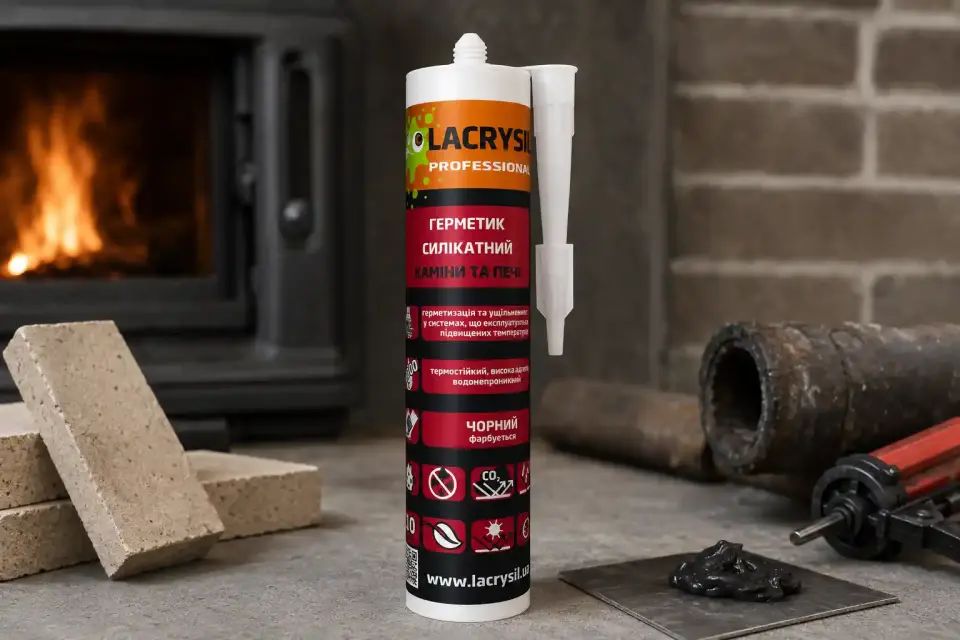
Silicate sealant “Fireplaces and stoves”, Black, 0.55 kg

A silicate fire-resistant sealant for fireplaces, stoves and flues. Withstands +1500 °C, smoke- and gas-tight Asbestos-free

Specifications

Color:
Black
Maximum joint depth:
5 mm
Consumption:
17.6 linear m (4x4 mm seam, 0.55 kg cartridge)
Storage term:
18 months
Drying time:
24 - 48 hours
Operating temperature:
-50°C ... +1500°C
Packaging:
0.55 kg
Base:
Silicate
Application temperature:
+5°C ... +35°C

Choose a variant

1 available

Packaging: 0.55 kg

Consumption calculator

Maximum joint depth: 5 mm

Selected variant Black · 0.55 kg

121.58 ₴

Description

Fire-resistant silicate sealant is a one-component sealant for use in the path of direct flame.

+1500 °C is a different class

Neither silicone nor acrylic: a silicate base, chemically closer to water glass than to polymers. Hence -50 to +1500 °C, where the most heat-resistant silicone here stops at +130 °C.

Cured by fire

The logic is inverted: once dry, the bead must be exposed to direct flame or high heat to become waterproof and flexible. You fire the stove after the repair, and that finishes the job.

Smoke- and gas-tight

The reason to seal a cracked stove is carbon monoxide, not draught. The bead passes neither smoke nor gas.

Where it is used

Lasting repairs to joints, cracks and gaps in fireplaces, stoves, fireboxes and flues, and to car and motorcycle exhaust systems, which face the same mix of heat, vibration and combustion gas.

Asbestos-free

No asbestos, which matters for a material sitting where hot air enters the room.

Specs

Black, applied at +5 to +35 °C, 0.55 kg, 18-month shelf life. Strong adhesion to brick, concrete, metal and firebrick.


How much you need

The 0.55 kg pack gives about 15 running metres of 4×4 mm bead: ample for repair work.

  • a crack along a firebox joint: usually 0.5–2 m;
  • a flue-to-ceiling junction: 1–1.5 m;
  • around cast-iron stove doors: about 2 m;
  • an exhaust repair: 0.3–0.8 m.

One pack covers a full stove repair. Keep beads narrow in the firebox: a wide band survives rapid heating less well than a thin one.

Application

Preparation

  • the stove must be completely cold;
  • open out the crack and clear soot, ash and debris: nothing bonds to soot;
  • brush and blow the surface clean;
  • pack deep cavities with mineral rope or firebrick grit.

Application

  • gun into the crack, filling the whole void;
  • tool flush with the surface;
  • remove surplus at once.

The required step

  • let the bead dry;
  • then fire the stove: direct heat is what makes the joint waterproof and flexible;
  • bring the first firing up gradually.

Afterwards

  • clean tools before the material sets;
  • seal the pack;
  • store above freezing; 18 months.

Compatibility table

Material / Base Concrete, brick, gypsum Stone, granite, marble Glass Tile, ceramic, porcelain Primed metal
Concrete, brick, gypsum
Stone, granite, marble
Glass
Tile, ceramic, porcelain
Primed metal

FAQ: fireboxes, firing and heat resistance

  • Can it seal a crack in a firebox?
    Yes. On a cold stove, with all soot cleared out.

  • Why fire the stove afterwards?
    Direct heat is what gives the bead its water resistance and flexibility.

  • Versus heat-resistant silicone?
    +1500 °C against +130 °C. Silicone burns away in a firebox.

  • Exhaust pipes?
    Yes, a listed use.

  • Asbestos?
    None.

Video
Reviews (0)

Similar products

7 similar products