










Active filters
ClearShowing 1–6 of 6 products
-15%
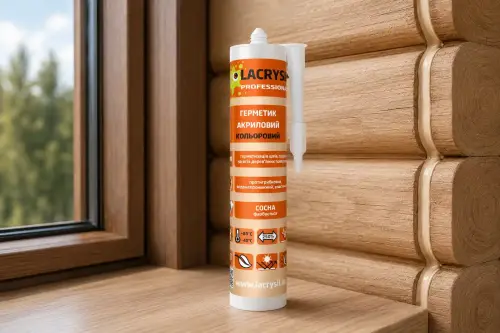
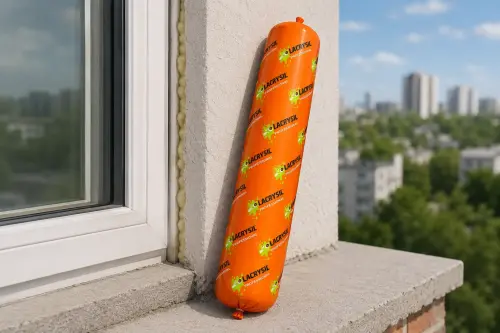
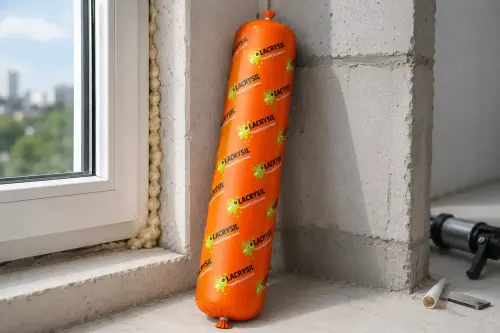
Acrylic sealant is made on an acrylic dispersion. A fresh bead washes off with water, and once dry it stays elastic; most acrylic sealants can be filled and painted along with the wall. All LACRYSIL acrylic sealants take joints up to 5 mm deep. Acrylic is not for joints under constant water or with large movement; those need silicone sealant.
Types of acrylic sealant
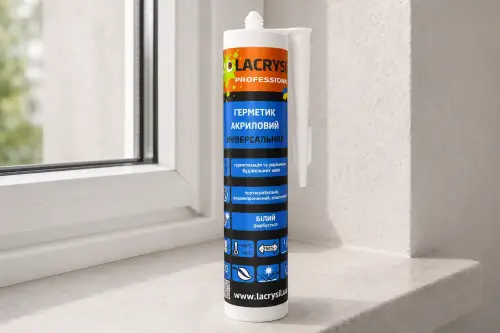
Universal is white and fills gaps around windows, doors, skirting and sills, cracks in mineral surfaces and wood, and joints in external wall insulation systems. It is applied from +10 °C.
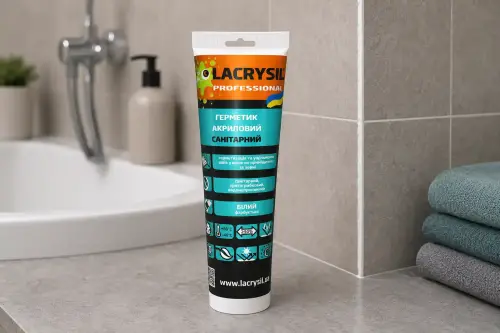
Sanitary contains antiseptics against mould, takes paint, handles up to 35 % movement and suits bathrooms, kitchens, laundries and toilets.
Coloured comes in wenge, walnut, oak and pine for gaps in parquet, floors and wooden joints.
A and B work as a pair in a window installation joint. A is vapour-permeable, goes on the outside and can be applied from -25 °C; B is a vapour barrier on the room side. Neither may be diluted with water.
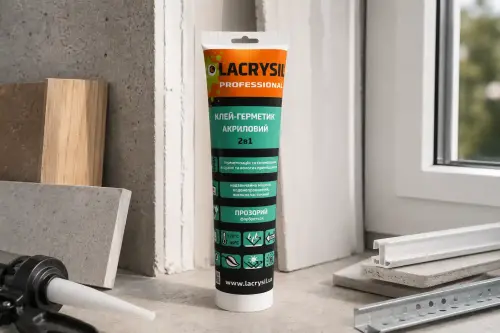
2-in-1 is clear: one bead bonds a part with up to 800 kg/m² and seals the joint. It is applied only at +18…+22 °C.
Questions and answers
Which acrylic sealant can be painted?
Universal, Sanitary, A and B. They are collected in “Paintable acrylic sealant”.
Can acrylic sealant be used outdoors?
Yes, Universal and A are made for exterior work. In winter only A is used for the outer window joint.
How long does acrylic sealant take to dry?
Universal, Coloured, A and B take 24–48 hours; Sanitary and 2-in-1 take 48 hours.
Where can I read more?
In the article “Acrylic sealant: where to use it and how to apply a bead”.