Save to favorites

Add to compare

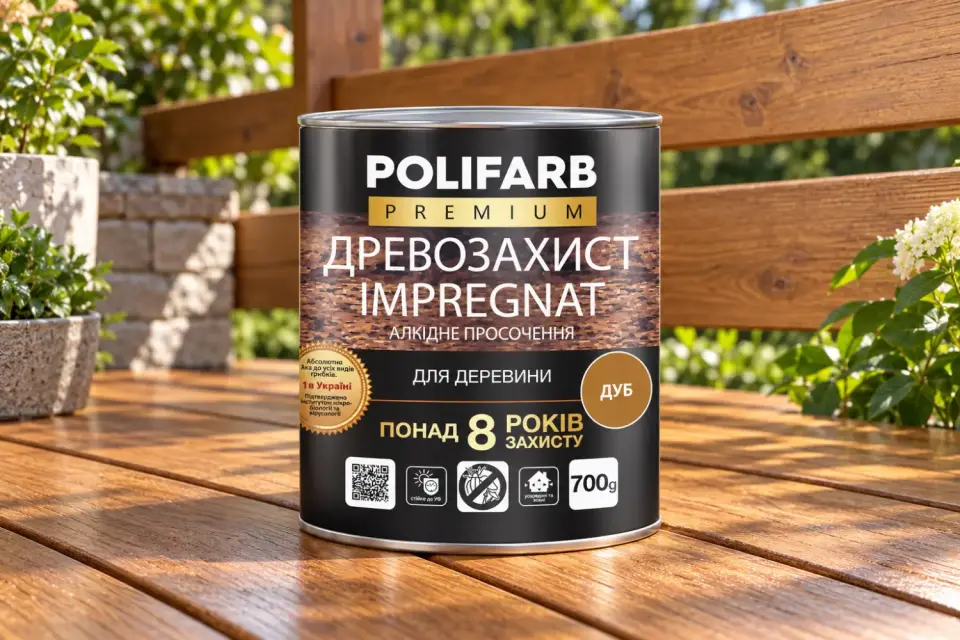
DREVOZAHIST IMPREGNAT Antiseptic Wood Preservative, Oak, 0.7 kg

5.0 (1)

An alkyd impregnation that enters the fibres instead of sitting on top. Protection against fungi, insects and mould Eight shades Thinned with white spirit

Specifications

Color:
Oak
Consumption:
80–100 g/m² per coat
Storage term:
18 months
Drying time:
8 hours between coats
Application area:
Indoor and outdoor use
Number of coats:
2–3
Packaging:
0.7 kg
Thinner:
White spirit
Application temperature:
+5…+30 °C

Choose a variant

8 available

Consumption calculator

Calculated at the average rate of 90 g/m² per coat (data sheet range 80–100 g/m²). Coats: 3.

Selected variant Oak · 0.7 kg

310.50 ₴

Description

DREVOZAHYST IMPREGNAT by POLIFARB is an alkyd impregnation for the decorative and protective treatment of timber and wood-based surfaces, indoors and out.

An impregnation, not a coating

The key difference from lazures and varnishes: it soaks deep into the timber and polymerises inside the fibres rather than forming a film on top. A film eventually peels, and what it was meant to prevent starts underneath; an impregnation has nothing to peel from. It is not a finish coat, though: once dry, the surface is protected with pentaphthalic varnish, 1–2 coats for items used indoors and 2–3 coats for items exposed to weather. Indoor floors are treated only in combination with varnishes.

Three threats

The impregnation protects timber against fungi, insects and mould, and against rain and temperature swings.

The colour of fine timbers

Eight options: clear, pine, teak, oak, mahogany, walnut, wenge and classic rosewood. The pigments are UV-stable and the colour is durable.

It still breathes

The treatment does not block vapour permeability, so log walls, gazebos and cladding keep releasing moisture rather than storing it.

Where it is used

Timber facades, log houses, gazebos, fences, furniture, windows, doors, cladding, skirting, natural timber panels, plywood, OSB, MDF, chipboard and hardboard, and the outside of beehives.

Conditions

Stir thoroughly before use; thin with white spirit. No primer needed. Two or three coats, 80–100 g/m² per coat, the next coat after 8 hours. Apply with a soft brush, pad or sponge along the grain; do not spray. Air and substrate +5 to +30 °C, humidity no more than 60%. Clean tools with white spirit. The impregnation is flammable. 18-month shelf life, do not freeze. Packed in 0.7 kg.


How much you need

90 g/m² per coat over two or three coats: budget three, about 270 g/m².

  • 700 g covers about 2.5 m²: a window, a door, some furniture parts;

  • 3.5 kg covers about 13 m²: a gazebo or a run of cladding.

Typical areas:

  • a 3×3 m gazebo with roof, about 30 m²: 8 kg;

  • 20 m of 1.5 m fence, both sides, 60 m²: 16 kg;

  • an 8×6 m log house, 3 m high, about 84 m²: 23 kg.

Planed or sawn? Planed boards absorb less; sawn faces and end grain far more. Treat end grain generously. That is where water enters first.

Application

Preparation

  • clean off dirt, old coatings and the weathered grey layer;

  • sand and dust off;

  • moisture content no higher than 20 %: it will not enter wet timber;

  • no primer needed.

Application

  • stir; do not thin;

  • brush along the grain, or use a pad or sponge;

  • two or three coats, each after the last has dried;

  • up to 16 hours between coats at +20 °C, longer when cold.

Where to be generous

  • end grain: the main route for water;

  • the bottom courses of a log wall and anything near the ground;

  • joints, grooves and fixings where moisture lingers.

Afterwards

  • clean tools with white spirit;

  • spread out and dry any soaked rags rather than leaving them balled up;

  • seal the tin; 18 months.

FAQ: impregnation or lazure, coats, end grain

  • Versus DREVOZAHYST LASUR?
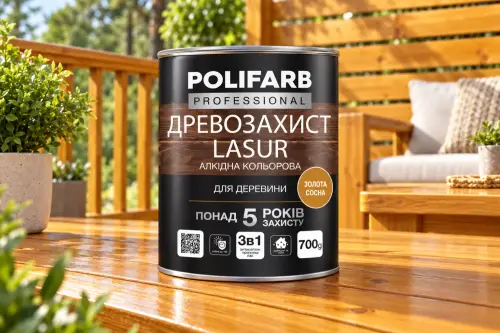
    Mechanism. This soaks in and forms no film, lasting over 8 years; the lazure leaves a tough elastic film and lasts over 5. They are often combined: impregnation first, lazure for appearance.

  • Primer needed?
    No, it primes itself.

  • How many coats?
    Two or three; three outdoors.

  • Beehives?
    The outside only, as the maker states.

  • New untreated boards?
    Ideal. Dry planed timber takes it evenly.

Video
Reviews (1)

Similar products

1 similar products