Save to favorites

Add to compare

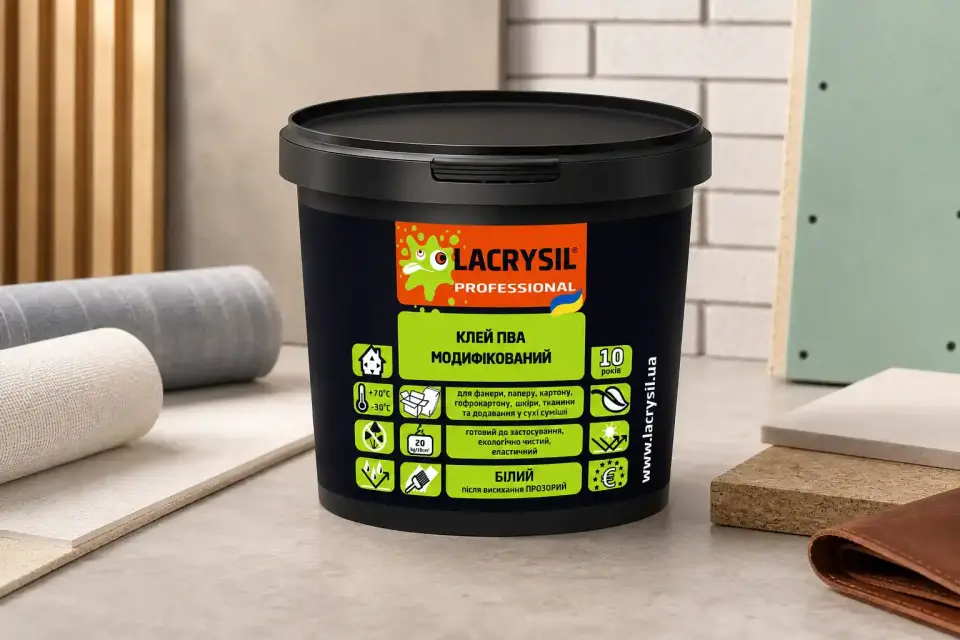
Modified PVA glue, White, transparent after drying, 4.5 kg

Modified PVA, solvent-free: bonds card, fabric and wallpaper, and doubles as an additive for render and cement mixes.

Specifications

Color:
White, transparent after drying
Consumption:
0.15 - 0.2 kg/m²
Storage term:
12 months
Drying time:
24 hours
Operating temperature:
-40°C ... +80°C
Packaging:
4.5 kg
Base:
polyvinyl acetate
Application temperature:
+18°C ... +22°C

Choose a variant

4 available

Consumption calculator

Selected variant White, transparent after drying · 4.5 kg

462.00 ₴

Description

Modified PVA is a water-dispersion polyvinyl acetate adhesive for finishing work and as an additive to building mixes.

Two jobs in one pail

Bonding card, plasterboard, fabric, paper and wallpaper, and, just as often, going into chalk, render and cement mixes to improve their grip on the substrate and make them more workable.

How it differs from PVA D3

D3 is a graded woodworking glue for furniture and windows. Modified PVA is a finishing and process material: cheaper, 800 kg/m² against 1000, but bonding a wider range of soft materials and made to be mixed into mortars.

Solvent-free

No solvents and no sharp smell, so it can be used in a living room and will not attack polystyrene.

A clear, flexible joint

It dries clear and stays flexible, so it does not crack on fabric, card and paper that move with the substrate.

Conditions

Optimum +18 to +22 °C, service -40 to +80 °C, dries in 24 hours, 0.15–0.2 kg/m². 0.9, 2.5, 4.5 and 9 kg, 12-month shelf life, water clean-up. Do not let it freeze in the tin.


How much you need

0.15–0.2 kg/m² for bonding, at a 0.3 mm bed.

  • 0.9 kg covers about 5 m², or an additive for two or three batches of render;
  • 2.5 kg covers about 14 m²;
  • 4.5 kg covers about 25 m²;
  • 9 kg covers about 51 m².

As an additive, use up to 5–10 % by weight of the dry mix, dissolved in the gauging water. More than that slows the cement gaining strength.

Application

Preparation

  • clean off dust, grease and limewash;
  • prime friable or very absorbent surfaces;
  • warm the room to +18–22 °C.

Bonding

  • spread a thin even coat on one face;
  • join and press;
  • light pressure suits card, fabric and paper; use weights or clamps for dense materials;
  • fully dry in 24 hours.

As a mortar additive

  • dissolve in the gauging water, not in mixed mortar;
  • up to 5–10 % by weight of the dry mix;
  • use the batch within its normal pot life.

Afterwards

  • wash tools with water;
  • seal the tin, do not freeze;
  • 12-month shelf life.

Compatibility table

Material / Base Concrete, brick Gypsum, plasterboard Wood, chipboard, fiberboard, MDF, plywood Polystyrene
Gypsum, plasterboard
Leather, fabric
Wallpaper, paper
Wood, chipboard, fiberboard, MDF, plywood
Tile, ceramic, porcelain
Polystyrene

FAQ: mortar additive, wallpaper, storage

  • Can I use it on furniture?
    Use PVA D3 for joinery and anything in a damp room: this one is a finishing adhesive.

  • How much goes into render?
    Up to 5–10 % by weight of the dry mix, in the gauging water.

  • Wallpaper?
    Yes, both on its own for heavy papers and as an additive to paste.

  • Will it leave white marks?
    No, it dries clear.

  • Can it be stored unheated?
    No. Freezing destroys the dispersion permanently.

Video
Reviews (0)

Similar products

7 similar products