Sealant consumption per metre of joint equals joint width times depth in millimetres: a 6 × 6 mm joint takes 36 ml per metre, so a 280 ml cartridge does roughly 7–8 m. For a triangular corner joint, halve the result. The sealant consumption calculator works out the length, margin and number of cartridges for you.
The formula in plain words
- Rectangular joint: length, m × width, mm × depth, mm = volume in ml.
- Triangular joint (bath corner, wall-to-worktop): rectangular volume × 0.5.
- With margin: volume × (1 + margin / 100). Uneven or deep joints need 10–20 %.
- Cartridges: result / cartridge volume in ml, rounded up.
Two calculator modes
Enter manually
Works for any sealant. Choose "Joint length" or "Opening perimeter" (for a window or door the calculator works out (width + height) × 2 × quantity), the joint profile, width and depth in millimetres, margin and cartridge volume. The defaults are a 6 × 6 mm joint, a 10 % margin and a 280 ml cartridge.
Pick a product
The calculator takes the package weight and sealant density from the manufacturer's data and converts kilograms to millilitres itself. It also warns you if the joint is deeper than allowed: 5 mm for POLIFARB acrylic sealants, 7 mm for the MS Polymer adhesive-sealant and 10 mm for silicones.
A 0.4 kg tube is not 400 ml
Acrylic tubes are often labelled by weight, but a joint is filled by volume. Universal acrylic sealant has a density of 1750 kg/m³, so a 0.4 kg tube holds about 229 ml. Sanitary silicone sealant has a density of 1000 kg/m³, so a 0.28 kg cartridge is exactly 280 ml. Count acrylic as "one gram per millilitre" and you will run out.
Example 1: a bath against three walls
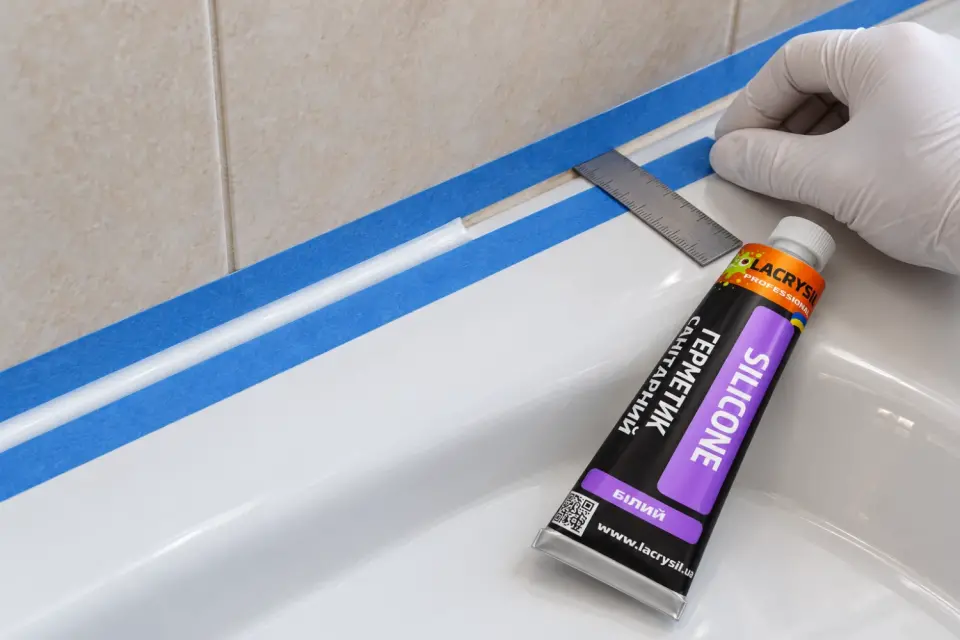
Joint length: 1.7 + 0.75 + 0.75 = 3.2 m. It is a triangular 5 × 5 mm corner joint, sealed with sanitary silicone.
- Volume: 3.2 × 5 × 5 × 0.5 = 40 ml.
- With a 10 % margin: 44 ml.
- Buy: one 280 ml cartridge; the rest will do the sink and the shower.
Example 2: inside reveals of three windows
Windows are 1.3 × 1.4 m, the joint between reveal and frame is 6 × 5 mm, and the sealant is Universal acrylic, painted over together with the reveal. In "Opening perimeter" mode enter width 1.3, height 1.4, quantity 3.
- Length: (1.3 + 1.4) × 2 × 3 = 16.2 m.
- Volume: 16.2 × 6 × 5 = 486 ml, or 535 ml with a 10 % margin.
- Buy: three 0.4 kg tubes (3 × 229 = 687 ml). Counting tubes as 400 ml, you would buy two and fall short on the third window.
Example 3: the outer layer of a window installation joint
Outside, the same windows' foam is covered with vapour-permeable installation joint sealant "A". The manufacturer gives about 0.13 kg per running metre: 16.2 × 0.13 = 2.1 kg, or 2.3 kg with a 10 % margin. A 3 kg bucket does the job. Inside, the joint is closed with vapour-barrier sealant "B", calculated the same way.
How much joint one package gives
Sealant | Package | Volume | Max joint depth | 5 × 5 mm joint per package |
|---|---|---|---|---|
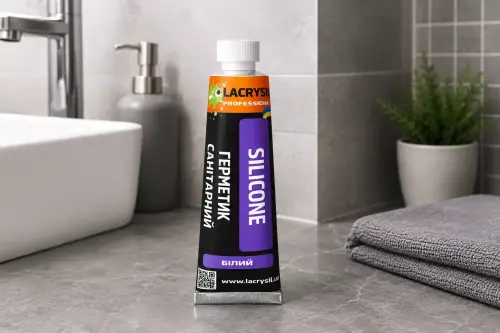
Sanitary silicone | 0.28 kg | 280 ml | 10 mm | ≈ 11.2 m |
0.28 kg | 280 ml | 10 mm | ≈ 11.2 m | |
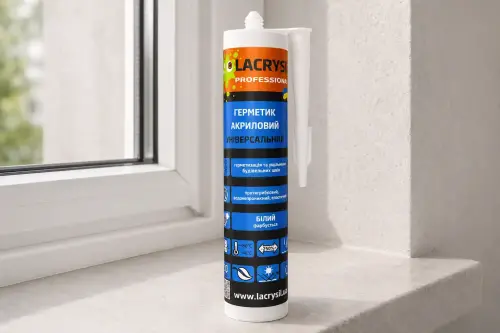
Universal acrylic | 0.4 kg | ≈ 229 ml | 5 mm | ≈ 9.1 m |
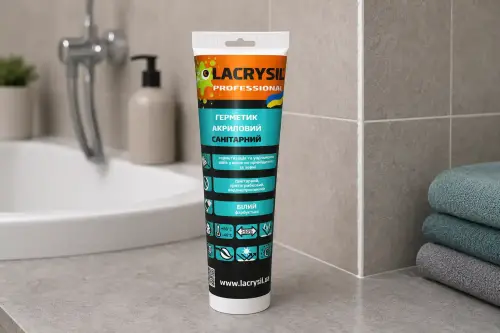
0.28 kg | ≈ 257 ml | 5 mm | ≈ 10.3 m | |
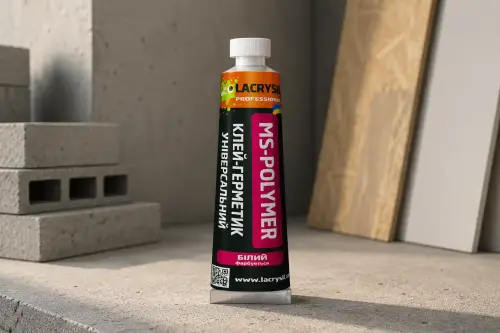
0.28 kg | ≈ 259 ml | 7 mm | ≈ 10.4 m | |
Installation joint sealant "A" | 0.87 kg | 600 ml | 5 mm | ≈ 24 m |
Volumes are calculated from the manufacturer's weight and density; lengths are without margin.
What increases consumption
- Uneven joint edges: the real width varies, so such joints get a 10–20 % margin.
- A deep joint. If it is deeper than the sealant allows, the manufacturer does not recommend that use, and the calculator will warn you.
- Working without a gun or with a bluntly cut nozzle: some material goes on cleaning up.
Common mistakes
- Counting acrylic grams as millilitres.
- Not choosing the triangular profile for corner joints and buying twice as much.
- Using silicone where the joint will be painted. Silicone does not take paint; use acrylic sealant there.
Which silicone suits a bathroom or kitchen is covered in our article on neutral and acetoxy silicone, and when a joint can get wet in how long sealant and silicone take to dry.
What to buy
For bathrooms and showers, Sanitary silicone; for joints that will be painted, Universal or Sanitary acrylic; for joints that need both bonding and sealing, MS Polymer Universal; for a window installation joint, the "A" and "B" pair. Check the length and number of cartridges in the sealant calculator.
FAQ
How much sealant per metre of joint?
A rectangular 6 × 6 mm joint takes about 36 ml before margin, a 5 × 5 mm joint 25 ml. A triangular corner joint of the same size takes half.
How many metres does a 280 ml cartridge do?
About 7–8 m of a 6 × 6 mm joint or 11 m of a 5 × 5 mm joint.
Why does the calculator have a triangular profile?
Corner joints are shaped as a triangle, so their volume is about half that of a full rectangular fill.
Why does the product-page calculator warn about joint depth?
The manufacturer sets a maximum depth for each sealant: 5 mm for acrylics, 7 mm for MS Polymer, 10 mm for silicones. Deeper joints are not recommended with that material.