Which mounting adhesive to choose depends on four things: the substrate, the weight of the element, the temperature during work and whether the joint also has to seal. In short: acrylic adhesive is for indoor finishing on porous substrates, rubber adhesive for heavy elements and cold-weather work, and MS Polymer for glass, metal, mirrors and joints that must hold and seal at the same time.
Three types of mounting adhesive compared
Parameter | Acrylic | Rubber | MS Polymer |
|---|---|---|---|
Base and curing | Water dispersion, dries by releasing water into the substrate | Rubber in organic solvent, contact method | Hybrid polymer, cures with air moisture |
Joint load | 800–1500 kg/m² depending on grade | 2500 kg/m² | Adhesive and sealant in one joint, damps vibration |
Application from | +5 °C | -10 °C | +10 °C (“Universal”) |
Two non-porous surfaces (glass, metal, PVC) | No, one surface must let moisture through | Yes | Yes |
Odour and clean-up | Mild odour, fresh adhesive washes off with water | Solvent odour, clean with acetone or petrol | No solvents, odourless after curing |
Stated service life | Not stated | Not stated | 50 years |
When acrylic adhesive is enough
Acrylic adhesives cover most finishing jobs in a flat: skirting boards, thresholds, mouldings, PVC panels, tiles and polystyrene decor on concrete, brick, plasterboard, OSB and plaster. They work from +5 to +35 °C, have a mild odour and do not attack polystyrene foam.
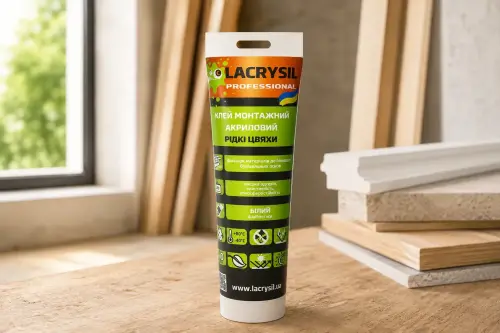
- Acrylic adhesive “Liquid Nails” comes in two versions: white holds 1000 kg/m², clear holds 800 kg/m² and stays invisible in the joint. Full cure takes 48 hours, service range is -40 to +80 °C.
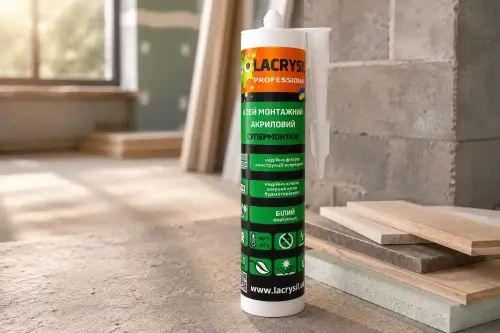
- Acrylic adhesive “Supermontage” holds 1500 kg/m² and works up to +100 °C. It is used for heavy ceramics, ceiling elements and fixing near radiators.
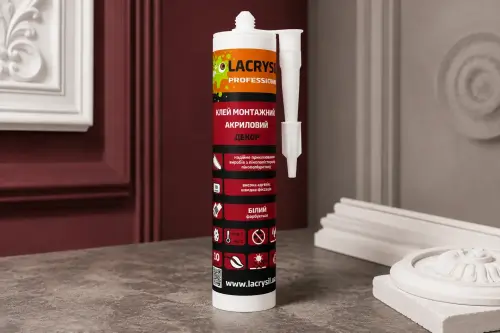
- Acrylic adhesive for mouldings “Decor” grabs as soon as it is pressed, so cornices and ceiling roses need no props. It holds 1000 kg/m² and is for indoor use only.
Acrylic has one strict limit: it dries by releasing water, so at least one of the surfaces must be porous. Glass to metal or PVC to aluminium is not bonded with acrylic.
Where rubber adhesive is needed
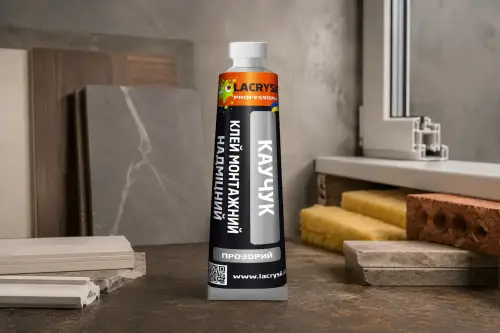
Rubber adhesive “Extra Strong” holds 2500 kg/m² and grabs instantly. It is the only adhesive in the range applied from -10 °C, so it works in an unheated house, a garage or outdoors in late autumn. The joint is waterproof and bonds non-porous pairs: metal to metal, glass to metal, plastic to concrete.
It uses the contact method: apply adhesive to both surfaces, wait until tack-free, then join. The part cannot be repositioned afterwards, so mark it out first. The formula contains organic solvent, so work only with ventilation and away from open flame.
When to use MS Polymer
MS polymer adhesives combine the properties of a mounting adhesive and a sealant. They cure with air moisture, so they bond non-porous pairs acrylic cannot handle, and they contain no silicone, isocyanates or solvents.
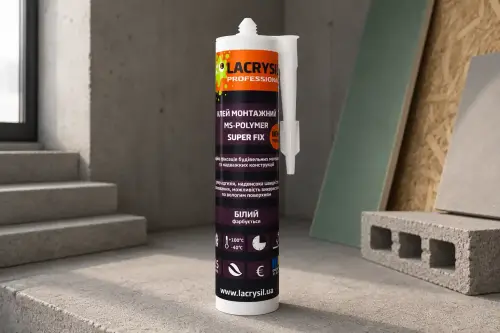
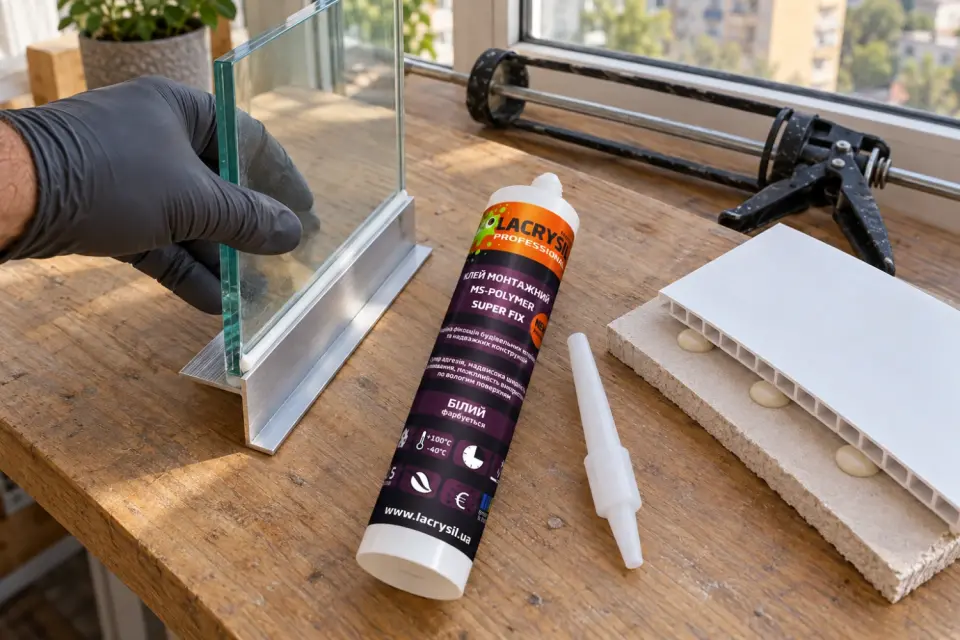
- MS Polymer adhesive “Super Fix” bonds metal and anodised aluminium, glass, mirrors, painted wood, polycarbonate, plastics and PVC. The joint damps vibration, so it is used to fix ventilation units, facade and sandwich panels. Stated service life is 50 years.
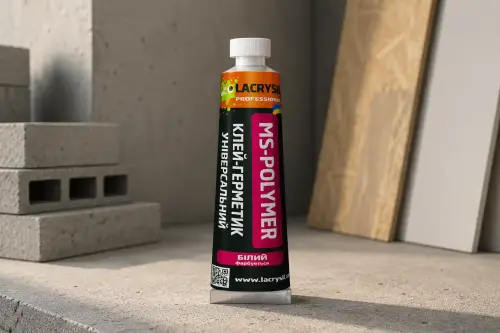
- MS Polymer adhesive-sealant “Universal” comes in white and clear, in 50 and 85 g tubes and 0.28 and 0.4 kg cartridges. Apply from +10 to +35 °C; it cures in 24–48 hours, works from -40 to +100 °C, and the maximum joint depth is 7 mm. The joint can be painted.
For mirrors, glass and heavy decor, see how to choose adhesive for mirrors and heavy decor.
How to prepare the substrate
- Check the substrate is sound. Peeling paint and crumbly plaster hold worse than any adhesive, so remove them.
- Clean off dust, grease and old adhesive. Degrease metal and glass.
- Prime porous and dusty substrates before using acrylic adhesive, otherwise the substrate soaks it up.
- Check the temperature: acrylic from +5 °C, MS Polymer “Universal” from +10 °C, rubber from -10 °C.
- Prop or hold heavy elements while the adhesive gains strength and do not load them before full cure.
Common mistakes
- acrylic adhesive between two non-porous surfaces: the joint never dries;
- bonding onto dust, grease or a weak substrate;
- joining rubber adhesive before it is tack-free, or trying to adjust the part afterwards;
- an MS polymer joint deeper than 7 mm;
- loading the element before the adhesive has gained strength.
What to choose
For skirting, thresholds, panels and decor in a flat, “Liquid Nails” is enough; for heavy ceramics and ceilings take “Supermontage”, for mouldings “Decor”. Cold-weather work, heavy panels and metal-to-glass pairs are covered by rubber “Extra Strong”. Mirrors, glass, metal and joints that also need sealing are bonded with “Super Fix” or MS Polymer “Universal”. Linoleum and carpet need a dedicated floor adhesive, see how to glue linoleum and carpet. The adhesive consumption calculator estimates the amount for your area, and the full range is in mounting adhesives.
FAQ
Which is stronger: liquid nails or MS Polymer?
By joint load, rubber adhesive is the strongest at 2500 kg/m². MS Polymer wins where glass, metal or plastic must be bonded and the joint sealed at the same time. Liquid nails hold 800–1000 kg/m² and suit porous indoor substrates.
Which mounting adhesive works in frost?
Rubber “Extra Strong”, applied from -10 °C. Acrylic adhesives need at least +5 °C, MS Polymer “Universal” at least +10 °C.
What bonds glass or metal to metal?
MS polymer or rubber adhesive. Acrylic does not work between two non-porous surfaces.
Can one adhesive cover every job?
Not really. Decor, heavy mounting, damp areas and floor coverings need different joint properties.