Mirror adhesive is chosen by substrate and compatibility with the mirror backing, not by the word “extra strong” on the tube. For mirrors, glass and tiles, an MS polymer adhesive is usually the right choice: it cures with air moisture, holds on non-porous surfaces and seals the joint at the same time. Mouldings, panels and heavy ceramics call for other formulas, and below we show what goes where.
What to bond with what: quick table
Job | Adhesive | Why |
|---|---|---|
Mirror, glass, metal on a wall or tiles | Bonds glass, mirrors, metal and PVC, damps vibration, solvent-free | |
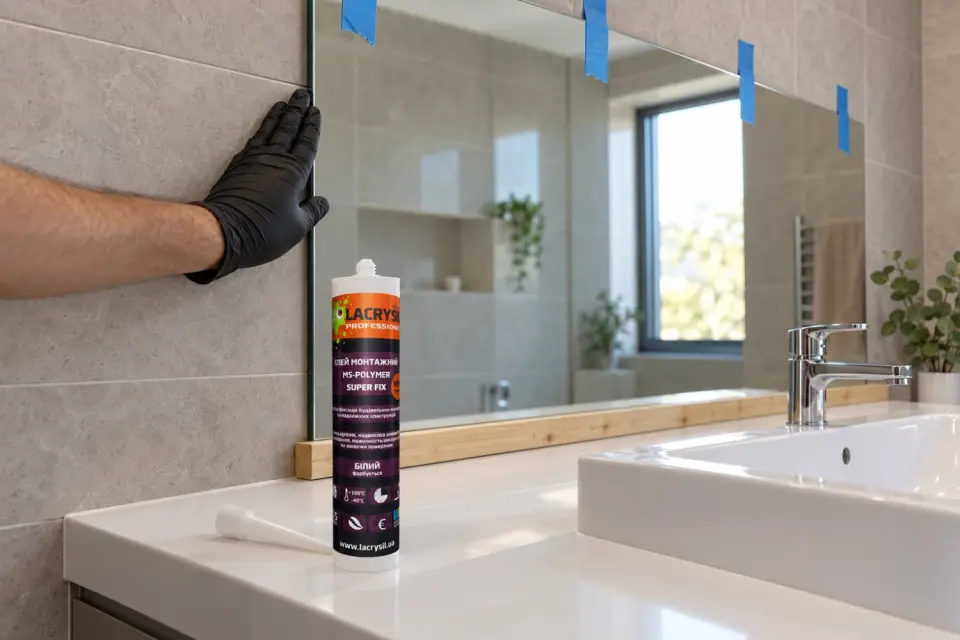
Bathroom mirror, glass shelf, visible joint | Holds and seals in one joint, works from -40 to +100 °C | |
Glass and light decor on a porous wall | 800 kg/m², invisible joint | |
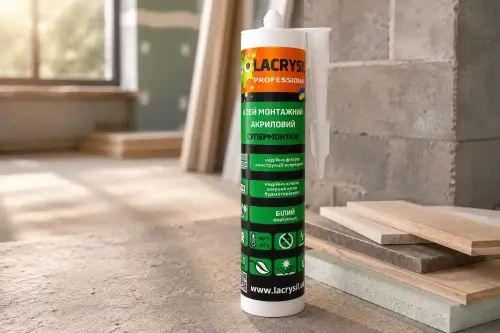
Heavy large-format tiles, ceiling elements | 1500 kg/m², service up to +100 °C | |
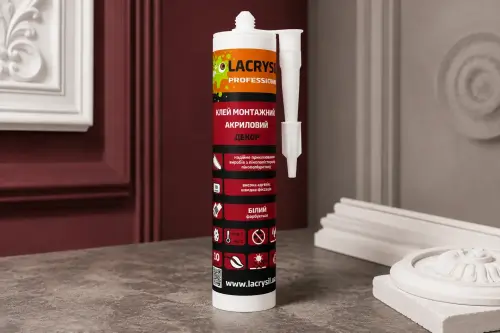
Mouldings, cornices, ceiling roses | Instant grab, 1000 kg/m², indoors only | |
Wall panels, stone, gypsum, unheated rooms | 2500 kg/m², applied from -10 °C |
A broader comparison of the three adhesive types is in which mounting adhesive to choose: MS Polymer, acrylic or rubber.
What to glue a mirror with
A mirror has two quirks. Its back is non-porous, and the protective coating over the silvering is sensitive to adhesive chemistry. Before you start, check the instructions confirm the adhesive is approved for mirrors.
MS Polymer: the main choice
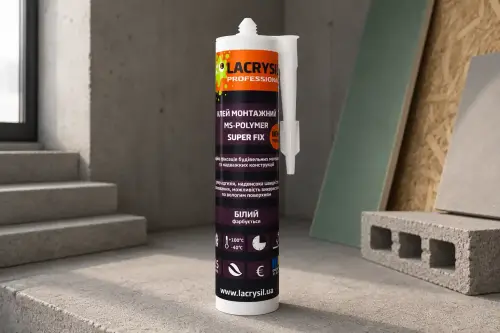
“Super Fix” lists glass and mirrors among its substrates. It contains no silicone, isocyanates or solvents and cures with air moisture, so it sets even between a mirror and tiles, where both surfaces are non-porous. The joint stays elastic and copes with vibration and temperature swings.
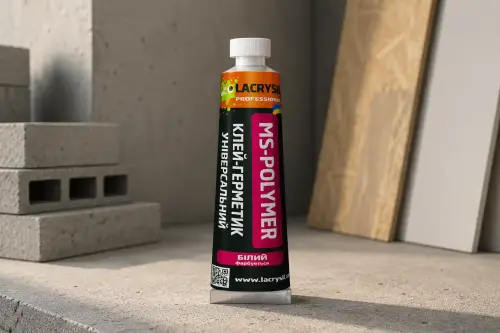
MS Polymer “Universal” comes in white and clear. Choose clear when the joint edge stays visible: a bathroom mirror, a glass shelf, a joint by the shower. Apply from +10 to +35 °C; it cures in 24–48 hours and the joint can be up to 7 mm deep.
When liquid nails will do
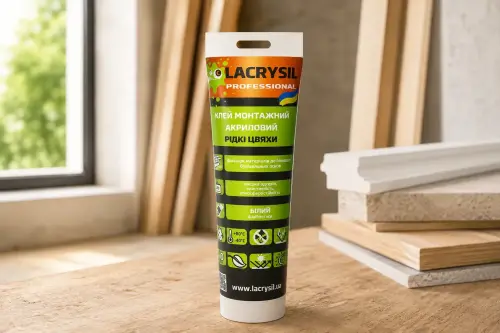
Clear “Liquid Nails” holds 800 kg/m² and is intended for glass, mirrors and light decor. But it is a water-based adhesive that dries by releasing water, so the substrate must be porous (plaster, plasterboard, concrete). On tiles or gloss paint, mirrors are bonded with MS polymer.
Why rubber adhesive is not for mirrors
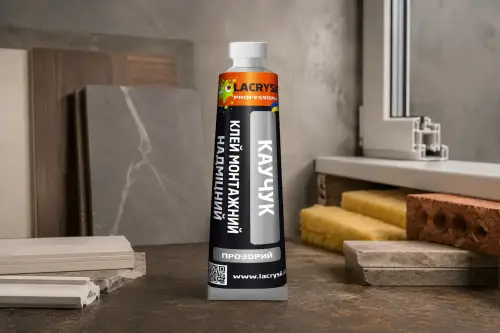
Rubber “Extra Strong” holds 2500 kg/m², but it is solvent-based and uses the contact method: coat both surfaces, wait until tack-free and join with no chance to adjust. It is not for mirrors: the solvent eats into the silvering and dark patches show through the glass. Its strengths lie elsewhere: wall panels, stone, gypsum and cold-weather work.
How to check the adhesive will hold
A 4 mm mirror weighs about 10 kg per m², so a 60×80 cm mirror weighs roughly 4.8 kg. The load figure on the tube (800, 1000, 1500 kg/m²) refers to the full area of a cured joint. Adhesive beads cover only part of the panel, so the safety margin is smaller than it looks. The takeaway is simple: apply enough adhesive and support heavy items until full cure.
How to glue a mirror: step by step
- Check the wall. Remove peeling paint and crumbly plaster: the adhesive holds only as well as the top layer does. Prime porous, dusty substrates.
- Dust and degrease the wall and the back of the mirror.
- Mark the position and prepare a support: a batten under the bottom edge.
- Apply adhesive in vertical beads, stopping a few centimetres short of the edges. The gaps between beads let air moisture reach the MS polymer.
- Press the mirror on and align it to the marks straight away. With contact rubber adhesive there is no repositioning at all.
- Leave the support in place while the adhesive cures: 24–48 hours for MS Polymer “Universal”, 48 hours for “Liquid Nails”.
Common mistakes
- bonding onto peeling paint or dust;
- acrylic adhesive between a mirror and tiles: the joint never dries;
- a continuous layer over the whole mirror instead of beads;
- removing the support before the joint has gained strength;
- relying on the tube figure without allowing for contact area.
Silicone for sealing the mirror edge by a sink is also chosen with glass in mind: the difference between neutral and acetoxy silicone is covered in neutral or acetoxy silicone: what to use for bathrooms, kitchens and glass.
What to use
For a mirror on a wall or tiles, take “Super Fix” or clear MS Polymer “Universal”. Clear “Liquid Nails” is enough for glass and light decor on a porous wall. Heavy tiles and ceiling elements go on “Supermontage”, mouldings on “Decor”, and wall panels and stone in unheated rooms on rubber “Extra Strong”. The full range is in mounting adhesives.
FAQ
What adhesive sticks a mirror to tiles?
An MS polymer adhesive such as “Super Fix” or “Universal”. Acrylic will not dry between two non-porous surfaces.
Can I glue a mirror with liquid nails?
Clear “Liquid Nails” is made for mirrors, but only on a porous substrate: plaster, plasterboard, concrete. On tiles or gloss paint, use MS Polymer.
How long should a mirror be supported after gluing?
Keep the support until cure: 24–48 hours for MS Polymer “Universal”, 48 hours for “Liquid Nails”.
How do I hang heavy decor without drilling?
Mouldings and cornices go on “Decor”, heavy tiles and ceiling elements on “Supermontage” (1500 kg/m²), panels and stone on rubber “Extra Strong” (2500 kg/m²).