










The colour on a wall almost never matches the colour catalogue chip exactly, and that is not necessarily a tinting mistake. The shade depends on the light in the room, the size of the painted area, the paint's sheen, the base and the number of coats. Here is why it happens, how to check a colour before buying the full amount and what to do if the wall has already come out "wrong".
Why the wall looks different from the colour catalogue
Different light. You looked at the colour catalogue under cold shop lights or by a window, while the wall lives under warm LEDs in the evening and daylight from the north or south. The same colour looks different under different light: warm lamps add yellow, north light makes a shade cooler and greyer. Two colours can even match under one light and differ under another; this is called metamerism.
A large area. A colour catalogue chip is a few square centimetres, a wall is tens of square metres. Over a large area the colour reflects light onto itself, so light shades look brighter and more saturated and dark ones look darker.
Sheen. The same code looks different on a deep matt paint and on a silk-sheen paint: a matt surface scatters light and looks lighter and softer, a glossier one looks deeper and more contrasting.
Base and coats. If old paint, filler or stains show through a single coat, the colour comes out uneven and mixes with the base. Without primer, paint soaks in differently in different spots.
Neighbouring colours. Floors, furniture, curtains and even greenery outside reflect onto the wall. A grey wall next to a wooden floor turns warmer, and next to a bright sofa it can pick up its tone.
A screen instead of paint. Colour on a monitor or phone depends on the screen settings. It is brighter and more saturated than paint, so a code chosen from a picture alone often looks duller on the wall.
The paint has not dried yet. Wet paint looks different from dry paint. Judge the shade only once it is fully dry, after the time given in the data sheet.
How to check a colour before buying the full amount
Preview the colour in POLIFARB Color System: it shows the shade on a photo of a room or facade and works out the tinting cost for the paint you need.
Order a small amount of tinted paint of the same brand and sheen you will buy for the whole wall.
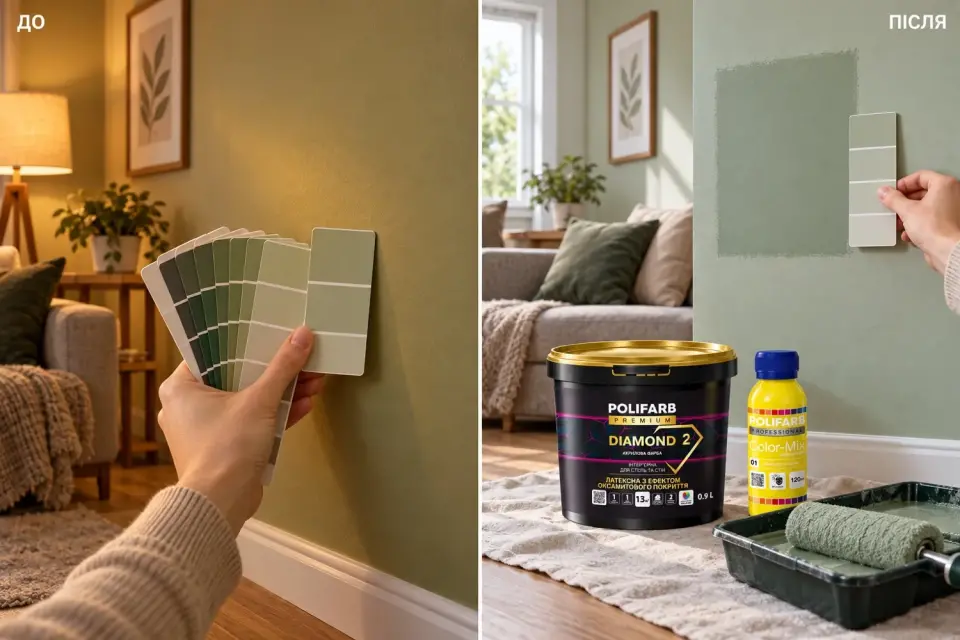
Paint a test patch on the wall itself, not on a sheet: at least 50 × 50 cm, two coats, over a primed base.
Look at the test in the morning, during the day and in the evening under artificial light, and on different walls of the room.
Compare it with the colour catalogue chip held against the dry patch, and only then tint the full amount.
How to paint so the colour comes out as planned
Prepare the base. Level and prime the wall so the paint goes on evenly and does not soak in patchily.
Apply two coats. One coat rarely gives full colour; check the number of coats and coverage in the paint's data sheet.
Tint the whole amount at once. That way every bucket is the same shade. Why different buckets give different colours is covered separately in shade differences between buckets.
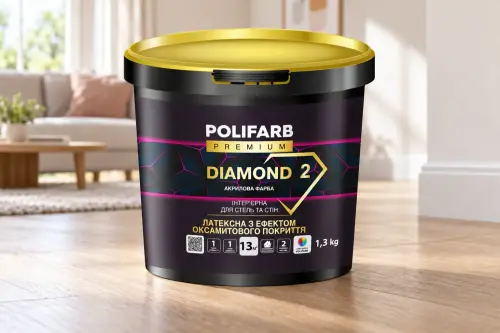
Choose paint for the room. For walls and ceilings that are washed often, deep matt acrylic latex DIAMOND 2 works well; the same colour on a silk paint comes out deeper.
If the colour has come out wrong
Slightly lighter or darker. First look at the wall in different light and once it is fully dry. Often the "wrong" colour is just the evening lamps.
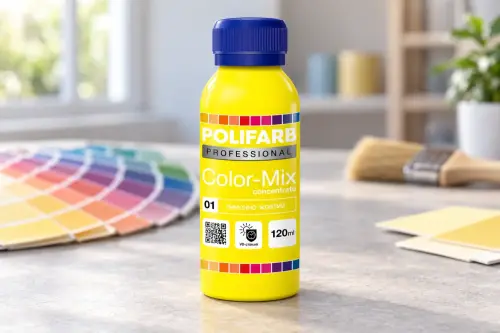
The shade needs a small change. A small correction can be made with COLOR MIX pigment: the paste goes into a white base at no more than 10% of the volume. Adjust all the remaining paint at once and paint a new test patch.
The colour is completely wrong. Repaint the wall in the new shade in two coats. To avoid repeating the mistake, choose the colour with a technologist.
We can help you choose a colour
If you are unsure which shade and paint suit your lighting, write to us or call. A technologist will suggest the colour, base and paint and explain how to make a test. General tinting rules are in paint tinting and colour matching.
FAQ
Why is the paint on the wall lighter than in the colour catalogue?
Over a large area the colour reflects light onto itself, and matt paint scatters light, so light shades on a wall often look lighter and brighter than the chip.
Why does the wall look different in the evening?
Warm lamps add yellow to a colour and cold ones make it greyer, so judge a test patch both by day and in the evening.
Can I choose a colour from a screen alone?
A screen helps narrow the choice, but the final decision needs a paint test on the wall itself.
How big should a test patch be?
At least 50 × 50 cm, two coats, over a primed base, in the same paint you will buy.
How can I slightly change the colour of paint that is already tinted?
Add COLOR MIX pigment to all the remaining paint, no more than 10% of the volume, stir thoroughly and paint a new test patch. If unsure, ask a technologist.