








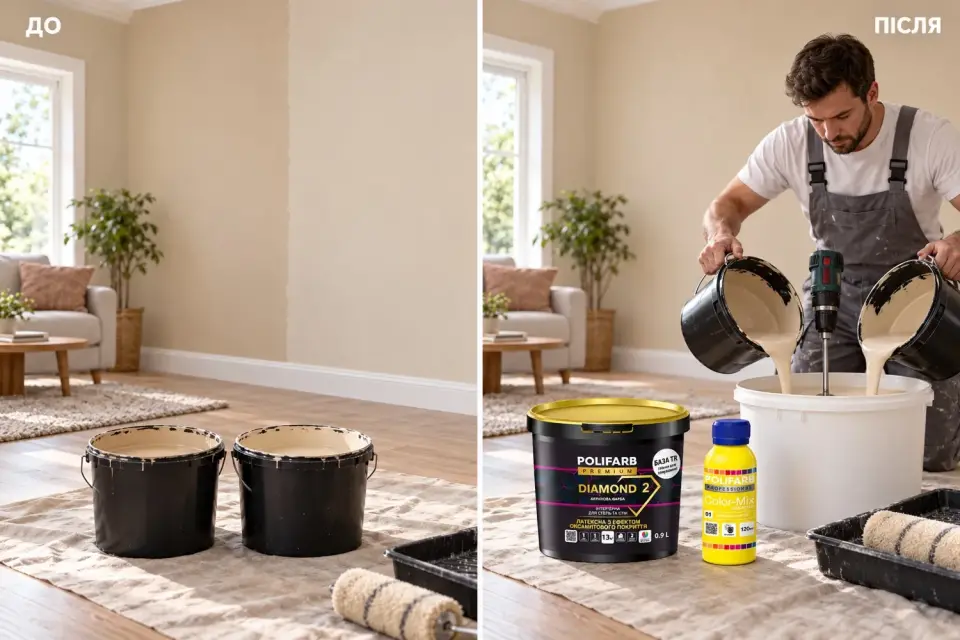
You painted two walls from different buckets and there is a visible band where they meet: one is slightly warmer, the other lighter. This shade difference almost never comes from "bad paint" but from how it was tinted, mixed and topped up. Here is where the difference between buckets comes from, how to avoid it and what to do if the band is already on the wall.
Why buckets of the same paint give different shades
They were tinted separately. Each bucket tinted on a different day or in a different order can differ slightly even with the same recipe. Most often the mismatch appears when the paint runs out and more is tinted later.
Paste was added by eye. When you tint yourself without measuring the paste exactly, each bucket ends up with its own pigment concentration. A difference of a few millilitres already shows on light shades.
Different base batches. Base from different production batches can differ slightly in whiteness. On a white wall it is invisible, but in a tinted colour it shows.
Different bases or pack sizes. The same code in white base W and in clear base TR uses different recipes, and the colour can differ between them. Use one paint and one base for the whole surface.
The paint was not stirred. Pigment and fillers settle to the bottom. If one bucket was stirred thoroughly and the other was not, the colour will differ even within one batch.
Different coats and base. An area with one coat or over unprimed filler looks different from the next area with two coats over primer, which is easy to mistake for a difference between buckets.
How to avoid shade differences
Calculate the paint in advance. Use the paint coverage calculator and add a small reserve for touch-ups.
Tint the whole amount in one order. In POLIFARB Color System you can choose the colour, the paint and the number of buckets and order them all tinted together.
Mix all the buckets. Before you start, pour the paint from several buckets into one large container and stir thoroughly. Even a small difference between buckets disappears.
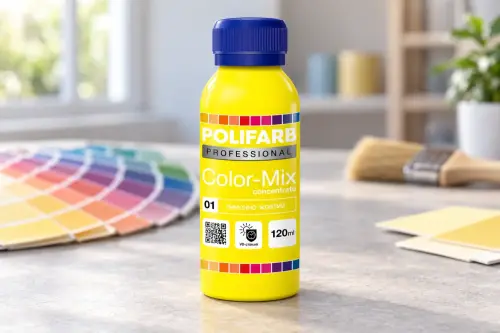
When tinting yourself, measure the paste. Measure COLOR MIX exactly for each bucket and write down how much you added. Use no more than 10% paste by volume of paint.
Change buckets at a corner. If you cannot mix everything at once, start a new bucket on a new wall, not in the middle of one.
Keep the colour details. Note the colour code, paint name, base and order number so the same recipe can be repeated.
If you run out of paint
Buy the same paint, base and colour code and give the number of your previous order.
Mix the new bucket with what is left of the old paint instead of applying it separately.
Start the new paint at a corner or on a separate wall so the join does not fall on a flat surface.
If the band is already on the wall
Look at the wall once it is fully dry and in different light: fresh paint often looks darker.
If the difference remains, mix all the paint you have in one container and repaint the whole wall from corner to corner, not just the band. Touching up one area usually only makes the join more visible.
If you have little paint left or the shade is hard to match, contact us: a technologist will advise how to match the colour to an already painted wall.
Why the colour on a wall can differ from the colour catalogue chip even from one bucket is covered in why the wall colour does not match the colour catalogue, and general tinting rules in paint tinting and colour matching.
FAQ
Why did two buckets of the same colour give different shades?
Most often the buckets were tinted separately, on different days or from different base batches, or the paint was not stirred before use.
How do I mix several buckets of tinted paint?
Pour the paint from all the buckets into one large container, stir thoroughly with a mixer, then pour it back or paint from that container.
Can I have more paint tinted later?
Yes, but the new batch may differ slightly. Mix it with the remaining old paint and start at a corner.
How much COLOR MIX paste can I add to paint?
No more than 10% of the material's volume. Measure the same amount for every bucket.
Can I repaint just the band?
Usually not: a touched-up area stands out. It is better to repaint the whole wall from corner to corner with mixed paint.