Odourless paint, strictly speaking, does not exist: even the data sheets of POLIFARB water-borne paints require ventilating the room until the specific smell is gone. The weakest smell comes from acrylic water-borne paints that contain no toxic organic solvents, and these are the ones to use when painting a flat you are living in.
Where the smell comes from and how paints differ
While the coating dries, its liquid part evaporates. In water-borne paints this is water: the data sheets list acrylic dispersion, pigments, fillers, additives and water. In alkyd enamels and stain-blocking or anti-corrosion paints it is white spirit or solvent naphtha, and the smell lingers longer.
The difference shows in the volatile organic compound (VOC) figures given in each data sheet.
Product | Thinner | VOC per data sheet |
|---|---|---|
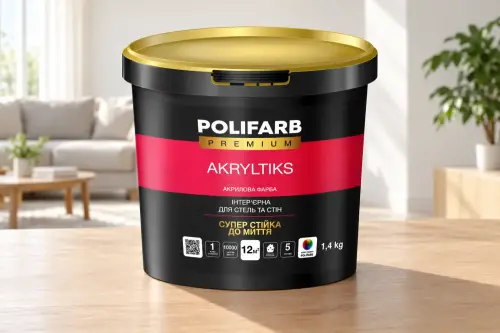
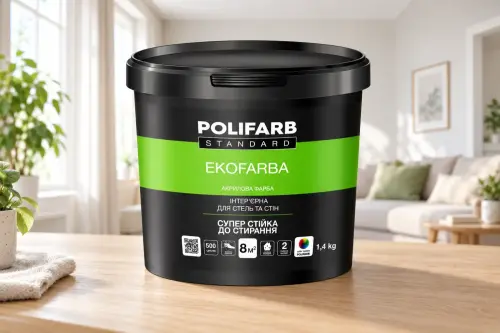
AKRYLTIKS, EKOFARBA, SNEJINKA, EXTRA LATEX | water | up to 10 g/l in the product (subcategory limit 30 g/l) |
Barvy Pryrody | water | up to 15 g/l in the product (limit 30 g/l) |
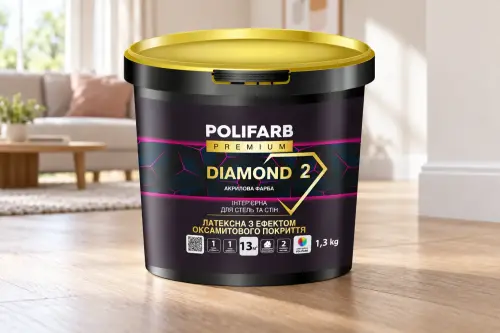
DIAMOND 2, DIAMOND 7 | water | subcategory limit 30 g/l |
PF-115 alkyd enamel | white spirit, solvent naphtha | subcategory limit 300 g/l |
IZOMAL, Zahyst 3in1, PF-266 floor enamel | white spirit or solvent naphtha | subcategory limit 500 g/l |
The limit is the maximum allowed for that product type, not the actual content. The scale still tells the story: between a water-borne wall paint and a solvent-borne enamel there is a difference of tens of times.
Walls and ceilings: water-borne paints
All POLIFARB interior paints for walls and ceilings are water-borne, non-flammable and free of toxic organic solvents. You choose between them by wet-scrub class and sheen.
- Kitchen, hallway, children's room: wet-scrub class 1. That means DIAMOND 2 deep-matt acrylic latex paint, DIAMOND 7 satin acrylic latex paint and Barvy Pryrody acrylic paint. More options are on the washable wall paints page.
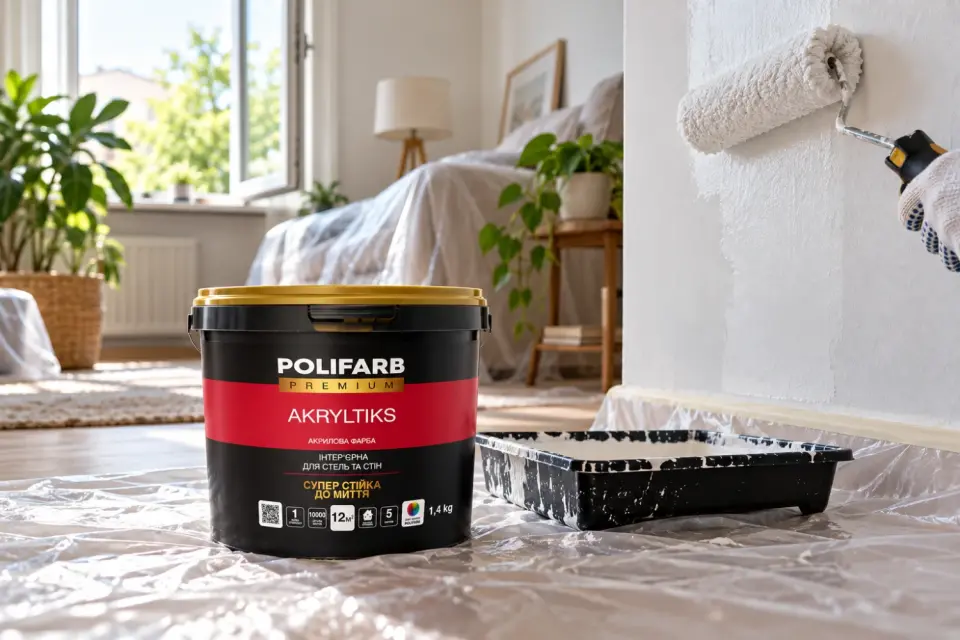
- Bedroom, living room: AKRYLTIKS thixotropic acrylic paint with class 2 or EXTRA LATEX interior paint with class 3.
- Ceiling: EKOFARBA deep-matt paint, resistant to dry rubbing and applied in 2 coats. More options on the ceiling paints page.
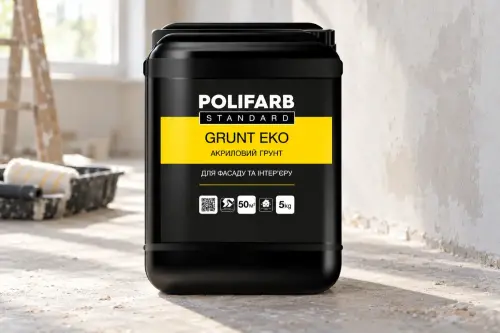
The primers for these paints are water-borne too: GRUNT EKO acrylic primer and PROFI GRUNT consist of acrylic dispersion, additives and water. How latex paint differs from acrylic is covered in latex or acrylic paint.
Doors, window sills, radiators: 7-in-1 primer-enamel
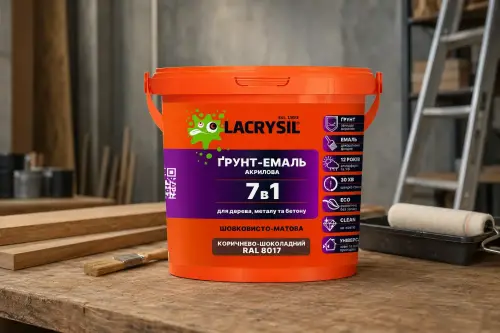
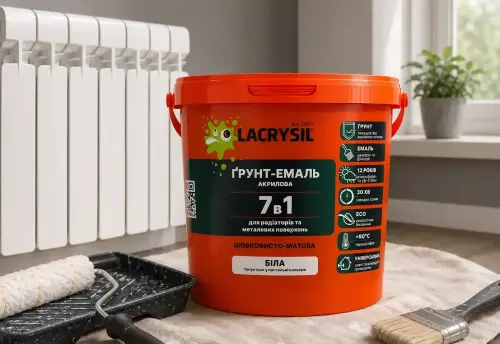
Wood and metal indoors are traditionally painted with alkyd enamel, which smells of solvent for several days. The alternative is the water-borne 7-in-1 primer-enamel: a water-based formula without a strong smell. A coat dries in 30 minutes and tools are washed with water.
- 7-in-1 acrylic primer-enamel for wood, metal and concrete for wooden doors, frames, window sills and metal parts.
- 7-in-1 primer-enamel for radiators withstands heat up to +80 °C, so it suits radiators. The technique is in how to paint heating radiators.
Floors: we have no low-odour floor paint
To be plain about it: POLIFARB has no water-borne floor paint. Wooden floors are painted with PF-266 alkyd enamel (thinned with white spirit, flammable), concrete floors with AKRYLBET, which is solvent-borne. Both smell of solvent, and PF-266 can be walked on only after 7 days.
So plan the floor for a time when you can stay elsewhere, or at least close the room off and keep it ventilated. Wooden floor enamels are collected on the wooden floor paints page.
When a solvent product cannot be avoided
Some jobs are beyond water-borne paint. Stains from leaks, soot, rust and nicotine bleed through a water-borne coating, so they are first sealed with IZOMAL stain-blocking paint, which is thinned with white spirit. Under a topcoat the data sheet recommends one coat; once dry, it can be painted with any POLIFARB water-borne paint. The IZOMAL area is usually small, so the smell is local, but ventilation is still required.
How to paint while living in the flat
- Paint one room at a time. Close the doors to other rooms so the smell does not spread.
- Ventilate during and after work. The data sheets allow the room to be used once the specific smell has gone.
- Keep within +5 to +30 °C: in the cold, paint dries more slowly and so smells for longer.
- Leave 2 hours between coats, as the wall paint data sheets state.
- Do not wash the walls until 7 days after painting.
- Close opened tins tightly. How to store leftovers is explained in how to store leftover paint.
If the smell still lingers, ways to speed up its removal are collected in how to get rid of paint smell after painting.
What to buy
For walls and ceilings in an occupied flat: DIAMOND 2 or Barvy Pryrody for rooms that get washed, AKRYLTIKS for bedrooms, EKOFARBA for ceilings, with GRUNT EKO underneath. For doors, window sills and radiators, the 7-in-1 primer-enamel. Plan floors and stain sealing separately, with ventilation. Work out the quantity in the paint consumption calculator.
FAQ
Is there a completely odourless paint?
No. Even water-borne paints have a specific smell while drying, and the data sheets require ventilation until it has gone. Water-borne paints smell much less than solvent-borne enamels.
Which low-odour wall paint suits a children's room?
A water-borne paint with wet-scrub class 1: DIAMOND 2, DIAMOND 7 or Barvy Pryrody. They contain no toxic organic solvents, and walls in a children's room need washing.
How can I paint radiators without a strong smell?
With the 7-in-1 primer-enamel for radiators: it is water-borne, has no strong smell and withstands heat up to +80 °C.
Is there an odourless floor paint?
Not from POLIFARB. PF-266 and AKRYLBET floor paints contain solvent, so the room needs thorough ventilation during and after painting.