Whether latex or acrylic paint is better comes down to the wet-scrub class and the gloss level, not the word on the label. In POLIFARB technical data sheets the binder is the same in both cases, an acrylic dispersion, so compare the numbers rather than the names.
How latex paint differs from acrylic
In the coatings industry, latex means a water-borne polymer dispersion. An acrylic dispersion is a latex too, so "acrylic latex paint" is a perfectly accurate description. In the market, "latex" has come to mean a paint with a denser, washable film.
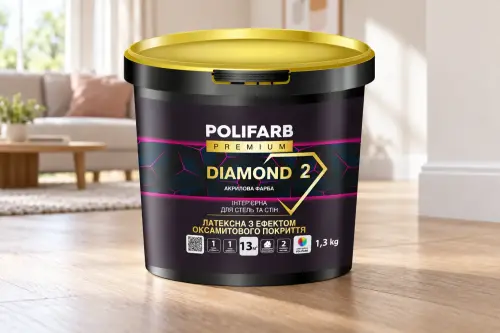
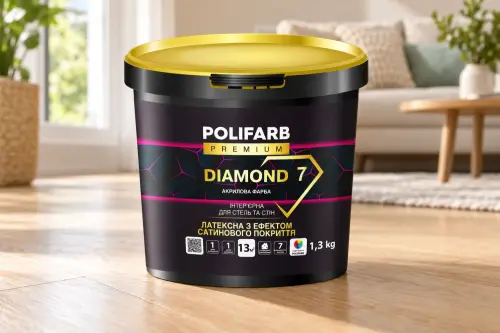
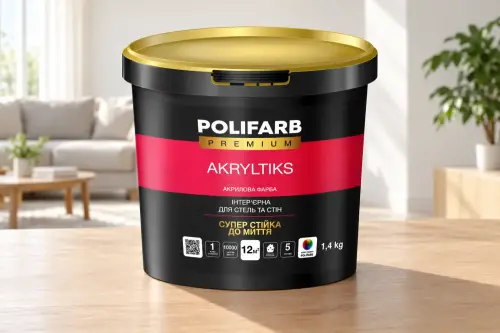
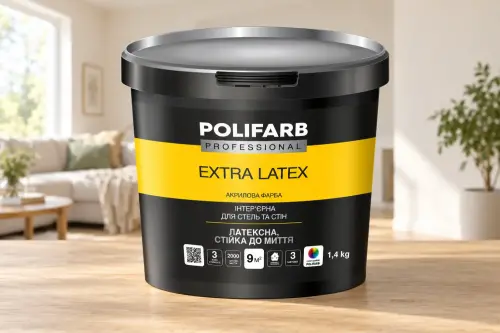
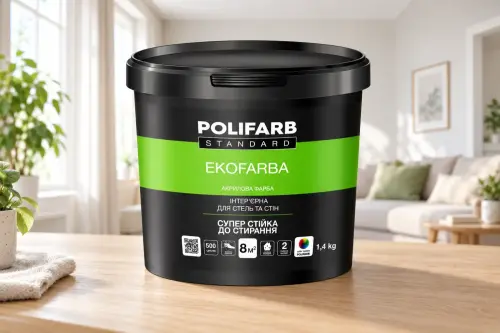
Look at the composition in the data sheets. DIAMOND 2 acrylic latex paint, DIAMOND 7 satin acrylic latex paint, EXTRA LATEX interior paint, AKRYLTIKS acrylic paint and EKOFARBA deep-matt paint all start with the same line: acrylic dispersion, pigments, fillers, additives, water. What differs is the formula: how much binder and filler, which gloss level and how much wet scrubbing the film withstands.
A telling example: EXTRA LATEX has "latex" in its name but wet-scrub class 3. AKRYLTIKS is listed as acrylic (its data sheet also says "latex" among its features) and has class 2, so it washes better. The name does not tell you how a paint will cope in a kitchen. The class does.
What to compare instead of the name
- Wet-scrub resistance class under EN 13300. Class 1 is the highest: up to 5 µm of wear after 200 scrub cycles. Class 2 is 5–20 µm, class 3 is 20–70 µm. The lower the number, the more often the wall can be washed.
- Gloss level. Deep matt hides plaster defects. Satin and silky finishes clean more easily but show every ripple in the substrate under side light.
- Hiding power. A class 1 paint covers the substrate without show-through at the stated spread rate; a class 3 paint needs two full coats.
- Consumption per coat in g/m², given separately for absorbent and non-absorbent substrates.
Five POLIFARB paints compared
Paint | Wet-scrub class | Gloss level | Hiding power | Consumption per coat, g/m² |
|---|---|---|---|---|
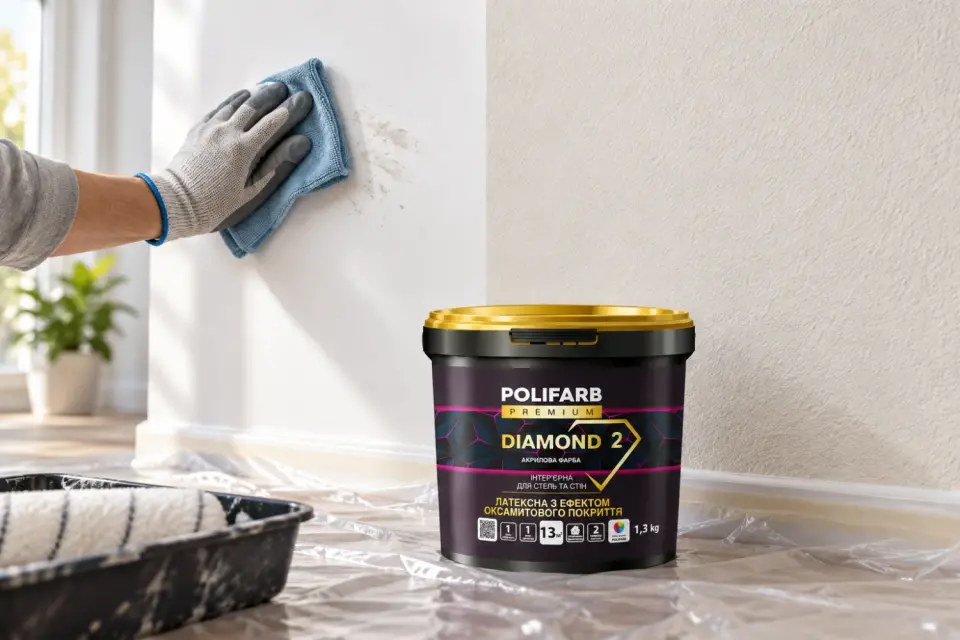
DIAMOND 2 | 1 | 2, deep matt | class 1 | 100–150 / 150–190 |
DIAMOND 7 | 1 | 7, satin matt | class 1 | 100–150 / 150–190 |
AKRYLTIKS | 2 | 5, matt | class 1 | 110–150 / 170–210 |
EXTRA LATEX | 3 | 3, matt | class 2 | 150–200 / 200–240 |
EKOFARBA | not stated, dry-rub resistant | 2, deep matt | class 3 | 170–220 / 200–240 |
The first consumption figure is for non-absorbent substrates, the second for absorbent ones. Figures come from the data sheets; actual consumption depends on the substrate, colour and tool. All five paints are applied at +5…+30 °C with 2 hours between coats. Paints with a wet-scrub class can be washed no sooner than 7 days after painting.
Which paint to use for walls and ceilings
Kitchen, hallway, children’s room
Walls here are washed regularly, so you need class 1. DIAMOND 2 gives a deep matt finish, DIAMOND 7 a satin one that releases stains more easily but shows a sheen on an uneven wall. For a more noticeable sheen, the range also includes DIAMOND 15 silky paint. More options are on the washable wall paints page.
Living room, bedroom, study
These walls are wiped only occasionally, so class 2 or 3 is enough. AKRYLTIKS is thixotropic: it does not drip off the roller or sag, and it has class 1 hiding power. EXTRA LATEX is matt with class 2 hiding power and goes on in two coats.
Ceiling
Nobody washes a ceiling, so the wet-scrub class matters less here. A deep matt finish that hides laps and trowel marks matters more. EKOFARBA with gloss level 2 works, and in a kitchen where grease settles on the ceiling, DIAMOND 2. See more options on the ceiling paints page and the technique in our guide on painting a ceiling yourself.
Bathroom
In a damp room choosing "latex" is not enough: the splash zone, primer and joints all matter. This is covered separately in which paint to choose for a bathroom. A full room-by-room guide is in how to choose wall paint.
Common mistakes
- Buying by the word "latex" on the tin without checking the wet-scrub class.
- Putting satin or silky paint on an uneven wall. The sheen will highlight every ripple; such walls need deep matt.
- Washing the wall a day or two after painting. The film needs 7 days.
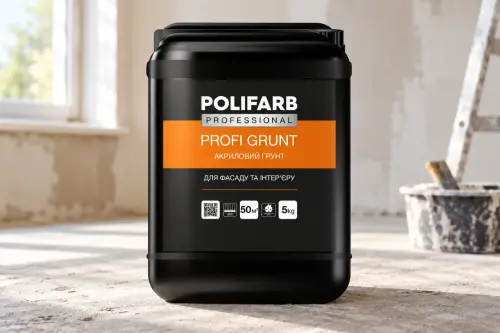
- Painting without primer. The data sheets of all five paints call for priming with GRUNT EKO, PROFI GRUNT or GRUNT CONCENTRATE 1:4 first.
- Tinting the paint in batches. Tint the whole quantity from one production batch at once; see the article on paint tinting.
What to buy
For the kitchen, hallway and children’s room, take DIAMOND 2 (matt) or DIAMOND 7 (satin), both class 1. For living rooms, AKRYLTIKS (class 2) or EXTRA LATEX (class 3). For ceilings and rooms where walls are not washed, EKOFARBA. Prime the substrate with PROFI GRUNT deep-penetrating primer and work out the quantity in the paint consumption calculator. What acrylic paint is in general is explained in our article on acrylic paints.
FAQ
Which is better, latex or acrylic paint?
Both use an acrylic dispersion binder. The better one is the paint whose wet-scrub class suits the room: class 1 for kitchens and hallways, class 2–3 for bedrooms and living rooms.
Can acrylic paint be washed?
Yes, if the data sheet gives a wet-scrub class, and no sooner than 7 days after painting. EKOFARBA is only rated for dry rubbing and should not be washed with detergents.
What does the number in DIAMOND 2 and DIAMOND 7 mean?
It is the gloss level: 2 is deep matt, 7 satin matt, 15 silky. All three share the same wet-scrub class, class 1.
How many coats should I apply?
EKOFARBA goes on in 2 coats according to its data sheet. DIAMOND, AKRYLTIKS and EXTRA LATEX take one or two coats with 2 hours of drying between them. One coat is usually enough only when repainting in a similar shade.