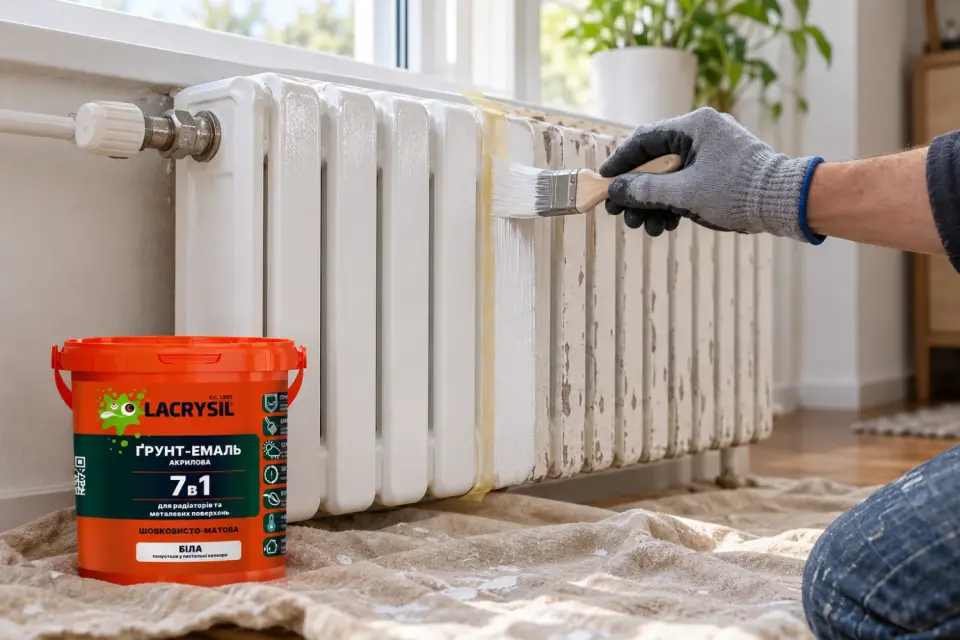
Heating radiators are painted with an enamel whose documentation states heat resistance up to the radiator’s working temperature. At POLIFARB that is 7-in-1 acrylic primer enamel for radiators and metal surfaces: it withstands up to +80 °C, dries in 30 minutes and goes straight over rust once the loose layer is removed. Below is how it differs from other metal enamels, how to prepare a radiator and what to avoid.
What a radiator paint needs
- Stated heat resistance. If the product page or data sheet gives no temperature, the coating’s behaviour on hot metal is unpredictable. Ordinary acrylic paint on a radiator yellows and eventually cracks.
- Adhesion to metal and rust. Old radiators are rarely clean, so it helps when the enamel doubles as a primer.
- Odour. Radiators are painted in living rooms, often in the cold season. Alkyd enamels smell during application and can give off odour when the heating comes on.
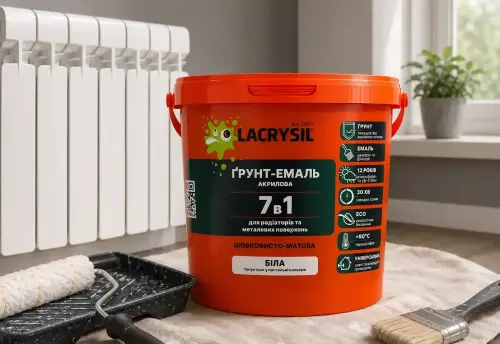
7-in-1 primer enamel for radiators
It is a water-based coating that works as primer and topcoat at once. What the product page says about it:
- heat resistance up to +80 °C;
- drying time per coat: 30 minutes;
- goes directly over rust after the loose layer is removed, no separate primer needed;
- film thickness: 0.25 mm;
- low-odour, so it can be used in an occupied room;
- satin-matt finish, for interior and exterior use, declared protection 12 years;
- tools clean with water.
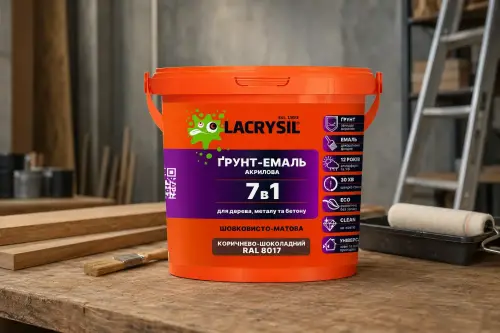
Do not confuse it with the 7-in-1 primer enamel for wood, metal and concrete. Heat resistance to +80 °C is stated only for the radiator version. Both versions are compared in detail in 7-in-1 acrylic primer enamel.
What about Zahyst 3in1 rust paint?
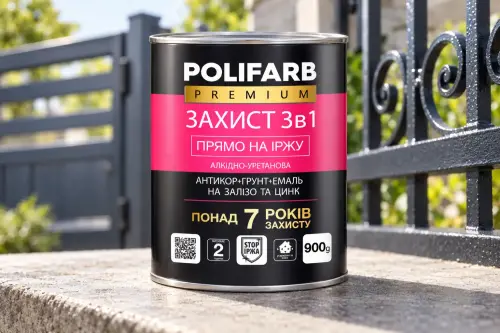
Zahyst 3in1 alkyd-urethane primer enamel also goes over rust without primer, but its data sheet gives no heat resistance. So we do not recommend it for hot radiators. It belongs on gates, fences and ferrous steel structures; it is not suitable for galvanised steel. How to use it is covered in the 3-in-1 paint guide, and other options are on the 3-in-1 rust paints page.
Parameter | 7-in-1 primer enamel for radiators | Zahyst 3in1 |
|---|---|---|
Base | water-based dispersion | polyurethane resin, solvent naphtha |
Heat resistance | up to +80 °C | not stated in the data sheet |
Drying per coat | 30 minutes | 2 hours, full cure at least 7 days |
Odour and safety | low-odour | flammable, ventilation required |
Gloss | satin matt | medium gloss |
Tool cleaning | water | ROZCHYNNYK 3 in 1 or solvent naphtha |
How to paint a radiator: step by step
- Turn off the heating and let the radiator cool. On hot metal a water-based enamel boils and goes on in bubbles.
- Remove loose rust, scale and flaking old coating with a wire brush or sandpaper.
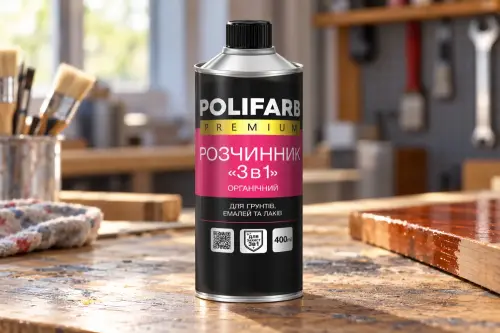
- Degrease the surface. ROZCHYNNYK 3 in 1 organic solvent does the job: its data sheet lists degreasing surfaces among its uses. Wipe the radiator with a dampened rag and let the solvent evaporate completely. The solvent is flammable and explosive, so wear gloves and a respirator and keep a window open.
- Cover the floor and the wall behind the radiator with film or paper.
- Apply the first coat by brush, roller or spray, about 0.25 mm thick. A thinner film will not give the declared protection; a thicker one takes longer to reach full strength.
- After 30 minutes, apply the second coat.
- Wash the tools with water straight away. How to clean a brush once paint has started to dry is explained in cleaning brushes and rollers.
- Turn the heating back on no sooner than a day after the last coat: the film needs time to build strength.
Do not add solvent to the primer enamel itself. It is water-based; the solvent is only for degreasing the metal.
Common mistakes
- Painting a hot radiator.
- Using an enamel with no stated heat resistance, including Zahyst 3in1 or the 7-in-1 primer enamel for wood, metal and concrete.
- Painting over loose rust and greasy patches: the coating will come off with them.
- Applying one thick coat instead of two thin ones.
- Turning the heating on straight after painting.
What to buy
For heating radiators, take the 7-in-1 primer enamel for radiators and metal surfaces, and ROZCHYNNYK 3 in 1 for degreasing. If there are metal doors, gates or an outdoor fence nearby, Zahyst 3in1 suits them, and the step-by-step process is in how to paint metal gates without rust.
FAQ
What paint keeps a radiator from yellowing?
An enamel with stated heat resistance. The 7-in-1 primer enamel for radiators is rated up to +80 °C, which covers a radiator’s working temperature.
Can I paint a hot radiator?
No. Turn the heating off and wait for the radiator to cool, otherwise the water-based enamel boils and goes on in bubbles.
Do I need a primer before painting a radiator?
Not with the 7-in-1 primer enamel: primer and enamel are in one product. Just remove loose rust and degrease the metal.
Can I paint a radiator with 3-in-1 rust paint?
The Zahyst 3in1 data sheet gives no heat resistance, so we do not recommend it for hot radiators. Use the radiator version of the 7-in-1 primer enamel instead.