Enamel differs from paint in its base: enamel is made on varnish (resin in an organic solvent) and forms a hard gloss film, while water-based paint uses water with a polymer dispersion and forms a matte or silky elastic coating. "Enamel paint" is simply an everyday name for the same enamel in a ready-made colour. Below we sort out the terms, the difference between water-emulsion and water-dispersion paints, and what to use for which job.
Enamel vs enamel paint
Enamel is a coating based on varnish, that is, resin dissolved in an organic solvent. Once dry, it forms a hard, dense, smooth film with a pronounced gloss, similar to a glassy finish.
Enamel paint is ready-coloured enamel. Its high varnish content gives a stronger, more wear-resistant and decorative coating than ordinary paints. So it is not a separate class of material, just enamel that people call "paint".
POLIFARB enamels include:
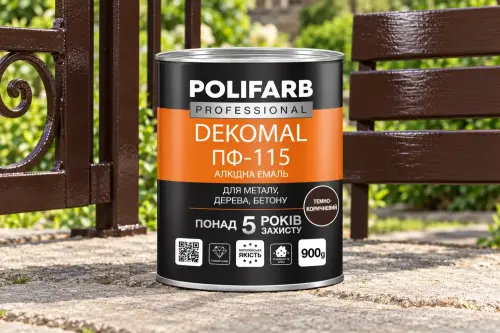
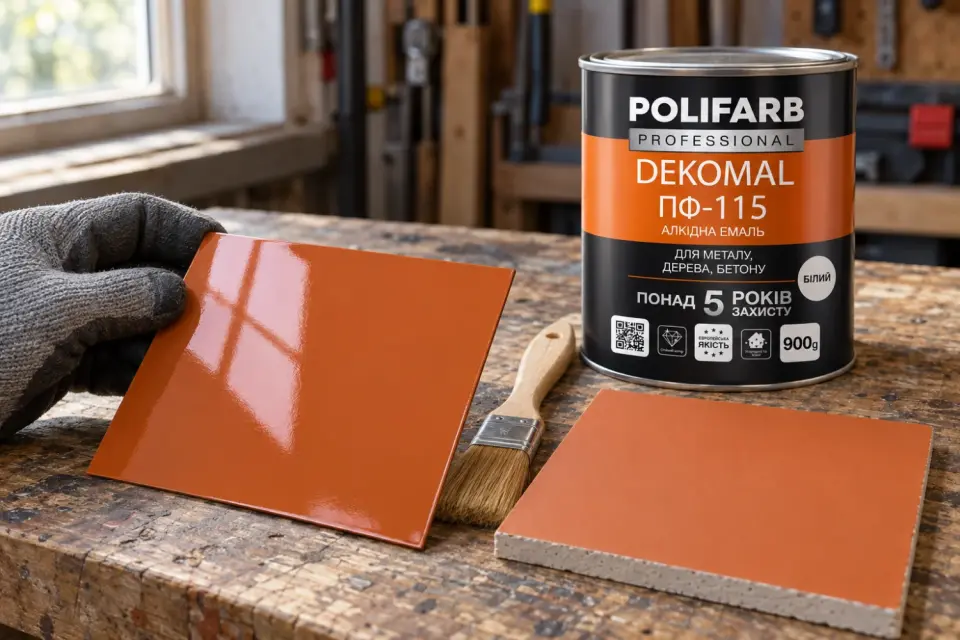
- DEKOMAL PF-115 alkyd enamel and EXTRAMAL PF-115 for metal, wood, concrete and outdoor structures;
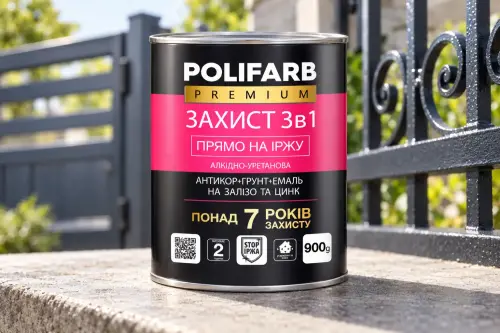
- Zahyst 3in1 anti-corrosion primer-enamel, alkyd-urethane, applied straight over rust, for ferrous metal (not for galvanized steel, which is primed with GF-021 and painted with RUBBER FARBA or PF-115).
Pros of enamels: high hardness, resistance to impact, moisture and chemicals, gloss or semi-gloss, corrosion protection. Cons: strong solvent odour during application and longer drying than water-based paints. Composition, grades and consumption are covered in our article on alkyd enamels.
Water-based paints: emulsion and dispersion
Water-based (water-thinnable) paints use water as the solvent. They have almost no odour, dry quickly, are easy to apply and suit most interior and exterior work. In the POLIFARB range these are acrylic, latex and silicone paints, which the manufacturer calls water-dispersion paints, although people often call them water-emulsion paints.
How they differ
- Water-emulsion paints (an emulsion of liquid polymer in water) usually hide better and give a more elastic film: suitable for ceilings and walls in dry rooms.
- Water-dispersion paints (a dispersion of solid polymer particles) are usually stronger and more resistant to moisture and weather: used on facades, in kitchens, bathrooms and high-traffic rooms.
In practice the difference is small, and many acrylic and latex paints combine the strengths of both. The wash-resistance class and intended use matter more than the name.
Examples of POLIFARB water-based paints
- SNEJINKA acrylic paint: brilliant white deep-matte paint for ceilings, does not yellow, resistant to dry abrasion.
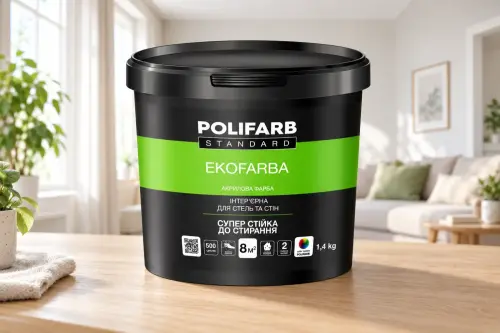
- EKOFARBA acrylic paint: deep matte for low-traffic rooms, 500 dry-abrasion cycles, hides hairline cracks.
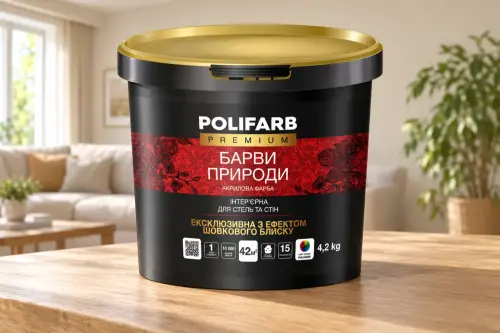
- Barvy Pryrody acrylic paint: silky sheen, class 1 wet-scrub resistance, highly elastic film.
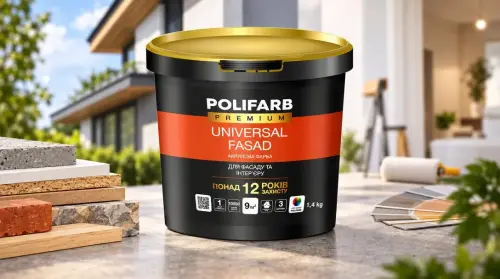
- UNIVERSAL FASAD facade paint: one paint for facade and interior, class 2 wash resistance, facade protection over 12 years.
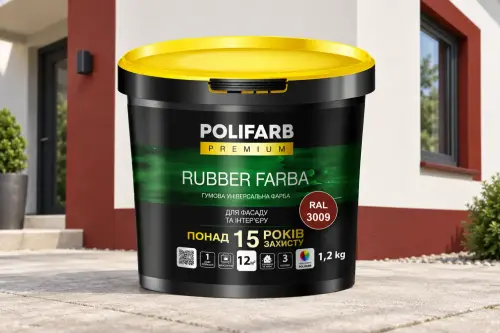
- RUBBER FARBA rubber paint: elastic acrylic film for roofs, plinths, metal and slate, class 1 wash resistance.
Enamels vs water-based paints
Parameter | Enamels (PF-115, Zahyst 3in1) | Water-based paints (acrylic, latex, silicone) |
|---|---|---|
Base | alkyd resin + organic solvents | water + acrylic, latex or silicone |
Odour | strong during application | minimal |
Finish | gloss or semi-gloss, hard | matte, silky or semi-matte, elastic |
Durability | very high: impact, chemicals, corrosion | high, especially silicone and rubber types |
Moisture resistance | high | good to high (facade and rubber types) |
Thinner | white spirit (PF-115), POLIFARB 3in1 thinner or solvent naphtha (Zahyst 3in1) | water |
Typical use | metal, wood, doors, windows, radiators | walls and ceilings, facades, wet rooms |
What to choose for the job
- Doors, windows, furniture, metal, radiators: enamels: DEKOMAL PF-115, EXTRAMAL PF-115 or Zahyst 3in1 for rusty metal.
- Walls and ceilings in a flat: interior water-based paints: SNEJINKA for ceilings, EKOFARBA for bedrooms and living rooms, Barvy Pryrody where walls get washed.
- Facades and wet areas: UNIVERSAL FASAD or RUBBER FARBA.
Before buying, check the can for the substrates and conditions the product is meant for. Water-based paints are tinted in the POLIFARB Color System and with COLOR MIX pastes. How to choose paint specifically for walls is covered in our wall paint guide, and how acrylic paints work in what acrylic paints are.
FAQ
What is the difference between enamel and paint?
Enamel has a varnish base with an organic solvent and forms a hard gloss film. Water-based paint is thinned with water and gives a matte or silky elastic finish.
Are enamel paint and enamel the same thing?
Yes, "enamel paint" is the everyday name for ready-coloured enamel.
Can you paint walls with enamel?
Yes, for example PF-115 in a garage or workshop where a hard washable finish is needed. For living rooms, water-based paints are more convenient: no strong odour and faster drying.
What is the difference between water-emulsion and water-dispersion paint?
Water-emulsion is an emulsion of liquid polymer; water-dispersion is a dispersion of solid particles. In practice the names are often used interchangeably.