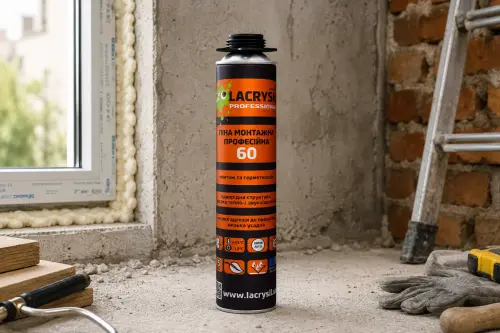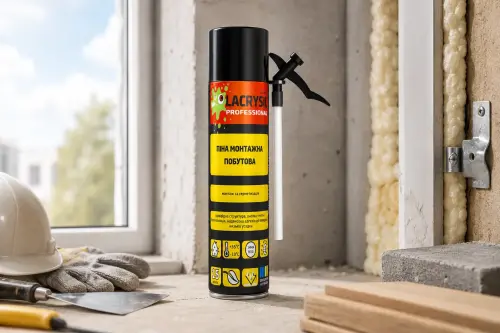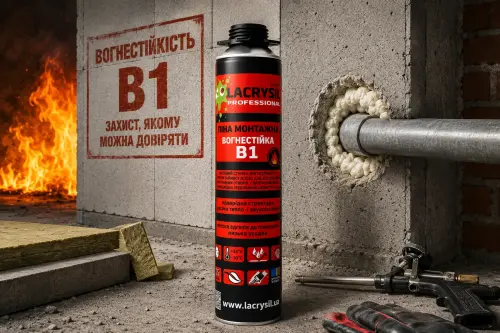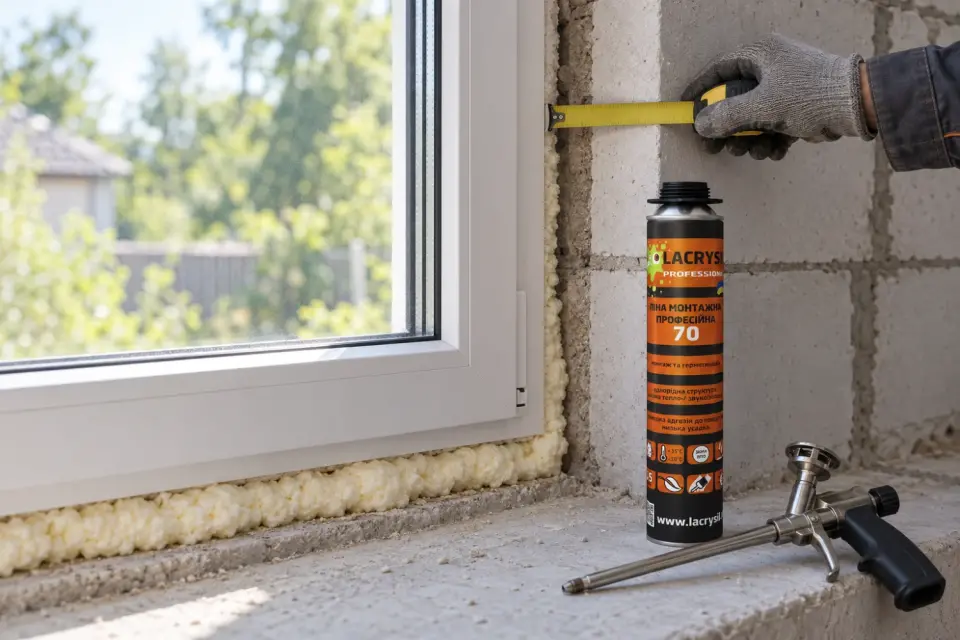
How much expanding foam a window needs depends on the gap volume: window perimeter × joint width × joint depth. For a 1.3 × 1.4 m window with a 3 × 6 cm gap that is about 10 l of foam, so one professional can covers several such windows. Work out your own case in the expanding foam calculator.
The formula in plain words
- Joint length. For a window or door it is the opening perimeter: (width + height) × 2 × number of openings.
- Volume, l = length, m × gap width, cm × gap depth, cm × 0.1.
- With margin: × (1 + margin / 100). The calculator defaults to 15 % so you are not buying another can at the end of the job.
- Cans = volume with margin / yield per can, rounded up.
Millilitres on the can vs litres of foam
The label shows the volume of liquid in the can (750, 800, 850 ml), but the calculation needs the yield of cured foam in litres. The manufacturer gives it as a maximum: "up to 60 l" from 750 ml, "up to 65 l" from 800 ml, "up to 70 l" from 850 ml. Real yield is always lower: in the cold, on a dry substrate and when spraying downwards the foam gives less, and a cold can yields half as much.
In the "Pick a product" tab the calculator does not use the "up to" figure; it works out the yield from the weight of foam in the can and its density. The result is more cautious: about 45 l for an 850 ml can of professional expanding foam and about 31 l for an 850 ml can of household foam with a straw.
Example 1: one window
A 1.3 × 1.4 m window, a gap 3 cm wide and 6 cm deep. These are the calculator's default values.
- Perimeter: (1.3 + 1.4) × 2 = 5.4 m.
- Volume: 5.4 × 3 × 6 × 0.1 = 9.72 l.
- With a 15 % margin: 11.2 l. One 45 l can covers this window comfortably.
Example 2: three windows, professional or household foam
The same windows, three of them: in "Opening perimeter" mode enter quantity 3.
- Length: 16.2 m, volume: 29.2 l, or 33.5 l with a 15 % margin.
- Professional foam, 850 ml (≈ 45 l calculated): one can.
- Household foam, 850 ml (≈ 31 l calculated): two cans.
Going by the "up to 70 l" label, both come out as one can, and with household foam you would run out on the third window.
Example 3: a door frame
A 0.9 × 2.1 m door; the threshold is not foamed, so the length is entered in "Joint length" mode: 0.9 + 2 × 2.1 = 5.1 m. Gap 2 × 6 cm.
- Volume: 5.1 × 2 × 6 × 0.1 = 6.12 l, or 7 l with a 15 % margin.
- A small 320 ml household can (≈ 8.6 l calculated) just about covers it; a 750 ml can (≈ 22.6 l) does it with room to spare.
POLIFARB can yields
Foam | Can | Label yield | Calculator yield | Post-expansion |
|---|---|---|---|---|
Professional (gun-grade) | 750 / 800 / 850 ml | up to 60 / 65 / 70 l | ≈ 34 / 42.5 / 45 l | 15–30 % |
Household (with straw) | 320 / 750 / 800 / 850 ml | up to 30 / 60 / 65 / 70 l | ≈ 8.6 / 22.6 / 24.6 / 30.6 l | 200–300 % |
800 ml | — | ≈ 39.7 l | 150–250 % |
Expansion affects technique: household foam fills a third of the joint depth, fire-rated foam about half, while professional foam adds only 15–30 % and does not push the frame.
What affects consumption
- Can temperature. Keep it at +15…+30 °C even when working in frost. Professional and household foam can be applied from -10 °C, fire-rated from +10 °C.
- Substrate and direction. A dry substrate and spraying downwards reduce the yield.
- Joint width and evenness. An uneven gap takes more than the average figures in the calculation.
- Dispensing. A gun meters foam more precisely; an opened can with a straw can hardly be kept, so the rest is often wasted.
Common mistakes
- Calculating from the millilitres on the can or the "up to 70 l" label.
- Using a cold can: the structure tears and the yield halves.
- Leaving no margin. A can you run out of on the last window costs more than a leftover.
- Leaving the joint exposed. Foam does not withstand UV and crumbles within a season, so outside it is covered with vapour-permeable sealant "A" or Universal silicone sealant.
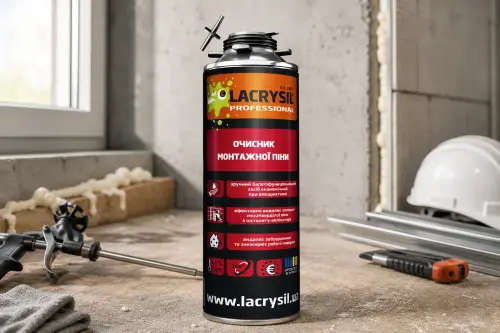
Why a joint crumbles or bends the frame is covered in our article on expanding foam mistakes. Fresh smears come off with expanding foam cleaner; for dried foam, see how to remove dried expanding foam.
What to buy
For several windows and doors, gun-grade professional foam pays off: it yields more and does not push the frame. For a single gap or door, household foam with a straw is enough. Where fire resistance is required, use fire-rated B1. Work out the number of cans for your openings in the foam calculator.
FAQ
How many cans of foam for one window?
A 1.3 × 1.4 m window with a 3 × 6 cm gap needs about 11 l of foam including margin, so less than one professional can.
Which can yield should I enter in the calculator?
The real or manufacturer-stated yield of cured foam in litres, for example 35, 45, 60 or 70 l. For buying, a more cautious value is safer.
Why doesn't the result match the can volume in ml?
The millilitres on the label are the liquid in the can; the joint is filled by foam after it has expanded.
How much foam for a door?
For a 0.9 × 2.1 m frame without the threshold and a 2 × 6 cm gap, about 7 l including margin. One 750 ml can is enough.