Save to favorites

Add to compare

Sale ends in

00 days
00 hrs
00 min
00 sec

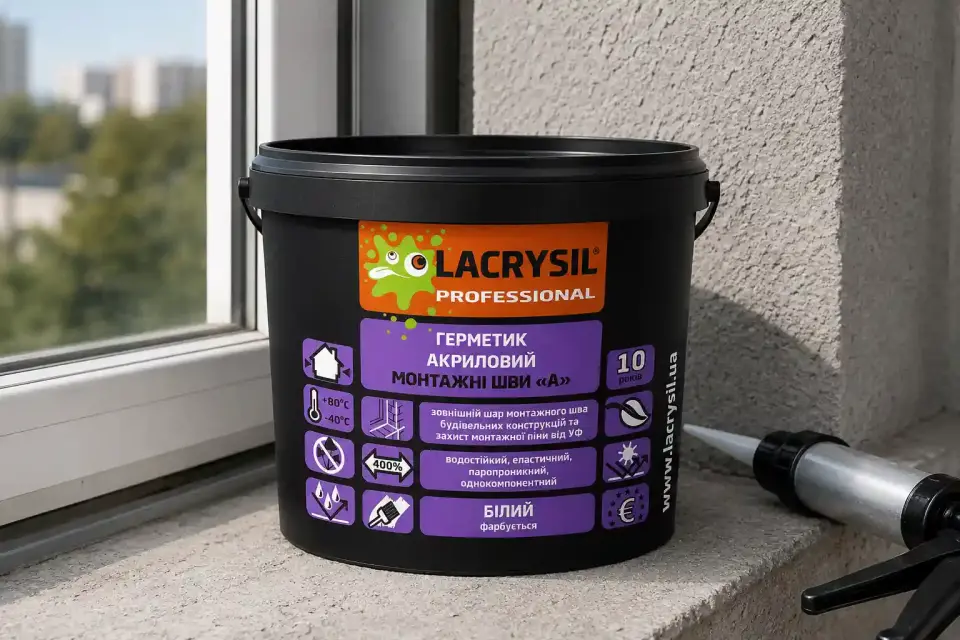
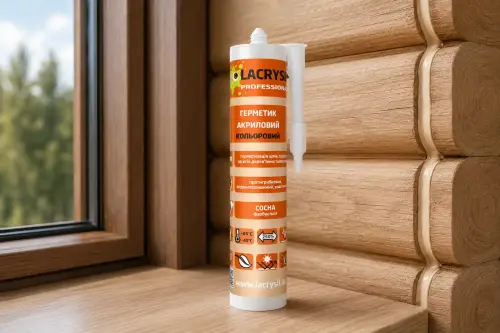
Acrylic sealant for installation seams “A”, White, 3 kg

The outer layer of a window installation joint. Vapour-permeable It lets moisture out of the foam Gunned from -25 °C A 20-year life

Specifications

Color:
White
Maximum joint depth:
5 mm
Consumption:
0.013–0.025 kg/linear m (3–5 × 3–3.5 mm seam)
Storage term:
18 months
Drying time:
24 - 48 hours
Operating temperature:
-40°C ... +100°C
Packaging:
3 kg
Base:
copolymer-acrylate
Application temperature:
-25°C ... +35°C

Choose a variant

4 available

Consumption calculator

Maximum joint depth: 5 mm

Selected variant White · 3 kg

441.15 ₴

Description

Joint sealant "A" is a one-component vapour-permeable acrylic sealant for the outside of an installation joint.

"A" means the outer layer

A window joint has three layers: an outer one shielding the foam from weather and UV, the foam itself, and an inner one keeping room vapour out. This is the outer layer; "B" is its inner counterpart. Swapping them traps moisture in the foam.

Why the outside must breathe

Foam absorbs moisture. In winter it freezes, expands and destroys the foam from within, and the joint starts to leak air within two or three seasons. A permeable outer seal lets the vapour escape instead.

Gunned in frost

-25 to +35 °C, the widest range in the sealant line. Windows are fitted in winter too, and most acrylic sealants will not cure below +5 °C.

20 years, paintable

A 20-year joint life, resistant to weather and movement, with strong adhesion to concrete, PVC, aluminium, timber, render, brick and natural stone, and painted along with the facade.

One firm prohibition

It must not be thinned with water: the maker is explicit: thinning cuts adhesion, destroys thixotropy and changes the joint.

Specs

Acrylic, white, service -40 to +100 °C, about 0.13 kg per running metre. 600 ml, 1.2, 3 and 7 kg, 18-month shelf life, water clean-up.


How much you need

About 0.13 kg per running metre: count the window perimeter, not its area.

  • a 1.4×1.4 m window: 5.6 m, about 0.75 kg;
  • 600 ml: one or two windows;
  • 1.2 kg covers about 9 m;
  • 3 kg covers about 23 m: a flat;
  • 7 kg covers about 54 m.

The same run also needs sealant "B" on the inside. Buy both together.

Application

Preparation

  • trim surplus foam flush with the reveal;
  • clean the joint of dust, ice and oil;
  • degrease PVC and aluminium;
  • mask the edges.

Application

  • spread or gun a continuous layer over all the foam;
  • it must cover the foam completely: exposed foam fails in one season of UV;
  • tool it flat;
  • pull the masking before it skins.

Do not

  • thin with water: expressly forbidden;
  • apply to a wet or frozen surface;
  • leave foam bare over winter.

Afterwards

  • paint once fully dry;
  • wash tools with water;
  • do not freeze the tub; 18 months.

Compatibility table

Material / Base Concrete, brick, gypsum, plasterboard Stone, granite, marble Mirror, glass Wood, chipboard, fiberboard, MDF, plywood Tile, ceramic, porcelain Primed metal Plastic, PVC Polystyrene
Concrete, brick, gypsum, plasterboard
Stone, granite, marble
Mirror, glass -
Wood, chipboard, MDF, fiberboard, plywood
Tile, ceramic, porcelain -
Primed metal
Plastic, PVC - - -
Polystyrene

FAQ: A or B, frost and the no-water rule

  • How does "A" differ from "B"?
    Direction of vapour. "A" is permeable and faces out; "B" is a vapour barrier and faces in. Reversing them traps water in the foam.

  • Can one sealant do both sides?
    No. The joint works only as a pair.

  • Really down to -25 °C?
    Yes, on a dry, ice-free surface.

  • Why no water?
    Thinning cuts adhesion and destroys thixotropy; the maker forbids it.

  • How much for a flat?
    Six windows is about 35 m: roughly 4.5 kg.

Video
Reviews (0)

Similar products

5 similar products