Save to favorites

Add to compare

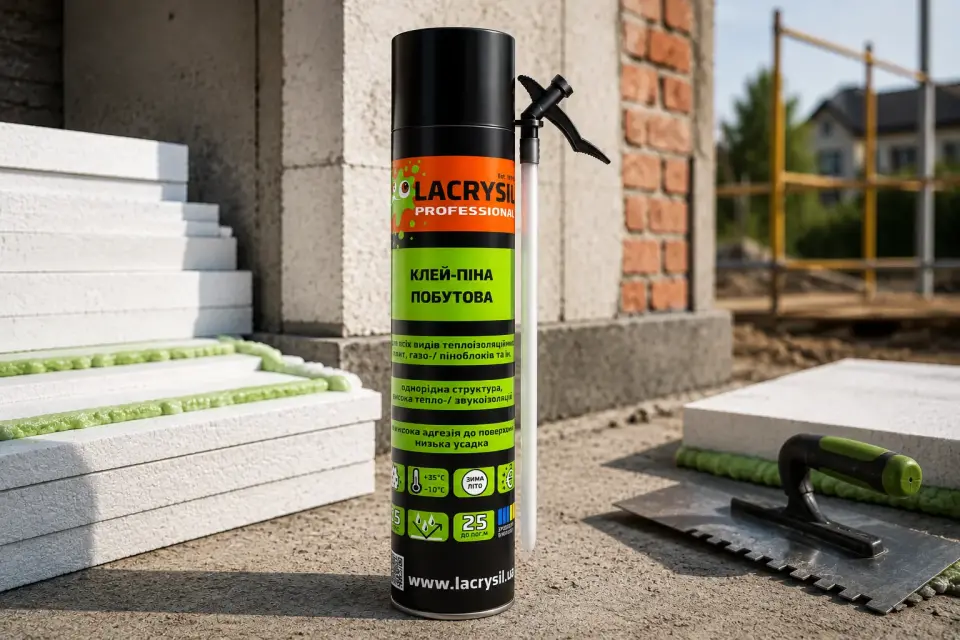
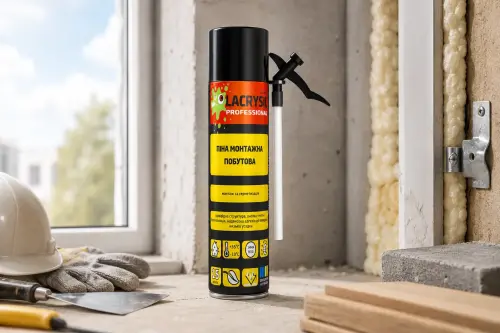
Household polyurethane adhesive foam, Orange, 800 ml

Household adhesive foam for EPS. No gun required Applied from -10 °C For insulating a single wall, plinth or loggia

Specifications

Color:
Orange
Curing time:
0.5 - 6 hours
Full polymerization time:
12 - 48 hours*
Maximum joint depth:
30 mm
Storage term:
18 months
Tack-free time:
5 - 30 minutes**
Cylinder temperature:
+15°C ... +30°C
Secondary expansion:
150 - 250%*
Packaging:
800 ml
Base:
foamed polyurethane composition
Application temperature:
-10°C ... +35°C

Choose a variant

1 available

Packaging: 800 ml

Consumption calculator

Maximum joint depth: 30 mm

Selected variant Orange · 800 ml

285.00 ₴

Description

Household adhesive foam is a one-component polyurethane adhesive in a straw can for fixing EPS and polyurethane boards.

When to choose it

The difference from the professional adhesive foam is delivery and scale, not chemistry. This can comes with a straw and needs no gun, which suits a single plinth, loggia or garage wall. For a whole facade, the gun version places a more accurate bead and works out cheaper.

The price of simplicity

Secondary expansion here is 150–250 % against 15–30 %. The foam rises far more after application, so lay a thinner bead than feels right, and check each board with a straightedge: uneven lift cannot be corrected later.

Frost is no obstacle

Applied from -10 to +35 °C, with the can itself at +15 to +30 °C. A cold can halves the yield and gives coarse foam.

Timings

Tack-free in 5–30 minutes depending on conditions, set in 0.5–6 hours, fully cured in 12–48 hours. Do not anchor or load before full cure.

What it bonds

EPS and XPS boards onto concrete, brick, render, timber and other conventional substrates: dry, sound and dust-free.

Limits

UV destroys exposed foam within a season, so joints must be covered by the reinforced coat and finish. An opened straw can cannot realistically be kept. 18-month shelf life.


How much you need

An 800 ml can covers about 8–10 m²: less than the professional version, since some foam is lost to expansion and trimming.

  • a plinth around a 10×8 m house, 0.5 m high: 18 m², two cans;
  • a 3×1.5 m loggia: about 12 m²;
  • a 6×2.5 m garage wall: 15 m², two cans;
  • a 20 m² cellar ceiling: two or three cans.

On a 1000×1000 mm board: a Ø30 mm perimeter bead 2–3 cm in, plus one central bead, laid thinner than with the gun version.

Application

Preparation

  • clean and dry the substrate; prime friable areas;
  • bring the can to +15–30 °C;
  • shake 20–30 times and fit the straw.

Application

  • hold the can inverted;
  • a Ø30 mm perimeter bead 2–3 cm in, plus one down the centre;
  • lay it thinner than feels right: it will rise 1.5–2.5 times;
  • wait 1–2 minutes and place the board.

Checking the plane

  • press the board and check with a straightedge at once;
  • adjust before the foam grabs;
  • check whole rows, not single boards.

Then

  • anchor after full cure;
  • trim surplus with a knife;
  • fill board joints with the same foam;
  • always cover with the reinforced coat.

FAQ: household or professional, coverage, frost

  • Versus the professional adhesive foam?
    Straw instead of gun, and 150–250 % expansion against 15–30 %. Fine for one wall, not for a whole facade.

  • Coverage per can?
    About 8–10 m².

  • Why did a board go out of plane?
    The bead was too thick and lifted it unevenly: irreversible once cured.

  • Autumn work below zero?
    Yes, from -10 °C, with the can kept warm.

  • Are anchors still needed?
    Yes. This replaces the adhesive mortar, not the fixings.

Video
Reviews (0)

Similar products

4 similar products