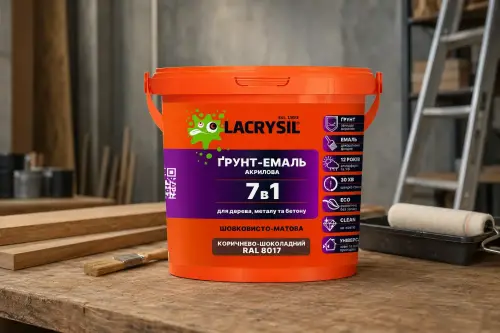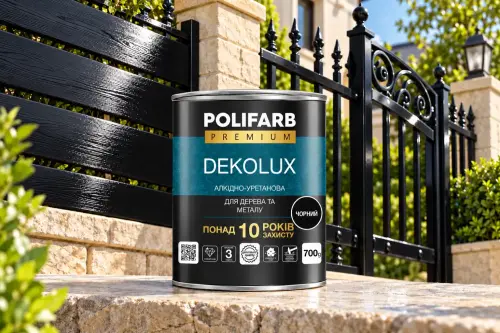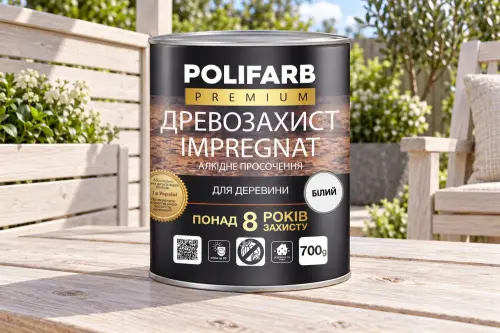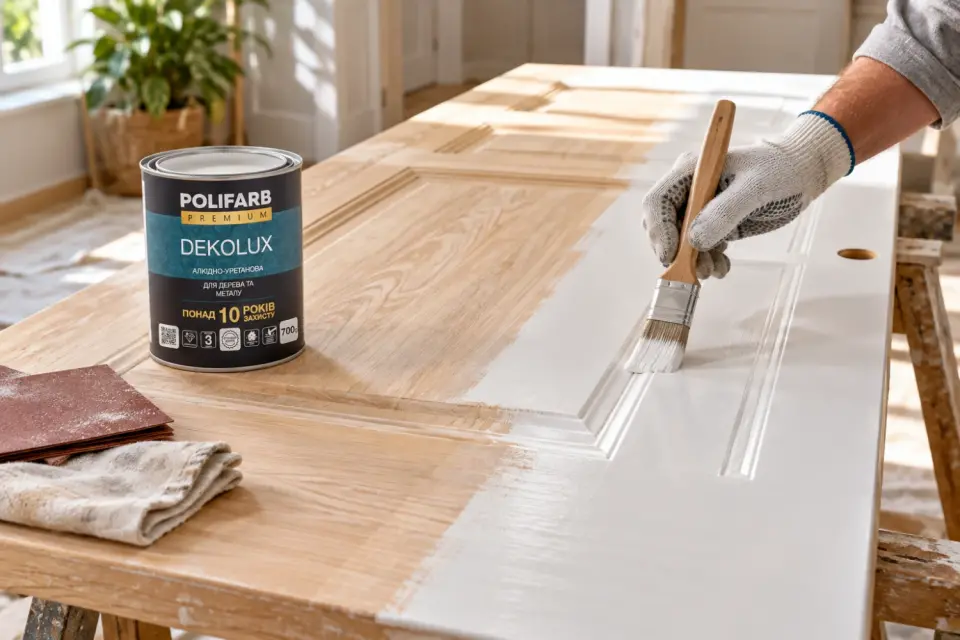
What to paint wooden interior doors with depends on the look you want. An opaque silky matt finish without a strong smell comes from the water-borne 7-in-1 primer-enamel, a hard high gloss from DEKOLUX alkyd-urethane enamel, and the wood grain stays visible under tinted DREVOZAHIST IMPREGNAT impregnation topped with lacquer. The manufacturer does not state any of these for MDF, veneered or laminate doors.
First, find out what the door is made of
- Solid wood, unpainted or already painted with enamel. All three options below apply.
- Doors faced with PVC film or laminate. This substrate is not named in the data sheets or product descriptions of these materials.
- Veneer under a factory lacquer. Lacquer is not named as a substrate either, so there is no proven system.
- MDF. It is not stated for the 7-in-1 primer-enamel or DEKOLUX. The IMPREGNAT data sheet does list MDF, but an impregnation has to soak in, and it will not soak into film or lacquer.
If the old paint on the door is sound enamel and you want to cover it with water-borne paint, see can you paint acrylic over enamel.
Three options compared
Parameter | 7-in-1 primer-enamel | DEKOLUX | IMPREGNAT + lacquer |
|---|---|---|---|
Base | water-borne acrylic | alkyd-urethane, thinned with white spirit | alkyd impregnation in white spirit |
Look | opaque silky matt | opaque high gloss | grain visible, precious-wood colour |
Primer | not needed | bare wood: 1 coat of clear Drevozahist impregnation or drying oil, 24 h to dry | not needed |
Between coats | 30 minutes | at least 5 hours | 8 hours, then 1–2 coats of lacquer |
Smell | no strong smell | solvent, ventilation needed | solvent, ventilation needed |
Consumption per coat | — | 30–60 g/m² | 80–100 g/m² |
The product description of the 7-in-1 primer-enamel gives no consumption figure, so the table leaves it blank.
Preparing the door
- Take the door off its hinges and lay it flat so the paint does not run. Remove the handles and locks or mask them.
- Remove flaking paint. Wash sound old coatings with detergent before enamelling.
- Fill gaps and dents, then sand once dry.
- Dust off the surface and degrease if needed.
- For IMPREGNAT, sand the wood back to clean fibres: old paint and lacquer will stop the impregnation soaking in.
Option 1. 7-in-1 primer-enamel: no strong smell
The 7-in-1 acrylic primer-enamel for wood, metal and concrete works as primer and topcoat at once. It is water-borne with no strong smell, so doors can be painted in an occupied flat. The product description mentions doors, door frames and window sills directly.
- Stir the enamel.
- Apply the first coat by brush or roller, about 0.25 mm thick. A thinner coat does not give the stated protection; a thicker one takes longer to harden.
- Apply the second coat after 30 minutes.
- Wash the tools with water straight away.
Clear Color technology keeps white white, so a white door frame does not yellow over time. Both versions of the primer-enamel are compared in 7-in-1 acrylic primer-enamel.
Option 2. DEKOLUX: hard gloss
DEKOLUX alkyd-urethane enamel forms an extra-hard high-gloss film on primed wood and wood-based surfaces. Gloss shows every flaw, so sanding matters here.
- Prime bare wood with one coat of clear Drevozahist impregnation or drying oil and let it dry for at least 24 hours. Doors already painted with enamel need no primer when renewed.
- Stir the enamel. If needed, thin with white spirit, solvent naphtha or a 1:1 mix, by no more than 10%.
- Apply 1–2 coats by roller, brush or spray. The second coat goes on once the first is fully dry, no sooner than 5 hours.
- Work at +5…+30 °C and humidity up to 60%.
The film reaches full hardness after 7 days, so protect the door from knocks until then. The enamel is flammable: ventilate and keep away from flame. There are 14 colours, including white, cream, light grey and dark brown. More about the enamel is in DEKOLUX enamel for wood and metal.
Option 3. IMPREGNAT under lacquer: the grain stays visible
The data sheet of DREVOZAHIST IMPREGNAT alkyd impregnation recommends it directly for doors, furniture, windows and solid-wood panels. It soaks deep into the wood, tints it to precious-wood shades and protects against fungus, mould and wood-boring insects.
- Stir the impregnation and keep stirring during work.
- Apply with a soft brush, pad or sponge along the grain. Do not spray.
- For a richer colour apply 2–3 coats, each 8 hours after the previous one.
- Indoors, the dried surface must be protected with 1–2 coats of pentaphthalic lacquer.
Colours: clear, pine, teak, oak, mahogany, walnut, wenge and rosewood classic. Consumption is 80–100 g/m² per coat.
How much paint a door needs
Count both faces of the leaf and its edges, and the frame and architraves separately. A 0.8 × 2.0 m leaf is about 3.2 m² counting both faces. At 30–60 g/m² per coat, two coats of DEKOLUX take roughly 0.2–0.4 kg. Work out the exact quantity in the paint consumption calculator.
Common mistakes
- Painting foil-faced, laminate or lacquered doors with products not stated for those substrates.
- Putting DEKOLUX on bare wood without primer.
- Applying the second coat of DEKOLUX sooner than 5 hours.
- Leaving IMPREGNAT without a lacquer topcoat.
- Painting the door upright on its hinges: the edges get runs.
What to buy
For wooden doors in an occupied flat, take the 7-in-1 primer-enamel for wood, metal and concrete. For a hard gloss finish, DEKOLUX over primer. To keep the solid-wood grain, IMPREGNAT plus pentaphthalic lacquer. Other wood enamels are on the wood paints page, and choosing low-odour paints for a flat is covered in low-odour paint.
FAQ
What can I paint doors with without a smell?
No paint is completely odourless. The weakest smell comes from the water-borne 7-in-1 primer-enamel for wood: it has no strong smell and dries in 30 minutes.
Can MDF doors be painted?
MDF is not stated for the 7-in-1 primer-enamel or DEKOLUX, and the manufacturer does not cover foil, laminate or lacquered veneer doors. There is no proven system for them.
How long does paint on a door take to dry?
7-in-1 primer-enamel: 30 minutes between coats. DEKOLUX: at least 5 hours between coats and 7 days to full hardness. IMPREGNAT: 8 hours between coats.
Do I need to strip old paint from a door?
Under enamel, only flaking paint is removed and sound paint is washed. Under IMPREGNAT, the wood is sanded back to clean fibres.