Repairing windows after a blast and restoring a roof and facade starts with whatever lets water and cold into the house: windows and roofing first, then the facade, balconies and interior walls. This guide sets out the order of work and the POLIFARB products for each stage: mounting foam and sealants for window joints, rubber paint and waterproofing for the roof, sealant and paints for the facade.
Order of work
- Inspect the structure. Cracks in load-bearing walls and floors, or sagging beams and slabs, mean calling in a specialist before any repairs.
- Close openings temporarily with sheeting or boards. POLIFARB does not make these materials, so they are not covered here.
- Fit windows and doors and seal the installation joints.
- Repair the roof.
- Fill facade cracks and paint the facade.
- Waterproof balconies and terraces.
- Seal leak and soot stains indoors and paint the walls.
Windows: foam and the installation joint
Which foam to use
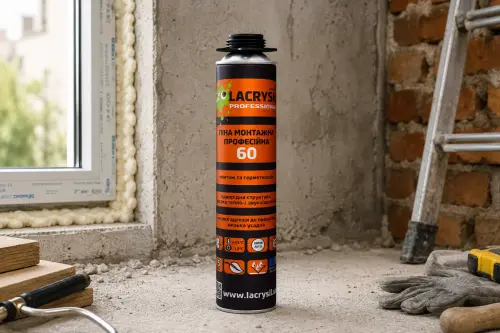
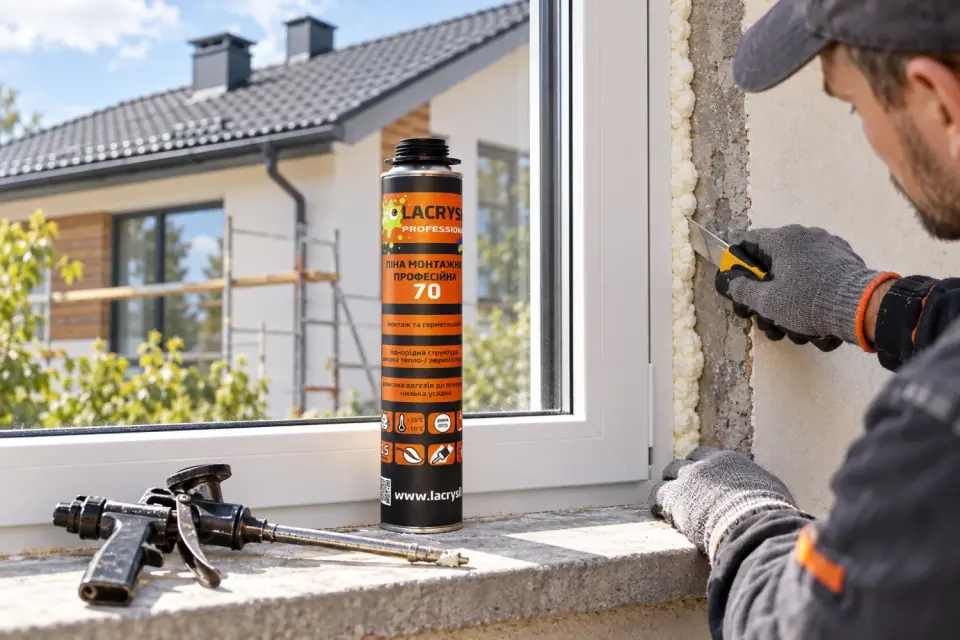
- Professional mounting foam for a gun has 15–30% post-expansion, so it does not push the frame out. It can be applied from −10 °C; a 750 ml can yields up to 60 L of foam and an 850 ml can up to 70 L.
- Household mounting foam with a straw needs no gun but expands by 200–300%. Fill the joint to a third of its depth.
- Fire-rated B1 foam is for joints where the design requires a fire-stopping detail. Expansion is 150–250%, so fill about half the joint, and apply at +10 to +35 °C.
The mounting foam calculator shows how many cans one window takes, and there is a step-by-step guide in how much mounting foam a window needs. Why joints crumble or bow frames is covered in why mounting foam crumbles or deforms a window. Fresh drips are removed with mounting foam cleaner; cured foam can only be cut away.
How to seal the joint
Exposed foam breaks down under UV and moisture, so the joint is sealed on both sides:
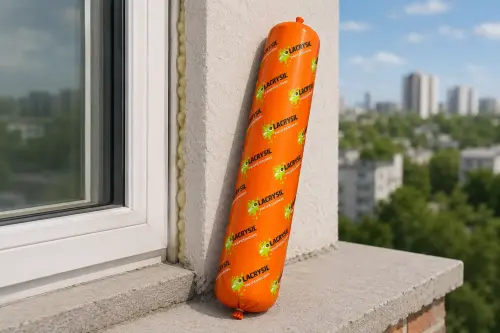
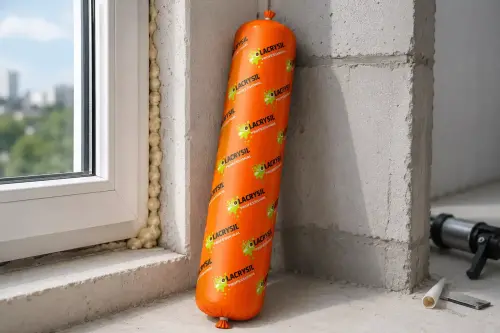
- outside with vapour-permeable sealant for installation joints “A”, which lets moisture out of the foam, can be applied from −25 to +35 °C and is painted along with the facade;
- inside with vapour-barrier sealant “B”, which keeps room moisture out of the foam and is painted along with the reveal;
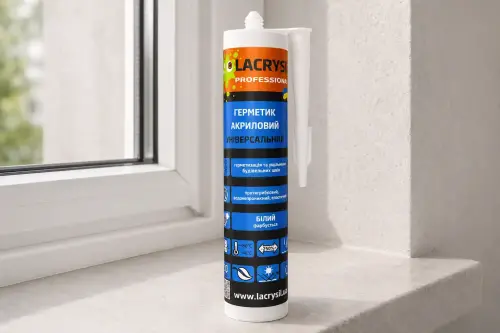
- on glass, glazing units and frames with silicone sealant “Universal”, which bonds to glass and protects the foam around frames from UV.
Sealants “A” and “B” must not be swapped or thinned with water. Work out the number of tubes in the sealant consumption calculator. More window products are on the mounting foam for windows and window sealant pages.
Roof: slate, metal and flat roofs
Slate, tiles, profiled sheet, galvanised steel
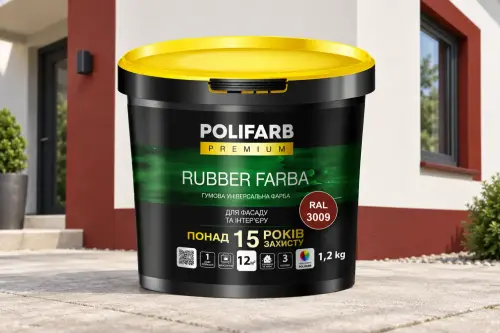
Replace punctured and cracked sheets first, because paint does not close a hole. Intact roofing can be painted with RUBBER FARBA rubber paint. Its data sheet lists slate, tiles, ondulin, galvanised steel, profiled sheet and asbestos cement among its substrates; galvanised steel is painted only over GF-021 primer. Apply 2–3 coats at air temperatures of +10 to +30 °C on a dry, clean surface. Mineral surfaces are first primed with PROFI GRUNT, GRUNT EKO or GRUNT CONCENTRATE 1:4. For new areas of ferrous metal prone to corrosion, the primer is DEKOMAL GF-021 or EXTRAMAL GF-021. Galvanised steel is degreased and given 1 coat of GF-021 only, then, once the primer is dry, painted with RUBBER FARBA, PF-115 enamel or DEKOLUX; ZAHYST 3 in 1 and paint applied directly to zinc are not suitable; see how to paint galvanised steel and profiled sheet. Details in how to paint slate and roof painting.
Flat roofs and roll roofing
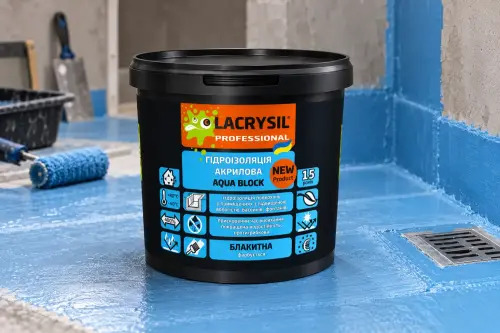
POLIFARB has no paint for bitumen roll roofing, and RUBBER FARBA is not meant for it. Aqua Block acrylic waterproofing is stated for roll, sand-cement and reinforced concrete roofs. Its super-elastic film bridges substrate cracks, resists UV and can stay exposed on a roof. Apply at +5 to +35 °C; full cure takes 24–72 hours depending on thickness. Water Block waterproofing, with 400% elasticity, is stated for the same roof types and is applied at +10 to +35 °C. The waterproofing consumption calculator covers both.
Facade: cracks and painting
Cracks and gaps in render, brick and concrete are filled with acrylic sealant “Universal”. The joint stays elastic and can be painted with the wall; apply it at +10 to +35 °C. Dried soot and smoke stains on brick, concrete and render are sealed with IZOMAL stain-blocking paint: its data sheet allows exterior use, and one coat is enough under a finish paint.
Then prime the facade with PROFI GRUNT deep-penetrating primer and paint two coats of SILIKON FASAD silicone paint or UNIVERSAL FASAD facade paint. Both are applied at +5 to +30 °C, and fresh render is painted no sooner than 3–4 weeks. Temperature and humidity limits for each product, and whether you can work in rain, are collected in what temperature you can paint outdoors. Work out paint quantities in the paint consumption calculator.
Balconies and terraces
Aqua Block is stated for balconies and terraces. Its blue colour shows any gaps, so you can check the layer is continuous before tiling. How much waterproofing two coats take is covered in waterproofing consumption per m².
Indoors: leak and soot stains
Dried water, soot and smoke stains bleed through ordinary water-based paint. Seal them first with one coat of IZOMAL; the finish paint can follow after 2 hours, for example DIAMOND 2 washable paint with wet-scrub class 1. If there is mould on the walls, treat it first with a dedicated product. More on IZOMAL in how to block soot, smoke and leak stains.
Compensation under eVidnovlennia
Ukraine’s eVidnovlennia programme compensates repairs to damaged homes, and the funds can be spent on building materials at participating shops. Terms, the list of participants and how to apply are published on the Diia portal (diia.gov.ua) and the Ministry for Development website (mindev.gov.ua). Check that list to see whether a particular shop takes part.
What to use: short list
- Windows: professional mounting foam, sealants “A” and “B”, silicone “Universal”.
- Slate or metal roof: RUBBER FARBA in 2–3 coats.
- Flat and roll roofs: Aqua Block or Water Block.
- Facade: acrylic sealant “Universal”, IZOMAL on stains, PROFI GRUNT and SILIKON FASAD or UNIVERSAL FASAD.
- Indoors: IZOMAL and DIAMOND 2.
FAQ
Where do I start repairing windows after a blast?
Inspect the opening and close it temporarily, then fit the window on professional foam and seal the joint with sealant “A” outside and “B” inside.
Which mounting foam should I use for windows?
Professional gun foam: its post-expansion is 15–30%, so it does not push the frame. For fire-stopping details use fire-rated B1 foam.
How do I repair a flat roof with roll roofing?
There is no paint for roll roofing in the range. Aqua Block and Water Block waterproofing are stated for roll roofs.
What do I fill facade cracks with before painting?
Acrylic sealant “Universal”: it is stated for cracks in mineral substrates and can be painted over.